Us vs Them Ads: How to Make a Comparison Video Ad That Holds Up
An us vs them ad puts your product next to the alternative and lets the viewer see the difference in one look. As a video, it gets stronger, because you can run the test on camera instead of claiming it in a checklist: same mess, same timer, two halves of the screen. The safe default is to compare against the buyer's old habit, a whole category or a price per use, and to name a rival only when you can prove every word of the claim.
Most of what ranks for this phrase is galleries of static image ads: two columns, ticks on one side, crosses on the other. This post covers the video version, two scripts you can shoot this week, and what the FTC and the platforms say about comparing yourself to someone else.
Why the video version beats the checklist
A static us vs them ad asks the viewer to trust your ticks. Anyone can draw a cross next to "lasts all day." A video of two halves of a stained counter, wiped once each in one take, asks for much less trust. It also gives you a hook the static can't: motion on both halves of the screen in the first second, and a reason to wait and see which side wins.
Want the static too? The product image ad maker guide has the two-column layout. Make both from the same shoot.
Pick the "them": a decision table
Who sits on the losing side decides how much proof you need and how likely the ad is to be rejected or draw a complaint.
| Compare against | Example "them" | When it works | Risk |
|---|---|---|---|
| The buyer's old habit | Buying a new plastic spray bottle every few weeks; waiting in for a plumber who "can't say until he sees it" | Almost always. The viewer recognizes themselves, and nobody owns a habit | Low. You still need to show the habit honestly, not as a cartoon |
| The category | "Ready-to-use sprays," "hourly call-outs," "fast fashion" | When your product works differently from everything else on the shelf | Low to medium. A generic stand-in that looks like one famous product can still point at that brand |
| Price per use | Cost per refill vs cost per new bottle; flat fee vs a typical hourly bill | When you cost more up front but less over time | Medium. The math has to be real, current and easy to check |
| A named rival | Brand X by name, logo or packaging | When you have a measurable edge and test results you'd be happy to show a regulator | High. Every number needs evidence, the basis must be clear, and some platforms limit negative comparisons. Talk to a lawyer first |
Start at the top. The habit comparison is usually the most relatable, because the buyer has lived it. A named rival only wins when the audience is already choosing between the two of you.
A 5-shot structure for a 15 to 20 second side-by-side
Vertical 9:16, split left and right (or top and bottom if both actions are wide), both halves the same size, light and framing.
| Shot | Time | What's on screen | Job |
|---|---|---|---|
| 1. The setup | 0 to 3 s | Both sides at the start line, a title naming the comparison | Hook. The viewer sees there's a contest |
| 2. The action | 3 to 8 s | Both sides do the task at the same time, one continuous take each | Proof. No cuts inside the test |
| 3. The result | 8 to 12 s | Hold on both end states, a short caption with the difference | The verdict, shown before it's said |
| 4. The reason | 12 to 16 s | Close-up on your product or the thing that makes the difference | Why it won, in one line |
| 5. The ask | 16 to 20 s | Product, offer, where to buy or book | CTA |
A few rules make the difference between a test that convinces and one that looks rigged:
- Shoot both sides in one take if you can. If you film them separately, match the light, the amount of mess and the clock.
- Don't speed up one side. If you trim the action, trim both halves equally and don't hide the moment the "them" side would have caught up.
- Put the basis on screen: "Same counter, one wipe each" or "Price per 500 ml, [month year]."
- Claim only what the footage proves. If the tablet cleans about as well as the spray, say "same clean, no new bottle," not "cleans better."
Label each half in big type for the whole test, since plenty of people watch muted, and check the video ad size and safe-zone checker so labels aren't buried under the app's buttons.
Script 1: ecommerce, cleaning tablet vs bottled spray
The "them" is the habit of buying spray in a new plastic bottle, not a brand. Hide any label and avoid a bottle shape everyone recognizes. Fill the brackets with real, current prices, or cut that line.
Shot 1 (0 to 3 s). Split screen. Left: a hand puts an empty spray bottle in a recycling bin, which already has two in it. Right: a hand drops a tablet into the same refill bottle, filled with tap water. Labels: "NEW BOTTLE" left, "SAME BOTTLE" right. Voiceover: "Two ways to get a full bottle of kitchen spray."
Shot 2 (3 to 8 s). Left: the hand takes a new spray bottle off a shelf, still in its packaging. Right: the tablet fizzes and dissolves, in real time, with a small on-screen timer. Voiceover: "One means another plastic bottle. The other is a tablet and the tap."
Shot 3 (8 to 12 s). One continuous overhead shot of a counter with the same coffee ring spilled on each half. Each spray is used on its half, one wipe each. Hold on the clean counter. Caption: "Same counter. One wipe each." Voiceover: "Same clean."
Shot 4 (12 to 16 s). Close-up of the tablet pack next to the refill bottle. Caption: "[$X] per refill vs [$Y] for a new bottle ([store], [month year])" Voiceover: "And a refill costs [X] instead of [Y]."
Shot 5 (16 to 19 s). Product pack, logo, offer. Caption: "Starter kit: one bottle, [N] tablets" Voiceover: "Keep the bottle. Order the tablets."
The script never says the tablet cleans better or is "eco-friendly." Each of those needs its own evidence. It sticks to what the footage or a receipt proves. More on product footage in ecommerce product video ads.
Script 2: local service, flat-rate plumber vs the open-ended quote
The "them" is the tradesperson who can't give a price until the job is done. Only run this if flat-rate pricing is really how you work.
Shot 1 (0 to 3 s). Split screen. Left: a homeowner on the phone, frowning. Right: the same homeowner on the phone, nodding. Labels: "BY THE HOUR" left, "FLAT RATE" right. Voiceover (owner, to camera, in van): "Two phone calls about the same leaking water heater."
Shot 2 (3 to 8 s). Left: caption types out what the homeowner hears, "We'll see when we get there." Right: caption types out "[Price], before we touch it." Voiceover: "One gives you a guess. We give you the price before any work starts."
Shot 3 (8 to 12 s). Right half goes full screen: the owner hands over a quote at the door. The homeowner signs. Caption: "Price agreed at the door. That's what you pay." Voiceover: "You agree to it at the door, and that's the bill."
Shot 4 (12 to 16 s). Hands working on the water heater, close and steady, then the van with the logo. Voiceover: "Licensed, local, [town] since [year]."
Shot 5 (16 to 20 s). Owner to camera, phone number and booking link on screen. Voiceover: "Call for a flat price on your job. [Phone number]."
The losing side is a pricing model, not a named competitor or a fake angry customer. If your price can change once you open a wall, say so in the caption ("we'll quote any extra parts before using them"). For filming and budgets for trades, see the video ads for local businesses guide.
The rules, in plain words
This section reports what the official pages say. It isn't legal advice, and rules differ by country. If you plan to name, show or hint at a specific rival, have a lawyer read the script first.
The FTC allows comparison ads, with conditions
The FTC's Statement of Policy Regarding Comparative Advertising (August 13, 1979) says its policy "encourages the naming of, or reference to competitors, but requires clarity, and, if necessary, disclosure to avoid deception of the consumer." It supports brand comparisons "where the bases of comparison are clearly identified." Disparaging ads are permissible "so long as it is truthful and not deceptive," and comparisons are judged like any other ad. Note its definition: comparative advertising identifies the other brand "by name, illustration or other distinctive information." A blurred logo on a famous bottle shape may still identify the brand.
You need the proof before the ad runs
The FTC's Policy Statement Regarding Advertising Substantiation (November 23, 1984) says advertisers need "a reasonable basis for advertising claims before they are disseminated." If the ad says "tests prove," the FTC expects "at least the advertised level of substantiation."
Meta bans deceptive and exaggerated claims
Meta's Unacceptable Business Practices ad standard says ads "must not promote products, services, schemes or offers using identified deceptive or misleading practices," and its guidelines list using "deceptive or exaggerated claims about the success of a product or service."
TikTok is the most specific
TikTok's misleading and false content ad policy (updated November 2026) says "comparative claims may be allowed, subjected to the provision of evidence or clear disclaimer(s)." It does not allow before-and-after product effect comparisons "which may cause viewers to have a false or distorted impression," claims that insult or mock users of a targeted brand, or "subjective/value-based claims and comparisons that make negative judgements about a targeted brand's" core attributes, with price, features, functionality and quality given as examples.
In practice: compare on something measurable, show the basis on screen, file the evidence before you spend, and don't mock anyone's customers. A habit or category comparison avoids most brand-specific rules, though the claims still have to be true.
What to test
Keep the test footage the same and change one thing per variant: the "them" (habit, category or price per use), the first line ("Two ways to get a full bottle of kitchen spray" vs "Stop buying spray bottles"; the video ad hooks guide has more), or the length (a 12-second cut without shot 4). Three to five variants per round is plenty on a small budget. The ad creative testing guide covers how long to run them and how to read the results, and mass ad creation covers turning a winner into dozens of versions.
Making a comparison video ad with Rend
Rend is an AI video agent. Bring your test clips, your product page and your brand, and say what you want: "a 20-second side-by-side, tablet vs new bottle, labels on each half."
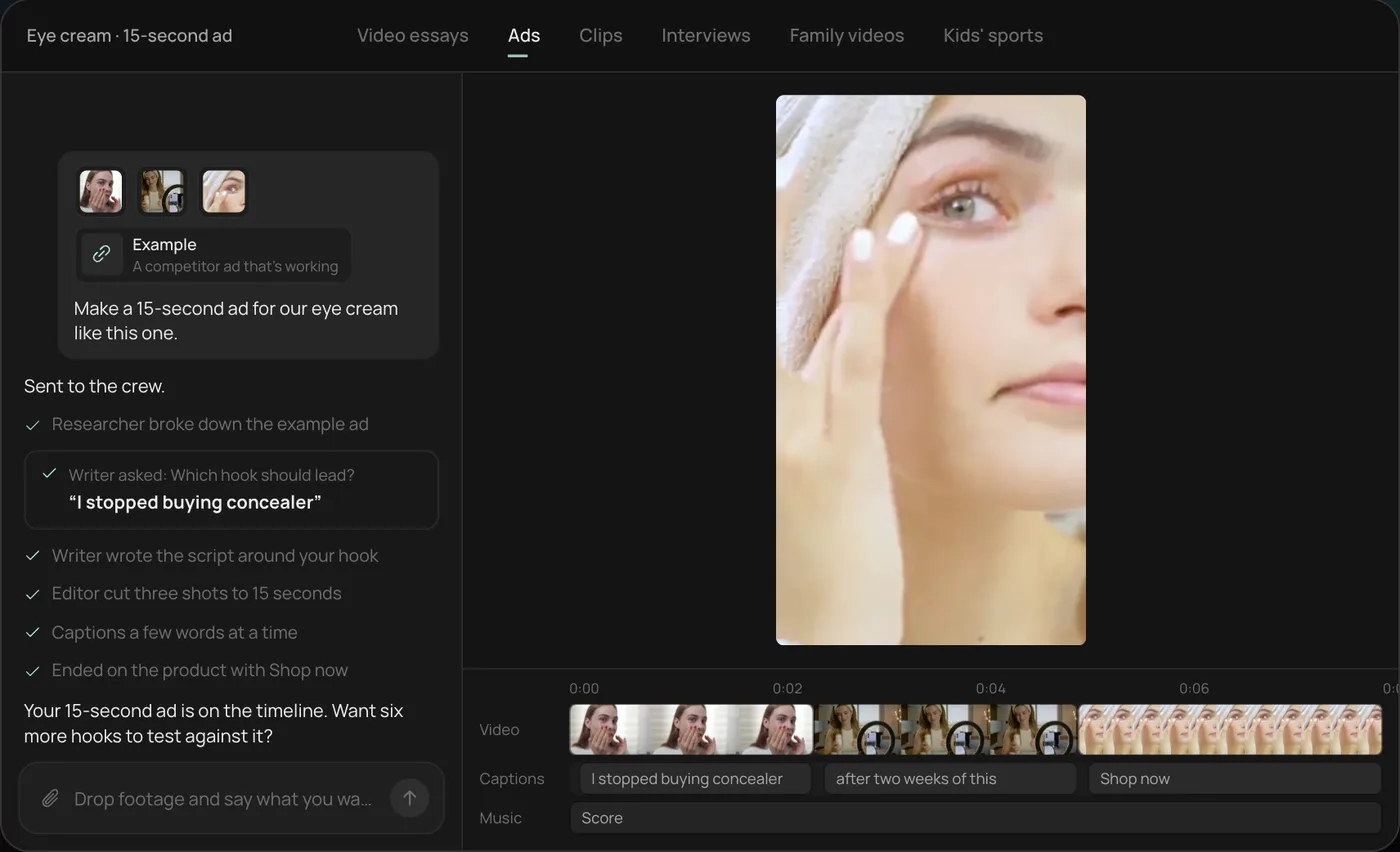
Rend's own writing model, rend-1, writes the hook options and the voiceover. Rend puts your two takes in a split screen with labels, titles and word-timed captions on a real, editable timeline you can open and change, then makes the sizes and hook variants, plus image ads from the same footage. Before you spend, share a review link so your team can mark up the frame and Rend makes the fixes (see the ad video review guide).
Download the set for your own Meta and TikTok accounts. Editing is free; you pay only when Rend renders or generates something. See pricing and the free tools.
FAQ
What is an us vs them ad?
An ad that shows your product next to an alternative, in a split screen or two columns. The alternative can be a habit, a category, a price or a named competitor.
Is it legal to name a competitor in an ad?
In the US, the FTC's policy encourages it if the comparison is clear, truthful and not deceptive, with the basis identified, and you need evidence before the ad runs. Other countries and platforms have their own rules. Check with a lawyer first.
Are comparison ads allowed on TikTok?
They may be allowed with evidence or a clear disclaimer, but not negative value judgements about a targeted brand, mocking its users, or misleading before-and-afters.
How long should a comparison video ad be?
Fifteen to twenty seconds fits the five shots above. Test a shorter cut too.
What should I compare my product against?
Start with the buyer's old habit or the category. Both are relatable and need less proof than a named rival.
If you've filmed a side-by-side test, or can this afternoon, start a free Rend project and ask for a first cut with a few hook variants.