Ad Creative Testing: How to Structure Tests on Meta and TikTok
Ad creative testing means running two or more versions of an ad that differ in one thing (usually the hook, the body or the call to action) with enough spend on each to tell which one actually performs better. Test hooks first, because the first three seconds decide most of an ad's results. Judge the hook on cheap early metrics like hook rate and click-through, which need a few thousand impressions per variant, then confirm the winner on cost per purchase, which needs far more spend. Run each round for about seven days, which is what both Meta and TikTok recommend.
Below is the structure we use, with the sample-size math, the tools Meta and TikTok give you (checked on their help centers on November 19, 2026), and how to spot fatigue before it costs you.
How to make ad variations to test in Rend, step by step
These screenshots come from Rend's demo of a 15-second eye cream ad; making test variations of your own ad works the same way.
1. Drop your clips and an example. Add your phone clips (here a creator take, a product close-up and a morning routine) plus a competitor ad you like, then type what you want: "Make a 15-second ad for our eye cream like this one."
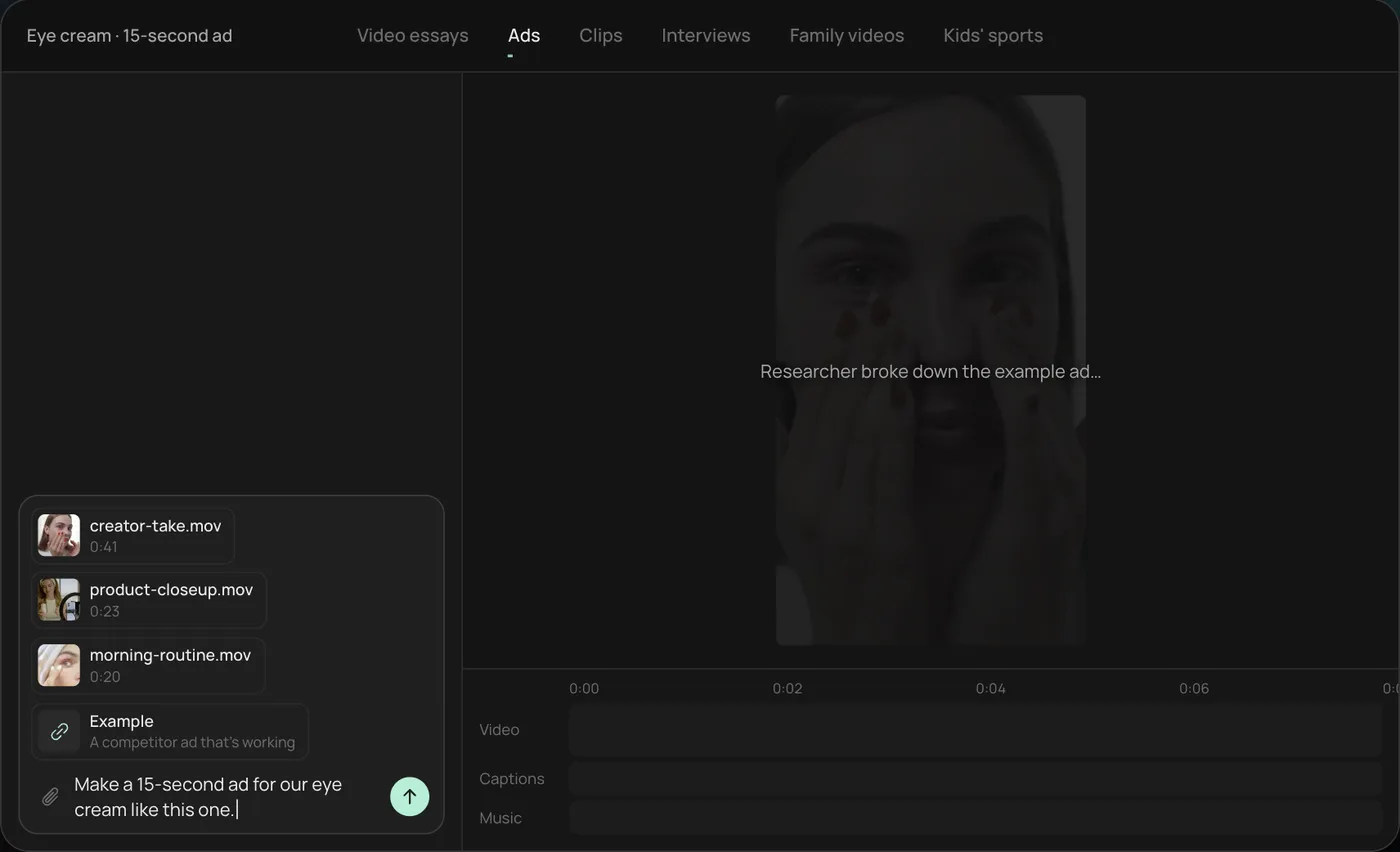
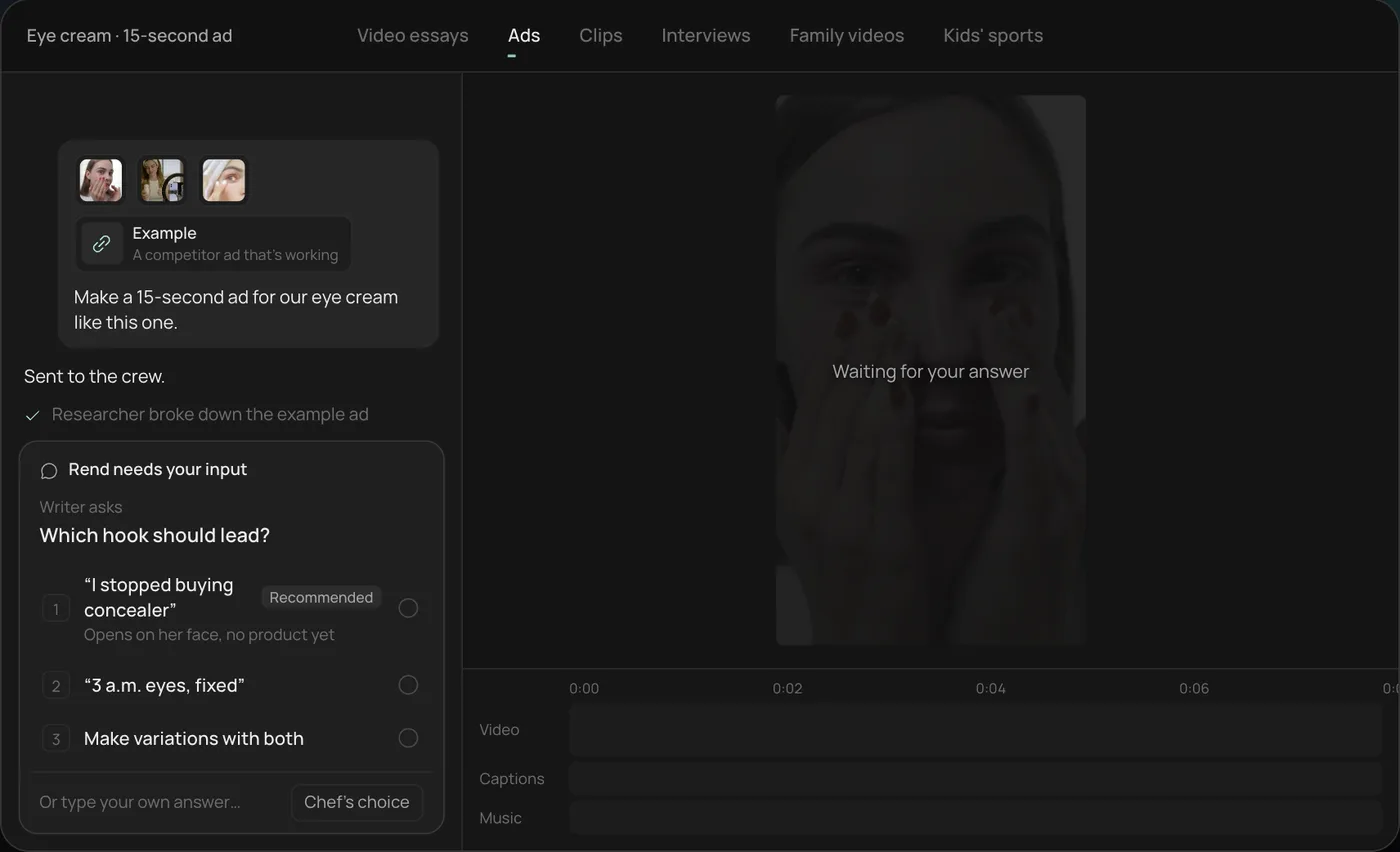
2. Answer the one question. Rend asks which hook should lead and marks a recommended answer. For a test, pick the option to make variations with both.
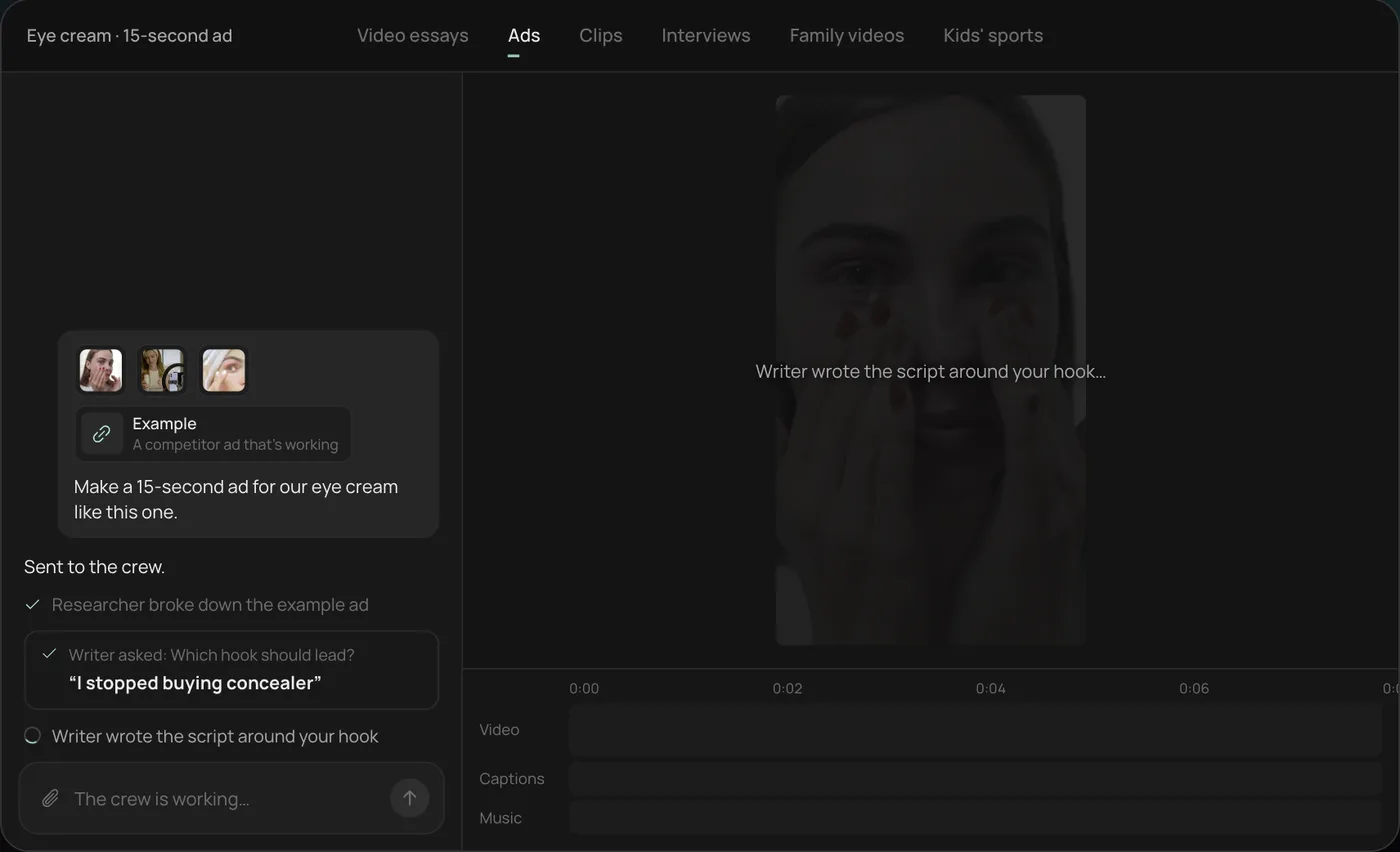
3. Let the crew work. The researcher breaks down the example ad and the writer builds the script around your hook, checking off each step in chat.
4. Open the finished ad. A 15-second vertical ad lands on a real timeline with captions and music on their own tracks, and Rend offers six more hooks to test.
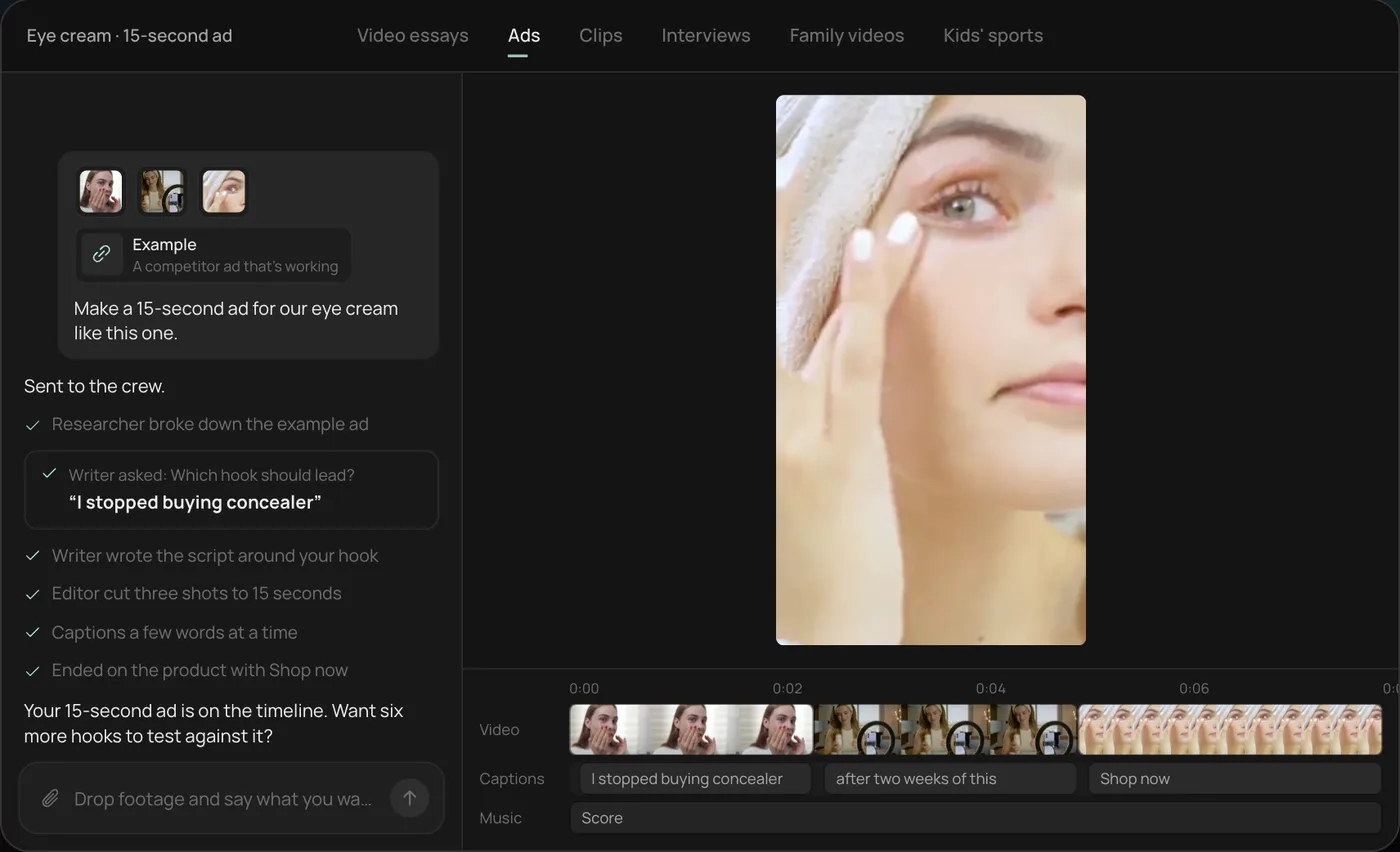
From there you can open the timeline and change anything by hand, share a review link, or export the set for your ad accounts. Start a free Rend project to try it on your own footage.
The three variables, in order
Every video ad has three parts you can test. Test them in this order, one at a time.
| Variable | What changes | Seconds of the ad | Why this order |
|---|---|---|---|
| Hook | First line, first shot, on-screen text | 0 to 3 | Decides who watches at all; biggest swings |
| Body | The proof: demo, testimonial, problem and fix, comparison | 3 to 12 | Decides who believes it |
| CTA | Offer, last line, end card | Last 2 to 3 | Smallest effect unless the offer changes |
The reason to hold everything else constant is simple: if you change the hook and the body at once and variant B wins, you don't know why, and you can't reuse what you learned. Meta's own best practices say the same thing: ad sets should be identical except for the variable you're testing.
The order matters because a great body behind a weak hook never gets seen. A typical first test: the same 12-second demo for eye drops, once opening on the product name and once on a problem ("My contacts dry out by 3 p.m."). Nothing else changes, so whatever moves is down to the first line.
What "enough data" means
This is where most creative tests go wrong. Four variants at $20 a day for three days is not a test; it's noise with a dashboard.
Here's the rough math, at the usual 95% confidence and 80% power (the same power level TikTok's split test page recommends). Assume a $10 CPM, which varies a lot by audience and season, so replace it with yours.
| Metric you judge on | Example difference | Needed per variant | Rough spend per variant at $10 CPM |
|---|---|---|---|
| Hook rate (3-second views / impressions) | 25% vs 30% | About 1,300 impressions | About $13 |
| Click-through rate | 1.0% vs 1.3% | About 20,000 impressions | About $200 |
| Purchase rate per click | 2.0% vs 2.6% | About 9,800 clicks (about 200 purchases) | Thousands |
Read that table carefully, because it explains how good testers work. Hook rate differences show up after a few dollars. Click-through differences need a couple hundred dollars per variant. Purchase differences need hundreds of conversions, which most small accounts never get in a week.
So test in layers:
- Use hook rate and hold rate (people still watching at a set point, like 50%) to kill obvious losers early.
- Use click-through and cost per click to pick a winner among the survivors.
- Use cost per purchase or ROAS over a longer window to confirm, ideally on the winner against your current best ad.
Never declare a purchase winner on 8 versus 5 sales. That difference is luck.
How to run a test on Meta
Meta gives you three ways, each with a different job.
| Method | How it works | Best for |
|---|---|---|
| Creative test (in Ads Manager) | Copies one ad into 2 to 7 test ads inside a live campaign, on a share of budget you pick (Meta suggests no more than 20%); ranks the top performers on a metric you choose | Fast reads on new hooks without building a new campaign |
| A/B test (Experiments) | Splits the audience so nobody sees both versions; runs 1 to 30 days, Meta recommends 7; reports a winner with a confidence figure | Clean answers on one big question |
| Several ads in one ad set | Meta's delivery picks which ad gets spend | Ongoing optimization, not testing; spend piles onto one ad early |
The creative test details come from Meta's help center as quoted by several agencies this fall; Meta changes these tools often, so check the current limits in your account. Note two limits: it runs only on the Highest volume bid strategy, and Meta gives no confidence level for its rankings, so apply the sample-size table above yourself.
The trap with option three is that it isn't a fair test. Meta's system decides early which ad to favor and starves the rest. An ad with $3 of spend didn't lose; it was never tested.
How to run a test on TikTok
TikTok Ads Manager's split test compares two versions, splits the audience into two equal groups, and can pause the losing ad group for you. TikTok's best-practice page (updated November 2026) recommends running at least 7 days (60 is the maximum), using a budget that reaches at least 80% power (it shows an estimate during setup), using a large audience, and not touching settings once it starts, since changes can send the ad group back to review.
For TikTok Shop sellers, it's different. GMV Max is now the only supported campaign type for Shop ads and it chooses creative itself, so you test by feeding it: TikTok's Video Shopping Ads guidance suggests at least three to five creatives per ad group and adding a new one about weekly. Track which videos get spend and orders and make more like the winners. Our guide to TikTok Shop videos covers that side.
A four-week testing plan for a small account
Built for $75 to $150 a day on Meta, with one product and one existing ad that works.
| Week | Test | Variants | Judge on | Keep |
|---|---|---|---|---|
| 1 | Hooks on the existing body | 4 hooks | Hook rate, then CTR | Top 1 or 2 |
| 2 | Bodies behind the winning hook | 3 bodies: demo, testimonial, problem and fix | CTR, cost per add to cart | Top 1 |
| 3 | Length and CTA | 15 s vs 30 s, two offers | Cost per purchase | Winner |
| 4 | New hooks on the new winner | 3 hooks | Hook rate, CTR | Becomes next control |
That's 14 ads in a month. Each one needs to be cut, captioned, sized for 9:16 and 4:5, and checked. If editing is your bottleneck, that's the reason to use a tool for the variations; our guide on how to make 100 ad variations from one video shows the full version, and video ad hooks has first lines to start week 1.
Reading results without fooling yourself
A few rules we hold to:
- Look at spend first. If one variant got 80% of the budget, the comparison is unfair. Use a split test or the creative test, not one ad set.
- Compare like with like. A variant that ran Friday to Sunday against one that ran Monday to Wednesday is a test of days.
- Ignore the first 48 hours for purchases. Delivery is still learning and attribution lags.
- Write down the hypothesis before launch. "The problem hook beats the product-name hook on CTR" can be wrong. "Let's see what happens" can't, so it teaches nothing.
- A tie is a result. If two hooks perform the same, the variable didn't matter. Test something bigger.
- Keep a log. A spreadsheet with the date, variable, variants, spend, metrics and winner. Six months of that log is worth more than any guide, including this one.
Creative fatigue: when to replace a winner
Every ad wears out. People see it too many times, stop reacting, and the platform charges more to show it. The signs, roughly in the order they appear:
- Frequency rising (on a prospecting audience, past about 3 in a week is where we start watching).
- Hook rate and click-through falling from their peak while the audience stays the same.
- CPM and cost per click rising.
- Cost per purchase rising last, after the damage is done.
Don't wait for step 4. When click-through is down 20 to 30% from the ad's own peak for several days, launch fresh hooks on the same body. Often that alone resets performance, because the body was never the problem. TikTok's own guidance to add a new creative about once a week, sooner when CTR drops, is a good default on that platform, where fatigue comes faster.
Where Rend fits
Rend is an AI video agent with an ad crew. Send it the ad that's working (or your clips and product page) and ask for a test set: "Four new hooks on this body, same captions, 9:16 and 4:5." It writes hooks with rend-1, Rend's own writing model for hooks and ad copy with live search, can research what competitors run in Meta ads first, cuts each version on exact transcript words and keeps the body identical so the test is clean. Every variant is an editable timeline with word-timed captions and sound on separate tracks, and a brand kit keeps them consistent.
You download the set for your own Meta or TikTok account and run the test there, or hand it to Rend Boost, where Rend runs the ads live on major networks and you pay per click (early access). Rend doesn't read your ad account's results for you; the reading in this guide is still your job. Before you spend, a review link lets your team mark up each variant (see reviewing ad creative before you spend).
Editing is free; you pay only when Rend renders or generates something. See pricing.
FAQ
How many ad creatives should I test at once?
Three to five per round on a small or mid budget. More than that splits spend so thin that no variant gets enough impressions to judge, even on hook rate.
How long should an ad creative test run?
About seven days. Meta recommends seven for A/B tests (it allows 1 to 30) and TikTok recommends a minimum of seven for split tests. A full week also evens out weekday and weekend behavior.
How much should I spend on a creative test?
Enough per variant for the metric you're judging. Hook rate needs roughly a thousand or two impressions per variant; click-through needs tens of thousands; purchases need hundreds of conversions. Work backwards from your CPM.
What should I test first in a video ad?
The hook, the first three seconds. It has the largest effect and the cheapest signal. Then the body, then the CTA.
What's the difference between Meta's creative test and an A/B test?
The creative test runs 2 to 7 copies of an ad inside a live campaign on a share of its budget and ranks them. An A/B test splits the audience so no one sees both versions and reports a winner with a confidence figure. Use the creative test for fast hook reads, the A/B test for a clean answer to one big question.
How do I know when an ad is fatigued?
Frequency climbs, then hook rate and click-through fall from their peak, then costs rise. Replace hooks when click-through is down 20 to 30% from the ad's best for several days, before cost per purchase moves.
If you have one ad that works and want a clean test set from it, make a free Rend account and ask for four hooks on the same body.