Arcads Alternatives in 2026: AI Actor Tools and Other Routes
We build Rend, so weigh our view accordingly. Competitor details were checked on November 19, 2026; prices and features change, so confirm on their sites.
The closest Arcads alternatives are MakeUGC (realistic AI actors with published prices, from $29 a month billed yearly) and Creatify (cheaper, with a free plan and product-link ads). For presenter videos and translation, HeyGen. For real creators, Billo. And if you already have UGC or founder footage that works, Rend turns it into many edited hooks, sizes and image ads on a timeline you can change, which is a different job from generating a new actor.
Arcads is very good at its core thing. You write a script, pick from what its site calls 1,000+ AI actors, and get a selfie-style video of someone saying it, in more than 30 languages. For testing 20 hooks with 20 faces in an afternoon, few tools match it. People look for alternatives because of cost, opacity and what happens after the video is made.
How Arcads pricing works
Arcads doesn't publish dollar prices on its site; its help center says they're shown on the pricing page inside the app. What it does publish, in its help center article on pricing (read November 19, 2026), is the credit system:
| Plan | Credits a month | When you run out | Unused credits |
|---|---|---|---|
| Starter | 8,000 | Generation stops | Reset each cycle |
| Creator | 16,000 | Generation stops | Reset each cycle |
| Pro | 48,000 | Extra usage billed next invoice | Roll over |
| Scale | 96,000 | Extra usage billed next invoice | Roll over |
| Business | 192,000 | Extra usage billed next invoice | Roll over |
The rates that matter: a standard talking-actor video up to 2 minutes costs 800 credits, a custom actor costs 1,600 once, and translating a video costs 240 credits per started 30 seconds per language. Trims, resizes and text overlays are free. So Starter makes about 10 actor videos a month, and a 15-second hook costs the same 800 credits as a 90-second one. Failed generations are refunded automatically, and yearly billing is 20% off.
There's a trial: 72 hours, 1,000 credits, all features, card required. If you don't cancel, it becomes a Starter subscription. Set a reminder.
Why people look for an Arcads alternative
You can't price it before you sign up. For an agency quoting a client, that's a real problem.
Short hooks cost the same as long videos. The 800-credit flat rate suits 60-second scripts. If you test 6-second hooks, you pay for 2 minutes each time. A smarter pattern is one actor video with all ten hooks in a row, then cut it apart in an editor.
Starter and Creator credits don't roll over. Miss a week of testing and those credits are gone.
The ad isn't finished when the actor stops talking. You still need product shots, captions in your brand style, an end card, and every size. Arcads lists AI editing with b-roll, music and transitions as "soon" on its site, so today most teams finish elsewhere.
Synthetic faces have a ceiling. Good hook tests, weaker on the ads you scale for months. Viewers who've seen the same face sell three products notice.
Quick comparison
| Tool | Type | Prices published | Cost per actor video (Nov 19, 2026) | Where Arcads is better |
|---|---|---|---|---|
| MakeUGC | AI actors | Yes | Starter $29/month billed yearly, 500 credits | Actor library size, languages |
| Creatify | AI avatars, URL to video | Yes | Free plan; Standard $10 yearly or $15 monthly, 55 credits | Actor realism |
| HeyGen | Presenter avatars, translation | Yes | Free plan; Creator $29/month | UGC selfie style, ad focus |
| Captions | AI creators, phone app | Yes (iOS) | Max $24.99/month, 500 credits | Ad testing at volume |
| Billo | Real creators | Yes | From $99 per 15-second video | Speed, cost per hook |
| Rend | AI video agent for your footage | Yes, at /pricing | Editing free; pay for renders and generation | A stock actor library |
1. MakeUGC: the closest like-for-like
MakeUGC does the same job (an AI actor delivers your script UGC-style) with prices you can read before signing up. Its pricing page lists Starter at $29 a month billed yearly with 500 credits and 300+ actors, Growth at $39 with 1,000 credits and 500+ actors, and Pro at about $75 with 2,000 or more credits, 1,000+ actors and API access. Product-in-hand shots and 50+ languages are on every plan, and there's a $1 trial.
Where Arcads is better: most reviewers still rate Arcads' top actors as more natural, and its custom actors and translation tools are more developed.
2. Creatify: cheaper, broader, less realistic
Creatify's pricing page lists a free plan (10 credits a month, up to 2 watermarked video ads), Standard at $10 a month billed yearly ($15 monthly) for 55 credits, and Pro at $38 billed yearly with 1,500 actors. It does avatars, product URL to video and image ads under one balance. Credits roll over one extra month, then expire. Our Creatify vs Arcads vs Rend comparison goes through it in detail, and Creatify alternatives covers its own gaps.
Where Arcads is better: actor realism, which is the whole point for many buyers.
3. HeyGen: for presenters and translation
HeyGen's pricing page lists Creator at $29 a month ($24 billed yearly) for 600 credits and videos up to 30 minutes, Pro at $49 and Business at $149 plus $20 a seat. It's the stronger tool for a polished presenter, a custom avatar of you, and translation with lip sync. See HeyGen alternatives.
Where Arcads is better: the casual, phone-camera UGC look that performs on TikTok and Reels.
4. Captions: when the creator is you
Captions, made by Mirage, lets you make a digital twin of yourself, generate AI creators, b-roll and music. Its pricing page lists Max at $24.99 a month with 500 credits, based on iOS prices, and credits carry for up to two extra months. It's a good fit for founders who'd rather clone themselves than hire a stranger's face. More in Captions app alternatives.
Where Arcads is better: batch testing many actors and scripts for ads.
5. Billo: real people
Billo's pricing page says videos start at $99 for a 15-second video from a regular creator with basic editing, paid from prepaid packs starting at $1,000 for up to 10 videos. Real hands on your real product, which is what an AI actor imitates. Delivery takes longer, and extra hooks are paid add-ons.
Where Arcads is better: speed and cost per hook. You can't test 20 faces on Billo this afternoon.
6. Rend: turn the winner into a full test set
Rend works from the other end. Instead of generating a new person, it takes the footage you have (a Billo video, an Arcads take, a founder clip, a TikTok that sold) and makes it into many finished ads.
Rend is an AI video agent. You send the footage, your brand and the product page, and say what you want. A crew of specialist agents researches competitor ads on Meta and what customers say on X, writes new hooks with rend-1 (Rend's own writing model for hooks and ad copy, with live search), cuts on exact transcript words, moves the strongest line to the front, reframes for 9:16, 4:5 and 1:1, adds word-timed captions in your brand style, music and sound on separate tracks, and generates any product shot or b-roll you're missing. It checks its own work. You also get still image ads and search ad copy from the same source.
Every variant is a real timeline. A wrong claim in second 4 is a text edit. Review links let a client draw on the frame; the agent reads each note and fixes it. Download the set for your own ad accounts, or hand it to Rend Boost (early access), where Rend runs the ads on major networks and you pay per click.
Where Arcads is better: Rend has no stock actor library. If you have no footage and want a believable person on camera today, Arcads or MakeUGC is the faster route.
The setup that gets the most from Arcads credits
If you stay with Arcads, or move to a like-for-like tool, this is the workflow that stretches each credit:
- Write ten hooks for one body. Keep each under 3 seconds spoken. Templates in UGC ad script templates and video ad hooks.
- Record all ten in one actor video. One script, ten hooks back to back with a beat of silence between them, then the body once. With a flat rate up to 2 minutes, that's one charge instead of ten.
- Cut them apart in an editor. Each hook plus the shared body becomes its own ad. In Rend: "Split this into ten ads, one per hook, each followed by the body. 9:16 and 4:5."
- Add the product. Cutaways of the product in use by second 3, plus your end card.
- Check before you spend. Captions out of the platform's interface zones (use the free ad size and safe zone checker), sound off still makes sense, the claim is accurate. Our ad video review guide has the checklist.
- Put real footage behind the winner. Once a hook wins, have a real creator film it and multiply that version. See how to make 100 ad variations from one video.
Which Arcads alternative to pick
| Your situation | Pick |
|---|---|
| Want Arcads' job with visible prices | MakeUGC |
| Want the cheapest way to try AI ads | Creatify |
| Need a presenter or translation | HeyGen |
| Want to clone yourself | Captions |
| AI faces aren't converting | Billo |
| Already have footage that works | Rend |
How to make an ad in Rend, step by step
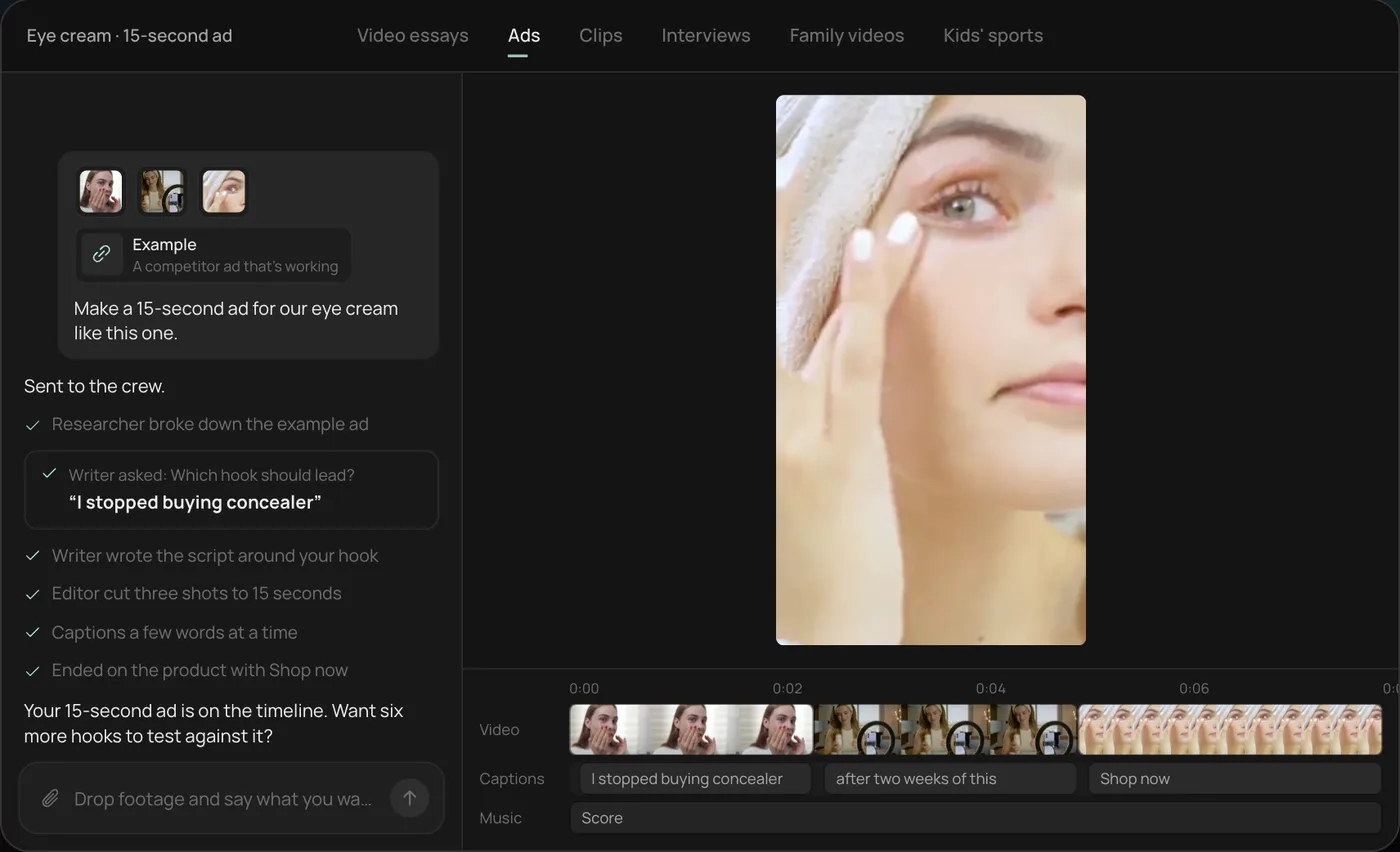
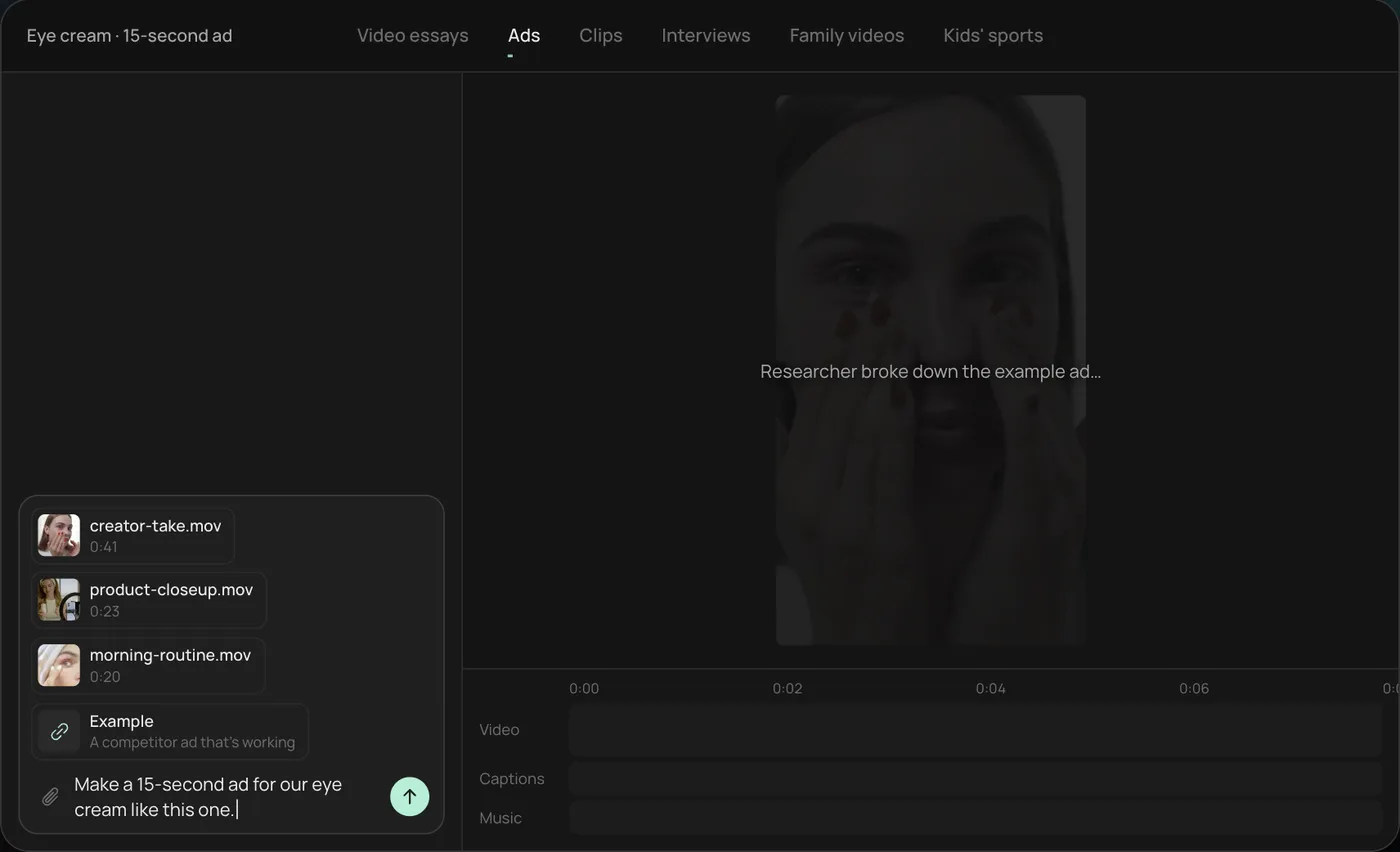
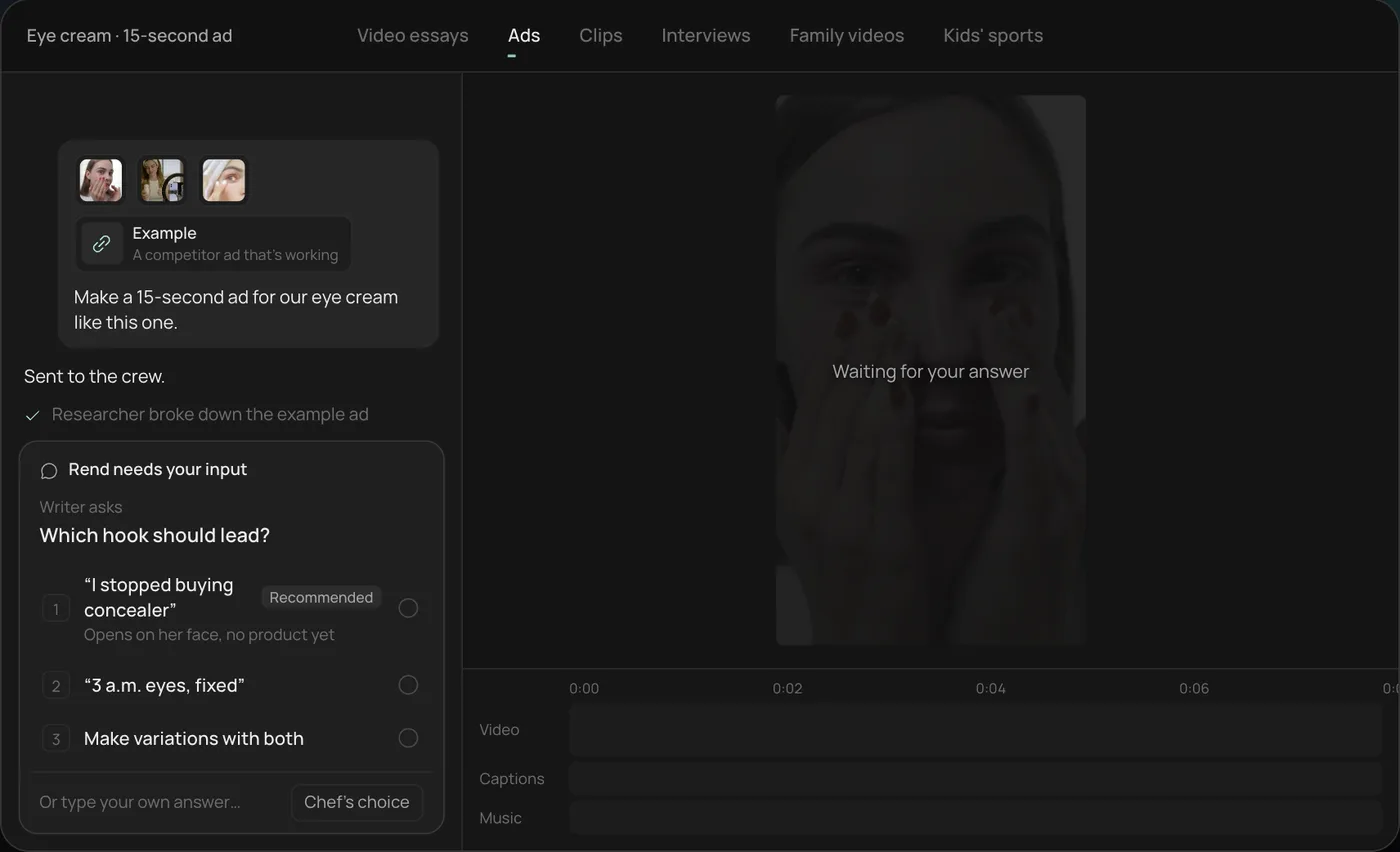
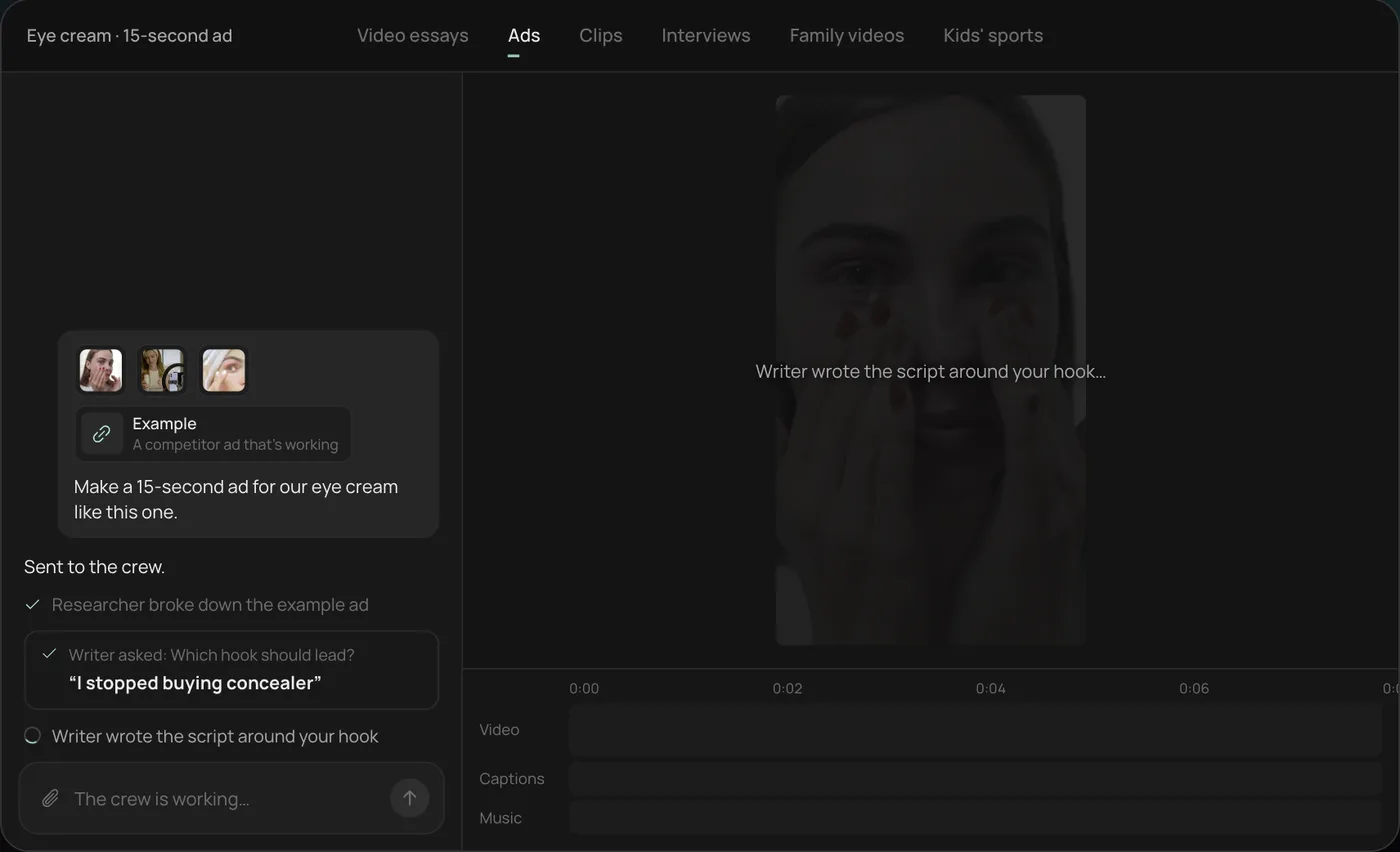
These screenshots come from Rend's demo of a 15-second eye cream ad from phone clips; your own project works the same way.
1. Drop in your clips and an example ad. Add your phone clips (here a creator take, a product close-up and a morning routine) plus an ad you like, then type what you want: "Make a 15-second ad for our eye cream like this one."
2. Answer one question. Rend asks which hook should lead and marks the one it recommends. You can also ask for variations with both.
3. Watch the crew work. A researcher breaks down the example ad and a writer builds the script around your hook, each step checked off in the chat.
4. Get the finished ad. A 15-second vertical ad lands on a real timeline with captions and music on their own tracks, and Rend offers more hooks to test.
From there you can open the timeline and change anything by hand, share a review link for notes, or export. Start a free Rend project to try it on your own footage.
FAQ
How much does Arcads cost?
Arcads doesn't publish dollar prices; they're shown in the app after signup. Its help center lists plans by credits, from Starter at 8,000 a month to Business at 192,000, with a standard actor video costing 800 credits. Yearly billing is 20% off.
Does Arcads have a free trial?
Yes. Its FAQ describes a 72-hour trial with 1,000 credits and all features, with a card required. It turns into a Starter subscription unless you cancel.
Do Arcads credits roll over?
On Starter and Creator, no; they reset each cycle. On Pro, Scale and Business, unused credits roll over with no cap, according to its help center.
What's the best Arcads alternative for small budgets?
Creatify, which has a free plan and a Standard plan from $10 a month billed yearly. MakeUGC is the cheaper like-for-like option for realistic actors.
Can Rend make AI actors like Arcads?
No. Rend doesn't offer a stock actor library. It edits real footage and generates shots, images, voice and b-roll around it. Many teams use an actor tool for hook tests and Rend to turn footage into the full set of ads.
Do I need to label AI actors in ads?
Platform rules change often and vary by category. Check Meta's and TikTok's current advertising policies on AI-generated and synthetic people before launch.
If you've got one ad or creator video that works, start a free Rend project and ask for ten hooks in two sizes. Editing is free, so you see every variant before you pay for a render.