Best UGC Ad Tools in 2026: Creator Marketplaces vs AI Actors
The best UGC ad tool depends on whether you need real people or just the UGC look. For real creators filming your product, Billo is the most straightforward marketplace, with videos from $99 each. For AI actors reading many hooks quickly, Arcads is the specialist and Creatify the cheaper entry point. To turn the UGC you already have into dozens of editable hooks and sizes, Rend is built for that job.
We build Rend, so weigh our view accordingly. Prices were checked on November 18, 2026.
Two ways to make UGC, and why most brands use both
User-generated content ads look like a normal person filmed them on a phone: a quick hook, the product in hand, a reaction, a call to action. You can get them two ways.
Real creators bring trust, real hands on a real product and the little imperfections viewers believe. They cost more per video and take days or weeks.
AI actors are fast and cheap per variant. They are great for testing 20 hooks before you pay a human to film the winner. Audiences are also getting better at spotting them.
The efficient pattern is to test hooks with AI or edits, then put real creator footage behind what wins, then multiply that footage into variants. The tools below each cover part of that loop.
The picks at a glance
| Tool | Type | Real people? | Variants per source | Price (Nov 18, 2026) |
|---|---|---|---|---|
| Billo | Creator marketplace | Yes | One video per creator order; hooks and variations are add-ons | From $99 per video (15 s, regular creator), paid from prepaid packs |
| Arcads | AI actors | No | Many actors and hooks per script | Credit plans from 8,000 credits/mo; no public price page |
| Creatify | AI avatars from a product link | No | Batches of scripts | Standard $15/mo monthly, 55 credits |
| CapCut | Editor with templates | Your footage | Manual | Free; Pro $19.99/mo |
| Rend | AI video agent | Your footage, plus generated shots | New hooks, sizes, image and search ads from one video | Editing free; pay for renders and generation (pricing) |
Billo
Billo connects brands with creators who film to your brief. Its pricing page says videos start at $99, which covers a 15-second video from a regular creator with basic editing; longer videos, premium creators and extras like captions or hooks cost more. You prepay through packs.
Wins: real people, real product, and no negotiating with creators one by one.
Falls short: lead time and cost per variant. Ten hooks means ten paid add-ons or ten orders.
Arcads
Arcads gives you a library of AI actors who deliver your script UGC-style. It doesn't publish a price page; its help center lists monthly credit plans from 8,000 credits on Starter to 192,000 on Business, with talking-actor video billed by the minute in credits.
Wins: hook testing at volume. Twenty faces saying twenty first lines in an afternoon.
Falls short: unclear pricing until you sign up, and changing one word means regenerating. See Creatify vs. Arcads vs. Rend.
Creatify
Creatify turns a product URL into avatar-led ads. Standard is $15 a month on monthly billing for 55 credits, about 30% less yearly, and credits expire after two months.
Wins: lowest cost to see AI UGC on your product.
Falls short: the avatar look is recognizable, and editing is limited to what the app exposes.
CapCut
If a creator sends you raw clips, CapCut is a cheap place to cut them. Pro is $19.99 a month.
Wins: price and trend-native captions.
Falls short: every variant is your time.
Rend
Rend starts from footage: a creator video you paid for, a TikTok that worked, clips your team shot. Send it with your brand and product page, and Rend's ad crew writes new hooks with rend-1 (Rend's own writing model for hooks and ad copy, with live search), cuts every size, makes image ads and search ads, and can research competitor ads on Meta and what customers say on X first. Where you need a shot you don't have, it can generate one.
Each variant is a real timeline: word-timed captions you can restyle, sound on separate tracks, your brand kit applied. Review links let your team mark the frame; the agent reads every note and fixes it. Download the set for your ad accounts or hand it to Rend Boost to run on major networks, paid per click (early access).
Falls short: it doesn't recruit creators. If you have no footage and want a real human on camera, start with a marketplace like Billo.
The UGC loop, with numbers you can plan around
| Step | Tool type | Output |
|---|---|---|
| 1. Write 10 hooks | Writing model or UGC script templates | 10 first lines |
| 2. Test hooks cheaply | AI actors or edits of existing footage | 10 short variants |
| 3. Film the winner | Real creator | 1 to 3 authentic videos |
| 4. Multiply | Editing agent | 20+ variants across hooks and sizes |
| 5. Review before spend | Review link | Fixes made, sizes checked |
Step 5 is where money leaks. Our checklist for reviewing ad videos before you spend catches the usual problems: captions in the safe zone, a hook that lands in the first second, the product visible by second three. For the no-creator route in full, see UGC ads without creators.
Pick X if...
- Pick Billo if you need real people holding your product and can wait for delivery.
- Pick Arcads if you want the widest AI actor library for hook tests.
- Pick Creatify if you want to try AI UGC for the least money.
- Pick CapCut if you're cutting creator clips yourself on a budget.
- Pick Rend if you have UGC that works and want many editable hooks, sizes and image ads from it.
How to make a UGC ad in Rend, step by step
These screenshots are from Rend's demo of a 15-second eye cream ad; your own project works the same way.
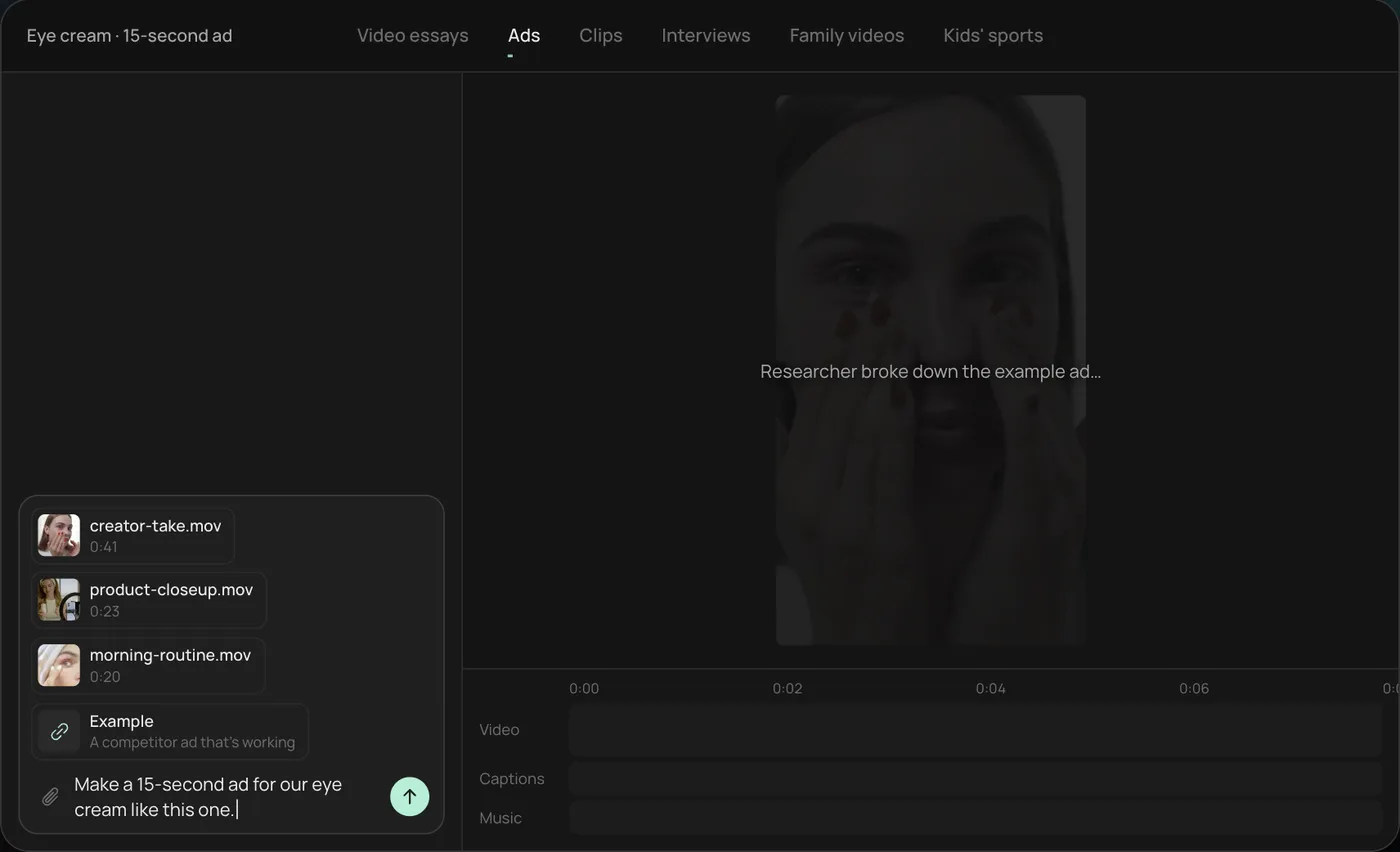
1. Drop your clips and an example. Add your phone clips (here a creator take, a product close-up and a morning routine) plus a competitor ad you like, then type what you want: "Make a 15-second ad for our eye cream like this one."
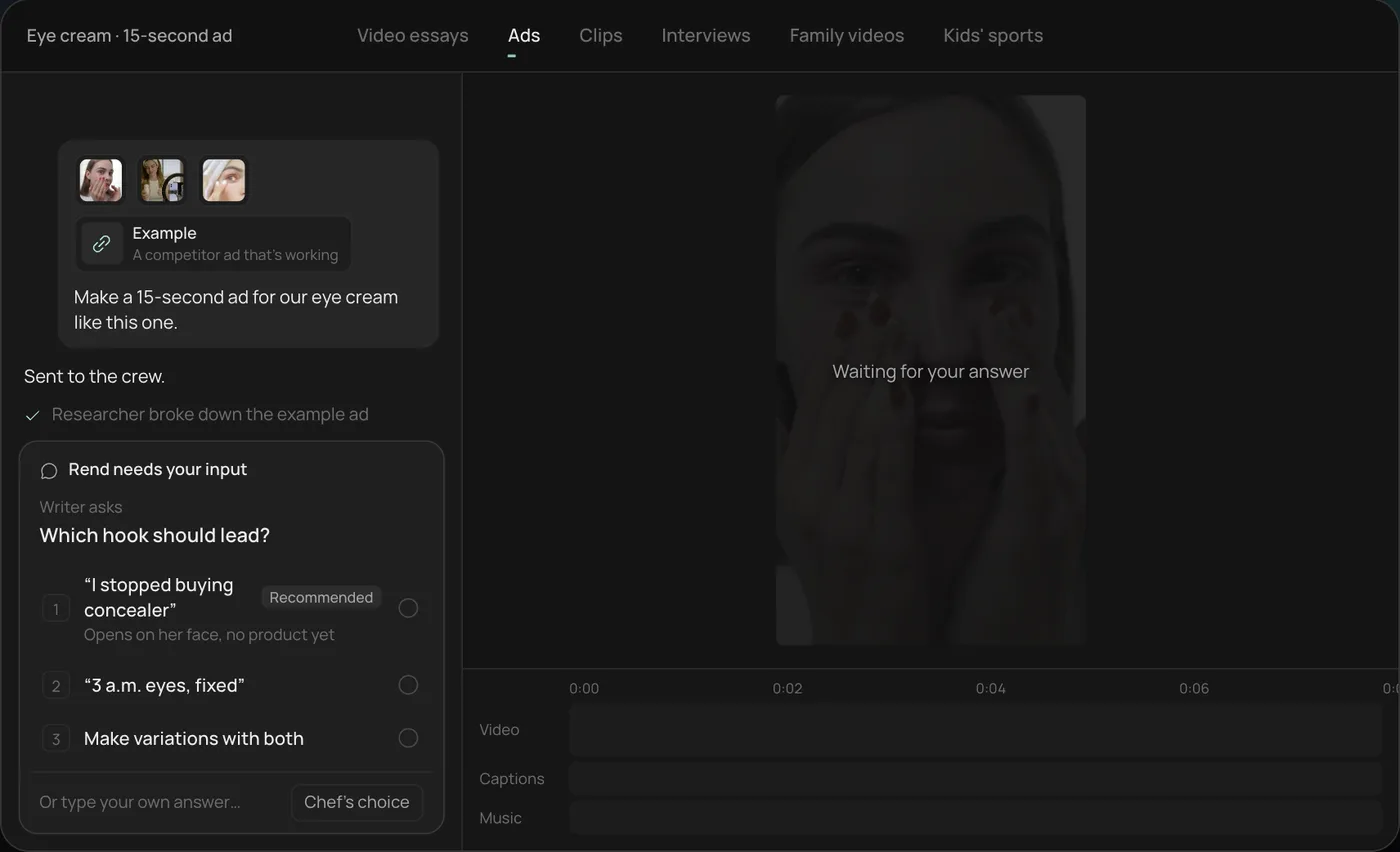
2. Answer the one question. Rend asks which hook should lead and marks a recommended answer. You can also ask it to make variations with both.
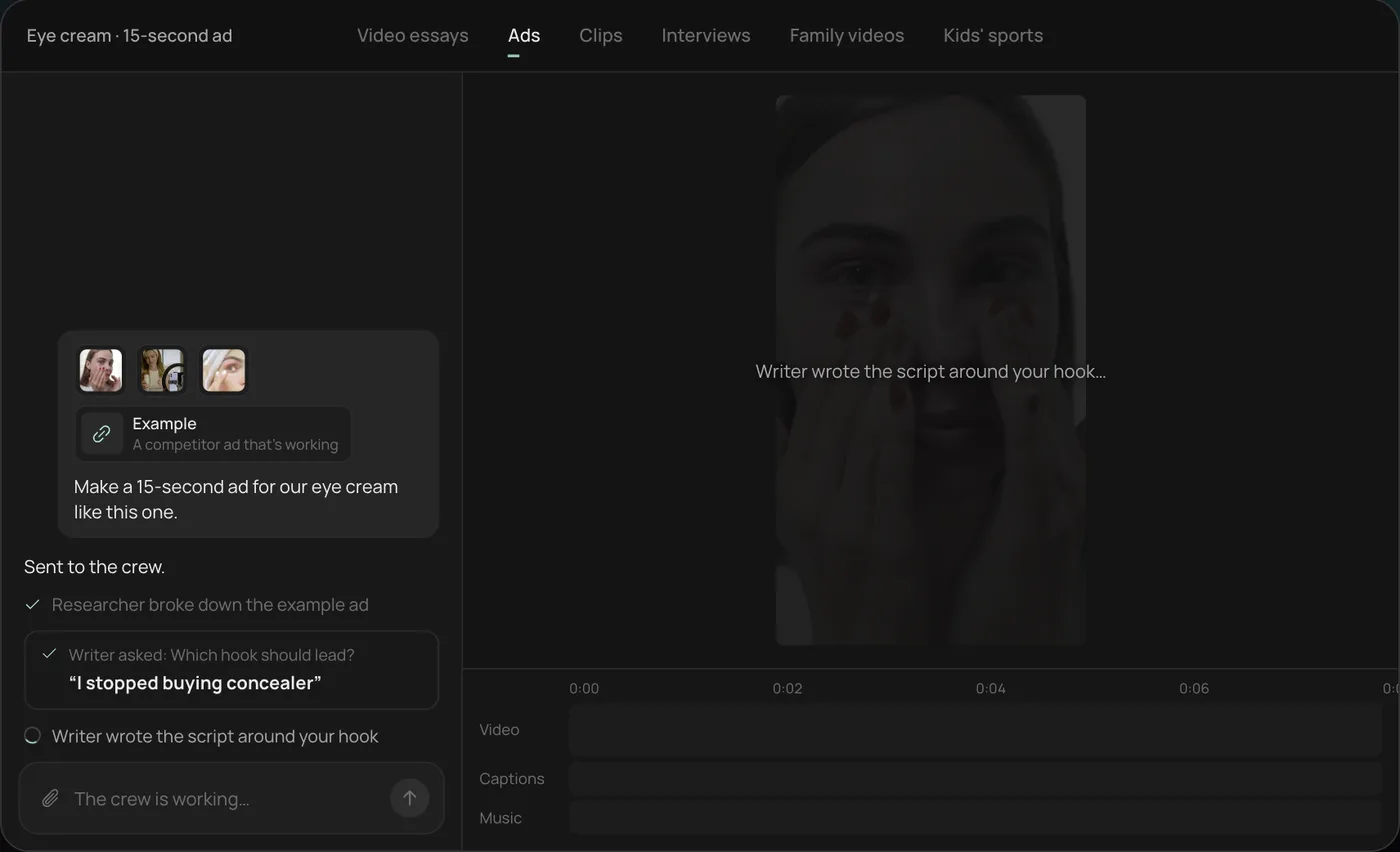
3. Let the crew work. The researcher breaks down the example ad and the writer builds the script around your hook, checking off each step in chat.
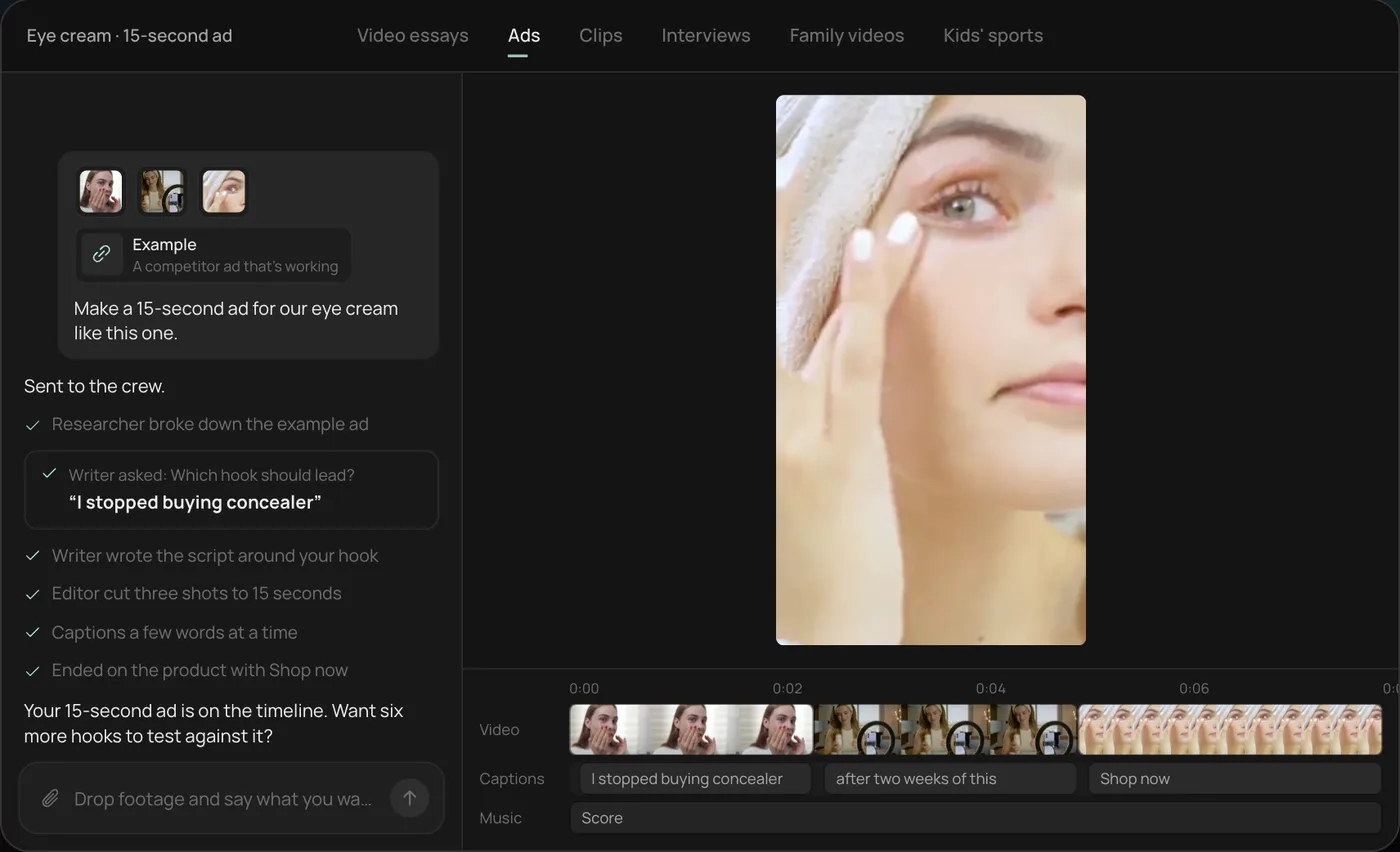
4. Open the finished ad. A 15-second vertical ad lands on a real timeline with captions and music on their own tracks, and Rend offers six more hooks to test.
From there you can open the timeline and change anything by hand, share a review link, or export. Start a free Rend project to try it on your own footage.
FAQ
What is a UGC ad tool?
Any tool that helps make ads in the user-generated style: marketplaces that hire creators, AI actor generators, and editors or agents that turn raw creator footage into finished ads.
Are AI UGC ads as effective as real creators?
They're useful for testing hooks quickly. Real creator footage usually builds more trust for the ads you scale. Many brands use AI to test and creators to scale.
How much does a UGC video cost?
On Billo, videos start at $99 for 15 seconds from a regular creator. Independent creators set their own rates. AI tools price by credits, so cost per video depends on length and plan.
How many UGC ad variations do I need?
Start with three to five hooks on one body, then make more of the winner in every size. Mass ad creation covers scaling to 100.
Do I need to disclose AI actors in ads?
Platform rules vary by category and change often. Check Meta's and TikTok's current policies, especially for realistic synthetic people.
If you already have one UGC video that sells, open a free Rend account and turn it into a full test set.