Car Dealership Video Marketing: Shot Lists for Sales and Service
Car dealership video marketing works when every unit on the lot has a short walkaround on its listing page, the service drive posts one useful clip a week, and every salesperson has a 30-second intro video they can text to a lead. A walkaround runs 60 to 90 seconds on a phone, takes about four minutes per car once your porter or lot attendant has the routine down, and answers the questions a shopper would otherwise call about. The ads come out of that same footage.
Below are the shot lists we use, the lengths that hold up, what goes wrong on a lot (glare, wind, a rep reading from the window sticker), and how to turn one morning of filming into a week of ads.
How to make a dealership ad in Rend, step by step
These screenshots come from Rend's demo of a 15-second eye cream ad from phone clips; a used car spotlight or a service special works the same way.
1. Drop in your clips and an example ad. Add your phone clips (in the demo, a creator take, a product close-up and a morning routine) plus an ad you like, then type what you want: "Make a 15-second ad for our eye cream like this one." For a dealership that might be a walkaround, a few detail shots and a competitor's inventory ad.
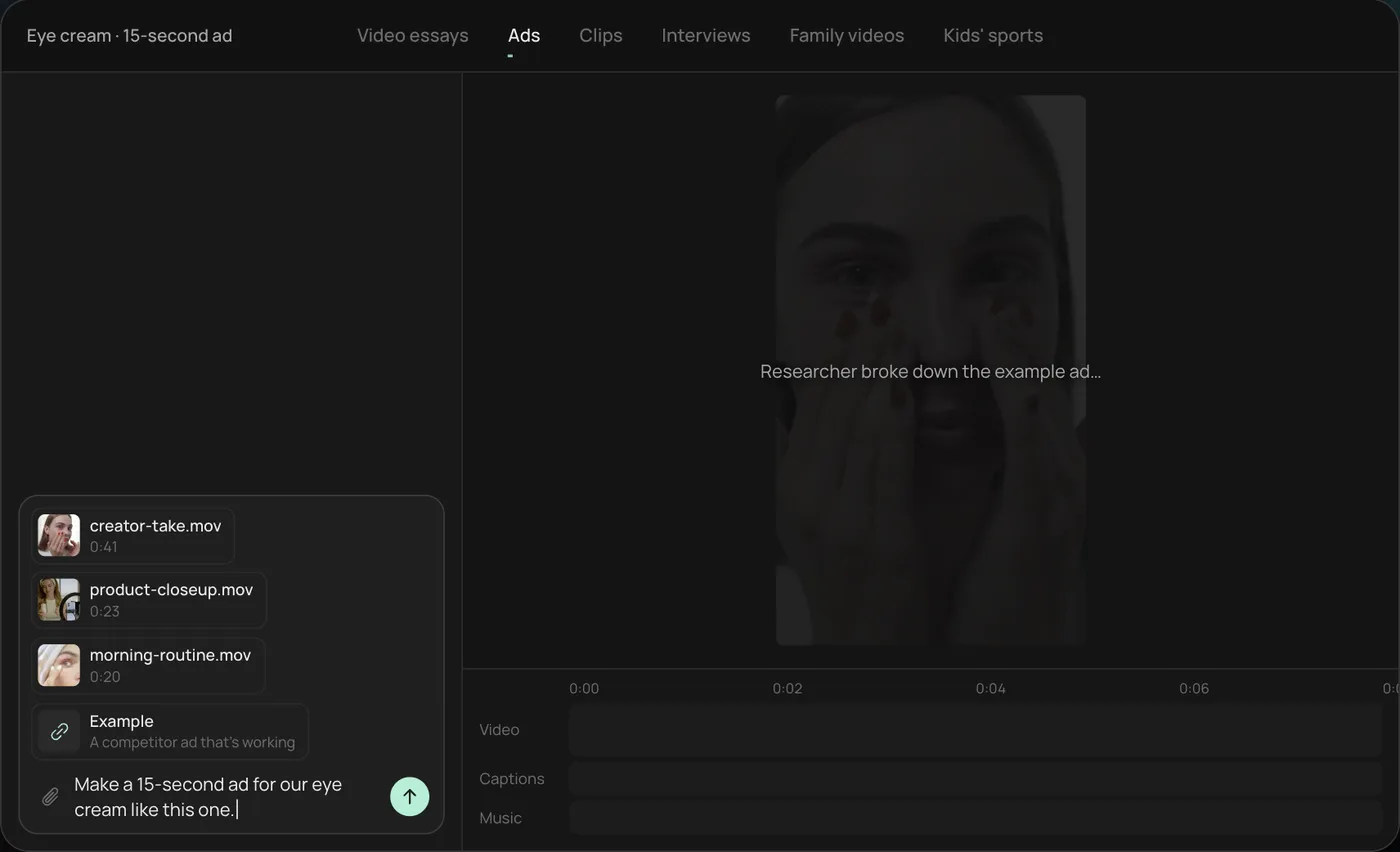
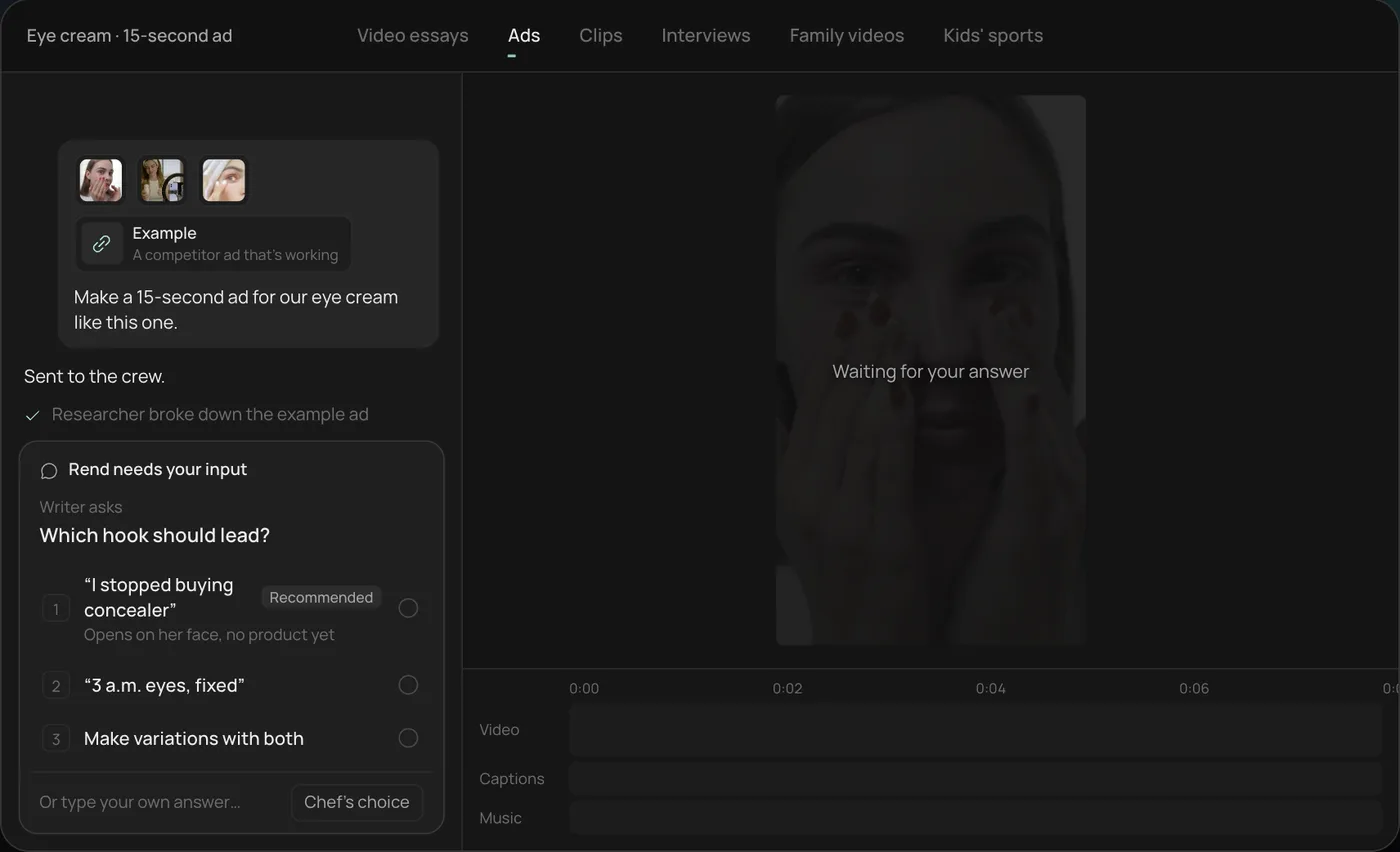
2. Answer one question. Rend asks which hook should lead and marks the one it recommends. You can also ask for variations with both.
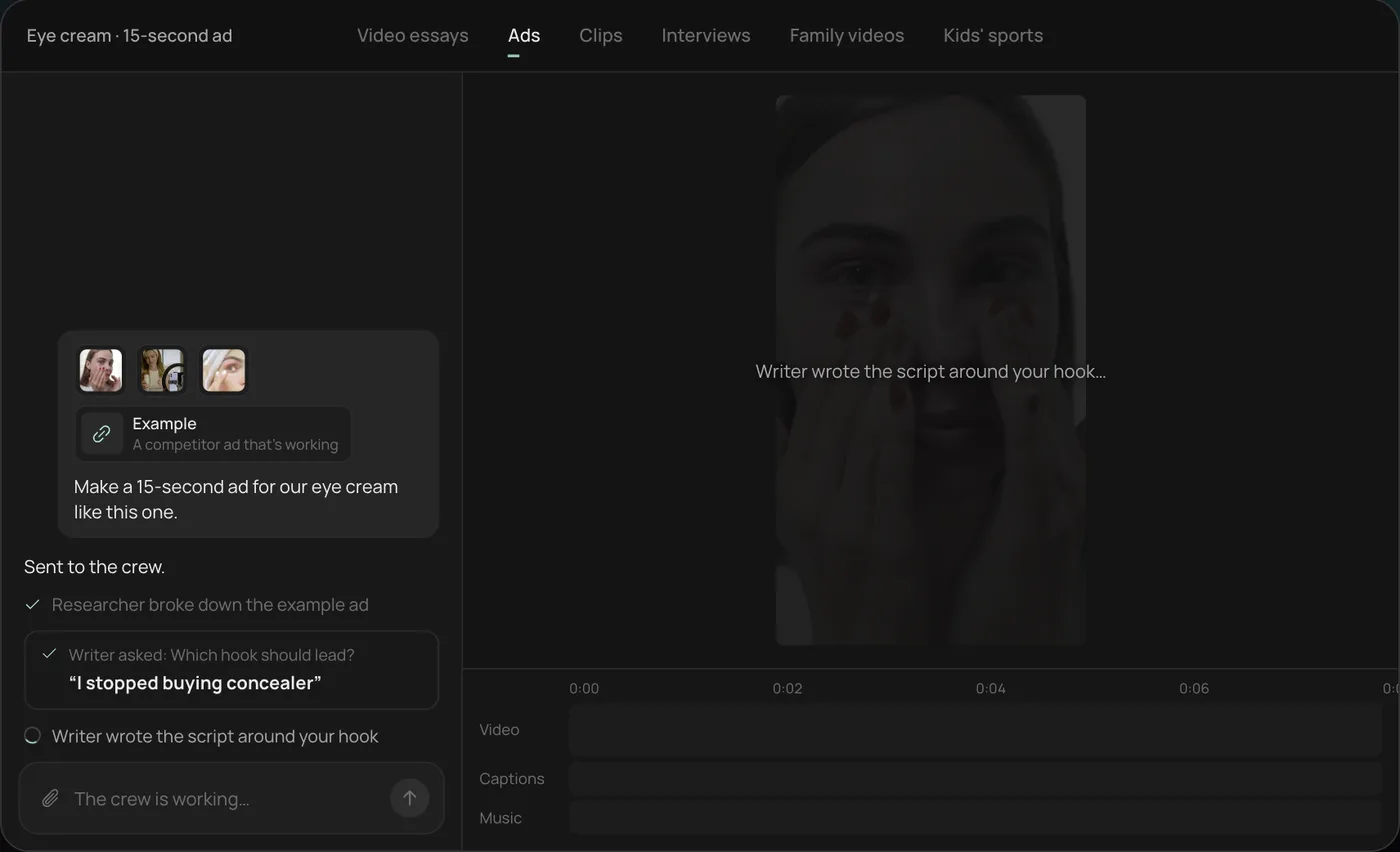
3. Watch the crew work. A researcher breaks down the example ad and a writer builds the script around your hook, each step checked off in the chat.
4. Get the finished ad. A 15-second vertical ad lands on a real timeline with captions and music on their own tracks, and Rend offers more hooks to test.
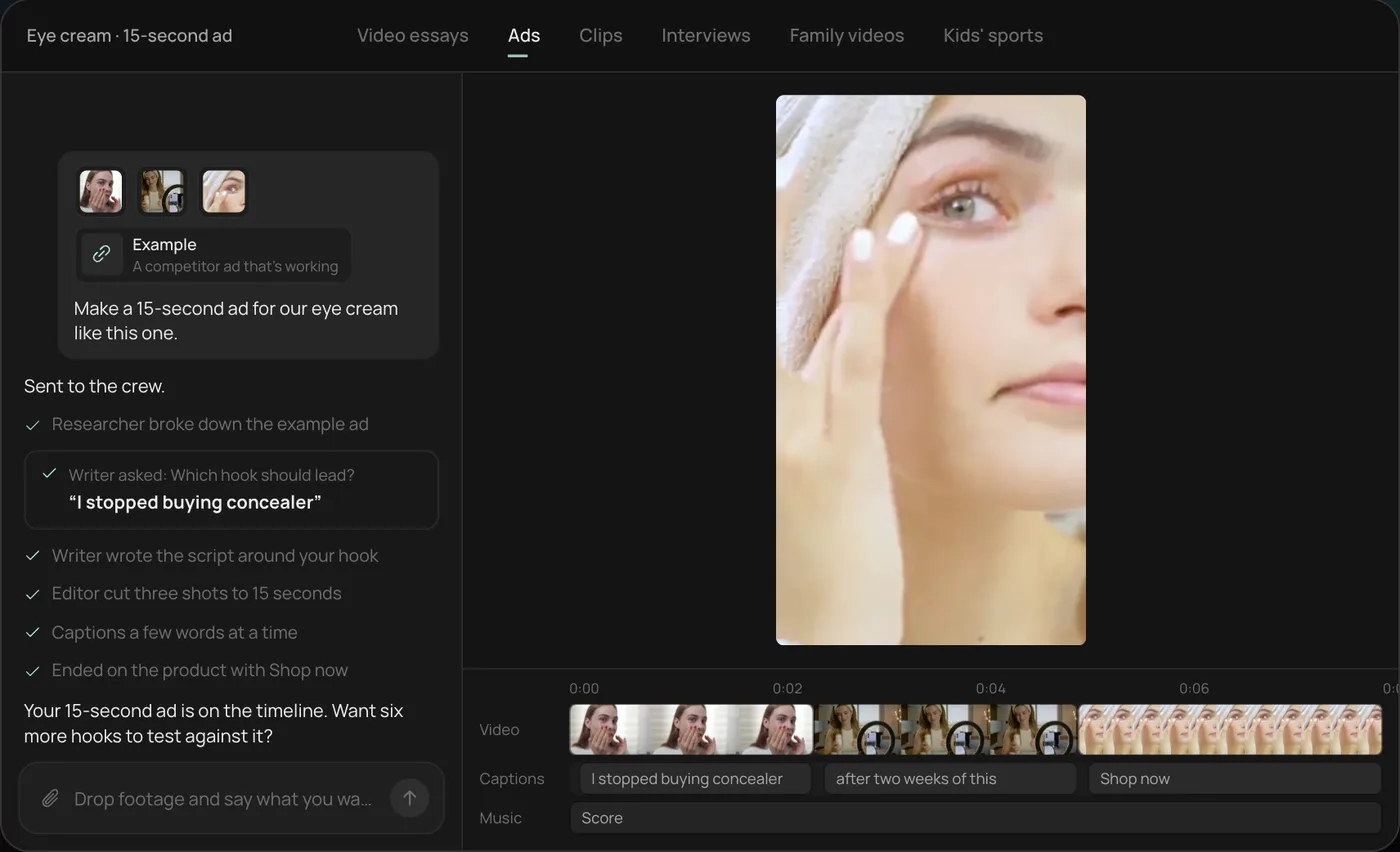
From there you can open the timeline and change anything by hand, share a review link for notes, or export. Start a free Rend project to try it on your own footage.
The four videos a dealership actually needs
Skip the brand spot and the drone shot of the lot. Shoppers want proof about one specific car and a sense of who they will deal with. These four videos cover it.
| Video | Where it lives | Length | Who shoots it | How often |
|---|---|---|---|---|
| Inventory walkaround | VDP, Marketplace listing, Shorts | 60 to 90 s | Porter, lot attendant or BDC | Every unit, within a day of frontline-ready |
| Spotlight ad | Paid social, YouTube | 15 to 30 s | Cut from walkarounds | 2 to 4 a week |
| Service department tip | Organic social, Google Business Profile, email | 20 to 45 s | Service advisor or tech | 1 a week |
| Rep intro | Texted or emailed to leads, rep's own socials | 20 to 40 s | Each salesperson, once | Refresh yearly |
Inventory walkarounds for the VDP
A still-photo gallery on the vehicle detail page leaves the same questions open every time: is that scratch real, how worn is the seat bolster, does the screen work. A walkaround answers them before the call.
The walkaround shot list
Shoot in the same order on every car so the porter never has to think and the edits all look alike.
- Front three-quarter, driver's side, 5 seconds. Hold still. This is the thumbnail.
- Slow walk down the driver's side to the rear three-quarter, 10 seconds.
- Rear, including the badge and tailgate, 4 seconds.
- Walk up the passenger side to the front, 10 seconds.
- Wheels and tires: one close-up of a front tire's tread, 3 seconds.
- Open the driver's door, show the seat bolster and the floor mat, 5 seconds.
- Start the car. Show the cluster with mileage and no warning lights, 5 seconds.
- Infotainment screen: tap through to the camera view, 5 seconds.
- Second row, wide, 4 seconds.
- Cargo area with the seats up, then down if they fold, 6 seconds.
- Any known flaw, honestly: a door ding, a curb-rashed wheel, 3 seconds each.
That is roughly a minute of usable footage. Shoot it horizontal if your website's player is horizontal and vertical if most of it will run on Marketplace and Shorts. If you only have time for one, vertical crops worse to horizontal than the other way round, so most stores we work with shoot horizontal at 4K and crop a vertical version from the middle.
What goes wrong on a lot
Glare is the big one. A black truck at noon shows the sky and the person filming. Shoot in the first two hours of the day or late afternoon, and stand so the sun is behind you but your shadow falls off the side of the car. Lock exposure on the paint (on an iPhone, press and hold on the screen until AE/AF Lock shows) so it does not pump as you walk past the windows.
Wind is the second. The phone mic picks it up as a roar. Either use a small clip-on mic with a furry cover or plan to mute the walkaround and add captions and music later. Plenty of shoppers watch listing video with the sound off anyway.
The third is narration. A rep reading the window sticker aloud is the fastest way to lose a viewer. If someone talks, have them say the three things a sticker does not: why the car came in (lease return, local trade), what the store did to it (new rear pads, two new tires), and one thing they would tell a friend about it.
The flaw shot is a trust shot
Showing a ding feels risky. But a shopper who has already seen the flaw shows up expecting it, while one who finds it at the car starts wondering what else was left out.
Spotlight ads cut from the walkaround
Once walkarounds are routine, the ads are almost free. Take the strongest 15 seconds of a walkaround, put the price and one reason on screen in the first two seconds, and end on the store name and a clear next step.
A spotlight that works usually follows this shape:
- 0 to 2 s: the car in motion or the best angle, with the year, model and one specific hook ("One owner, 31k miles").
- 2 to 10 s: three quick detail shots that back up the hook.
- 10 to 15 s: price or payment, store name, "Text us for a walkaround video."
Be careful with the price line. In March 2026 the FTC sent warning letters to 97 auto dealership groups about advertised prices that left out required fees, depended on rebates not everyone qualifies for, or only held with dealer financing (as summarized by Crowell & Moring). The CARS Rule itself was struck down by the Fifth Circuit in January 2025 and formally withdrawn in February 2026, but the FTC Act still applies. Advertise a price a walk-in can actually pay, or show the full disclosure on screen long enough to read. Your state may have its own rules too, so run price ads past whoever handles compliance.
For YouTube placements, Google's help pages say bumper ads run 6 seconds and standard non-skippable ads 7 to 15 seconds, while skippable ads let the viewer skip after 5 seconds. Our guide to making a YouTube ad goes through each format. For sizes on every network, the video ad size checker shows the safe zones.
Service department videos
Service is where a dealership keeps its customers between purchases, and it is also the easiest place to film because the subjects hold still. The best service videos are short, useful and a little nerdy.
Ideas that consistently earn views from people who already own the brand:
- What the multipoint inspection sheet colors actually mean, with a tech pointing at a real worn part.
- Old brake pad next to a new one, 15 seconds, "this is what 3 millimeters looks like."
- How to reset the tire pressure light on the brand's most common model.
- Why a cabin air filter matters, with the dirty one pulled out on camera.
- A tour of the service drive at 7:30 AM so a first-timer knows where to pull in.
Keep the tech's hands and the part in frame, hold the phone steady against something, and caption everything. A Google Business Profile video can be up to 30 seconds, 75 MB and at least 720p, according to Google's Business Profile help, so the 20 to 30 second versions double as profile content. See our Google Business Profile video guide for upload steps.
Salespeople's personal videos
A 30-second rep intro texted to an internet lead does something no auto-reply can: it puts a face and a voice on the store before the shopper visits. It also gives the BDC something better to send than "When can you come in?"
Have each rep film one in a quiet corner of the showroom with a window behind the camera, not behind them. Script it loosely:
- Name, how long at the store, and one real thing about them ("I've sold Tacomas here for six years").
- What happens when the shopper arrives: "Text me when you're ten minutes out and I'll have it pulled up front and warmed up."
- No pricing, no "best deal in town."
For hot leads, try a per-lead version: the rep next to the exact car the shopper asked about, saying their first name. No editing needed.
A weekly plan that fits a real store
| Day | Task | Time |
|---|---|---|
| Daily, first two hours | Walkarounds for every new frontline unit | 4 to 5 min per car |
| Monday | Pick 3 to 4 units for spotlight ads, cut and approve | 45 min |
| Wednesday | Service tip video with one advisor or tech | 20 min |
| Friday | Review ad results, retire the losers, cut new hooks from the winners | 30 min |
A big shoot once a quarter fails because inventory turns too fast. Four minutes every morning beats a production day.
How Rend fits a dealership
Rend is an AI video agent. You send the clips you already have (by chat, email or a web form) and say what you want: "Cut a 15-second spotlight from this walkaround, year and mileage up front, store name at the end, plus a vertical and a square version." A crew of specialist agents cuts it on a real, editable timeline, adds word-timed captions in your brand's look, music on its own track, and checks its own work.
Save a brand kit once (caption style, logo end card, music bed) and every spotlight after that comes out matching. Rend can spin new hooks and sizes from one video, so one good walkaround becomes several ads to test. You can download the set for your own ad accounts, or hand them to Rend Boost, where Rend runs them live on major networks and you pay per click (early access). Share a review link with your GM or compliance person; they draw on the frame or leave a note ("price needs the doc fee line"), and the agent makes the fix on the same link.
Where Rend is not the right tool: if your inventory feed provider already auto-generates slideshow videos for every VDP, that is cheaper for pure volume, and some of them push straight to your website. Rend is better for the walkaround edits and ads you want people to actually watch. For more local business ideas, read video ads for local businesses and how to make 100 ad variations from one video. Editing is free and you pay only when Rend renders or generates something; pricing has the details.
FAQ
How long should a car walkaround video be?
60 to 90 seconds for the VDP. Long enough to show the exterior, the interior, the cluster with mileage and any flaws, short enough that a shopper watches to the end. Cut a 15 to 30 second version for ads.
Should salespeople or porters shoot inventory videos?
Whoever is at the car every morning. Porters and lot attendants are usually more consistent than salespeople because they follow the same shot list every time. Save the rep's time for intro videos and per-lead videos.
Do dealership videos need captions?
Yes. A lot of listing and social video is watched with the sound off, and lot audio is usually wind and traffic. Captions also let you put mileage, trim and price on screen in a way a shopper can read.
Can we put prices in dealership video ads?
You can, but the FTC's 2026 warning letters targeted prices that left out required fees or depended on rebates and dealer financing. Advertise a price anyone can pay, disclose conditions on screen, and check your state's rules.
What camera do we need?
A recent phone, a small gimbal or steady hands, and a clip-on mic if anyone talks. The bigger upgrades are shooting in good light and following the same shot order on every car.
How many videos should a dealership post a week?
Walkarounds for every unit, two to four spotlight ads, and one service video is a realistic pace for a single-rooftop store.
Start with one car
Film tomorrow's first frontline unit with the shot list above, send the clips to Rend and ask for a VDP walkaround plus a 15-second spotlight. You can do it on the free plan and check every cut before you pay to render.