Home Decor Product Video: Show Size, Color and the Room
A home decor product video has to answer two things photos get wrong: how big the piece is and what color it really is in a normal room. Film a slow hero shot, then a scale shot with a tape measure and a hand or a familiar object, then the piece in its room, then the same piece in daylight and in warm evening lamp light, then the details (texture, glaze, hardware, the back). Put the dimensions on screen. That set does more for a vase, a lamp or a rug than any amount of styled b-roll.
Most decor videos are the styled b-roll: a candle glowing on a coffee table, a slow pan across a shelf. Pretty, but a buyer still can't tell if the vase is 8 inches or 18. Below is a 9-shot list by product type, the two-light test, how to edit for product pages and ads, and the origin and safety rules that touch decor captions. For phone basics, see making a product video with your phone.
Why decor needs its own approach
Decor is bought for a specific spot: the empty corner, the mantel, the wall above the sofa. The buyer is holding a picture of that spot in their head and trying to fit your product into it. Two things break that picture.
Scale. Styled photos are shot with props chosen to flatter, and a lamp next to a small stack of books can read as any size. Amazon's own seller guidance on product videos lists "dimensions (if it's not immediately evident)" as part of a good product video. For decor it's almost never evident.
Color under real light. Decor is lived with in the evening under warm bulbs. Linen that's oatmeal at noon can go orange at 8 pm; a "sage" glaze can go grey. Showing both is honest and heads off the "color is different than pictured" return.
Setup
- Shoot in a real room if you can, not a paper backdrop. Decor without context is just an object.
- Daylight first: big window, overhead lights off. Then switch to two or three warm table lamps for the evening shots.
- Lock exposure and white balance per lighting setup. Don't let the phone auto-correct the warm shots back to neutral, or you've hidden the thing you're trying to show.
- A tape measure, a hand, and one universal object (a standard mug, a paperback, an A4 or letter sheet).
- A tripod for the hero and room shots. Slow, smooth moves only; decor is sold on calm.
The 9-shot list
Hold each 5 to 8 seconds and take two of each.
| # | Shot | What it proves | How |
|---|---|---|---|
| 1 | Hero | What it is | Slow push in or slow arc, product filling a third of the frame |
| 2 | Tape measure | Exact size | Tape along the height or width in one take, number readable |
| 3 | Hand or object for scale | Size, instantly | Hand wrapping a vase, a paperback next to a frame, a person sitting on the bench |
| 4 | In the room | Where it goes | Wide shot of the piece in place, then a slow push in |
| 5 | Daylight close-up | True color and texture | Side light across glaze, weave, grain |
| 6 | Evening close-up | Color under warm light | Same framing as 5, lamps on, overheads off |
| 7 | Details | Quality | Hardware, stitching, the base, the back, the hanging kit |
| 8 | In use | Function | Flowers in the vase, lamp switched on, throw pulled over a knee, drawer opened |
| 9 | Unboxing or assembly | What arrives | Packaging, parts, a time-lapse of assembly if there is any |
Shots 2, 3 and 6 are the ones styled decor videos leave out, and they answer the questions behind "not what I expected" returns: size and color. Put the dimensions as a caption on shot 2 even if they're in the listing: "H 14 in / 36 cm. Opening 3 in."
By product type
| Product | Must-have shot | Extra |
|---|---|---|
| Vases and ceramics | Hand wrapping it, glaze close-up in two lights | Water test if you say it's watertight |
| Lamps | Switched on at dusk, showing the light it throws on the wall | Bulb type and shade fabric close-up; cord length on the tape |
| Rugs | Walk across it barefoot, pile close-up, corner flipped to show backing | Wide shot under a sofa for scale; true color in daylight |
| Wall art and mirrors | Hung above a sofa or console, a person walking past | Hanging hardware on the back |
| Throws and cushions | Draped and folded, the drape test (hold by a corner) | Insert or cover only, said on screen |
| Candles | Lit, burn pool after an hour, lid on and off | Burn time only if you've tested it |
| Small furniture | Someone using it (sitting, opening, placing a laptop) | Assembly time-lapse with a real clock |
Captions: origin, handmade and safety
Decor copy leans on words like "handmade," "artisan," "solid wood" and "made in USA." A few have real rules behind them.
Made in USA. The FTC's Made in USA guide says an unqualified claim requires "all or virtually all" U.S. content, with no or negligible foreign content, and that the policy covers "marketing through digital or electronic mechanisms," including social media. The 2021 Made in USA Labeling Rule adds civil penalties for unqualified claims on labels and in online materials that show a Made in USA mark. The FTC's own qualified examples fit decor well: "Couch assembled in USA from Italian Leather and Mexican Frame," or "Made in USA of U.S. and imported parts."
Handmade and solid wood. There's no general federal definition we could find for these in home goods, so the general rule applies: say only what's true. If a lamp base is cast and you hand-finished it, "hand-finished" is accurate and "handmade" invites trouble. If the tabletop is veneer over plywood, "solid wood" is false even if the legs are solid.
Dressers and tip-overs. If you sell chests, dressers or armoires, CPSC's clothing storage unit rule (16 CFR 1261) covers units made after September 1, 2023 that are at least 27 inches tall and 30 pounds with enough enclosed storage. They must pass stability tests and ship with an anti-tip device meeting ASTM F3096. Your video shouldn't contradict that: show it anchored when drawers are open, and never show a child pulling on drawers.
| Instead of | Say |
|---|---|
| "Made in USA" (assembled here from imported parts) | "Assembled in USA from imported parts" |
| "Handmade" (cast, then finished by hand) | "Hand-finished" |
| "Solid oak table" (oak veneer top) | "Oak veneer top, solid oak legs" |
| "Burns for 60 hours" (untested) | Burn time from your own test, or nothing |
| "Waterproof vase" (untested crackle glaze) | "Glazed inside; use a liner for fresh flowers" |
This is a summary, not legal advice.
Platform notes
On Shopify, video sits in the product gallery; a 20 to 30 second cut with dimensions on screen works well next to photos, and the Shopify product video guide covers upload limits and placement. Etsy listing videos are 3 to 15 seconds and silent, so the dimensions have to be on screen; see the Etsy listing video guide. For Amazon, the Amazon product video guide covers specs and what gets rejected.
Decor does well on Pinterest, where people plan rooms. The Pinterest video ads guide shows how to re-cut a TikTok ad into a Pin instead of reposting it. On TikTok Shop, most decor isn't restricted, but household appliances and live plants are restricted categories that may need qualification, per the Restricted Products Policy. A lamp is decor; a smart heater may not be.
From one shoot to a set
One afternoon per collection gives you:
- A 20 to 30 second product page video per piece: hero, tape, hand, room, two-light close-ups, details.
- A silent 10 to 15 second cut for Etsy.
- A "day to night" ad per piece: shot 5 into shot 6, same framing, one caption ("Here's how it looks at 8 pm"). It's a strong opening because it answers a question buyers have and other sellers dodge.
- A room tour ad featuring several pieces, each with its dimensions.
Rend does the editing. Send the clips from your phone in chat, by email or a web form, and ask for "a 25-second product page video per piece with dimensions as captions, a silent Etsy cut, and a day-to-night 9:16 ad for each." Rend cuts them on a real timeline you can open and change, with word-timed captions in your font. A brand kit keeps your caption style, music bed and end card the same across a 30-piece collection. If you need a clean studio-style shot or a room setting you can't get to, Rend can generate images and b-roll, but keep the tape-measure and two-light shots real; that's the proof.
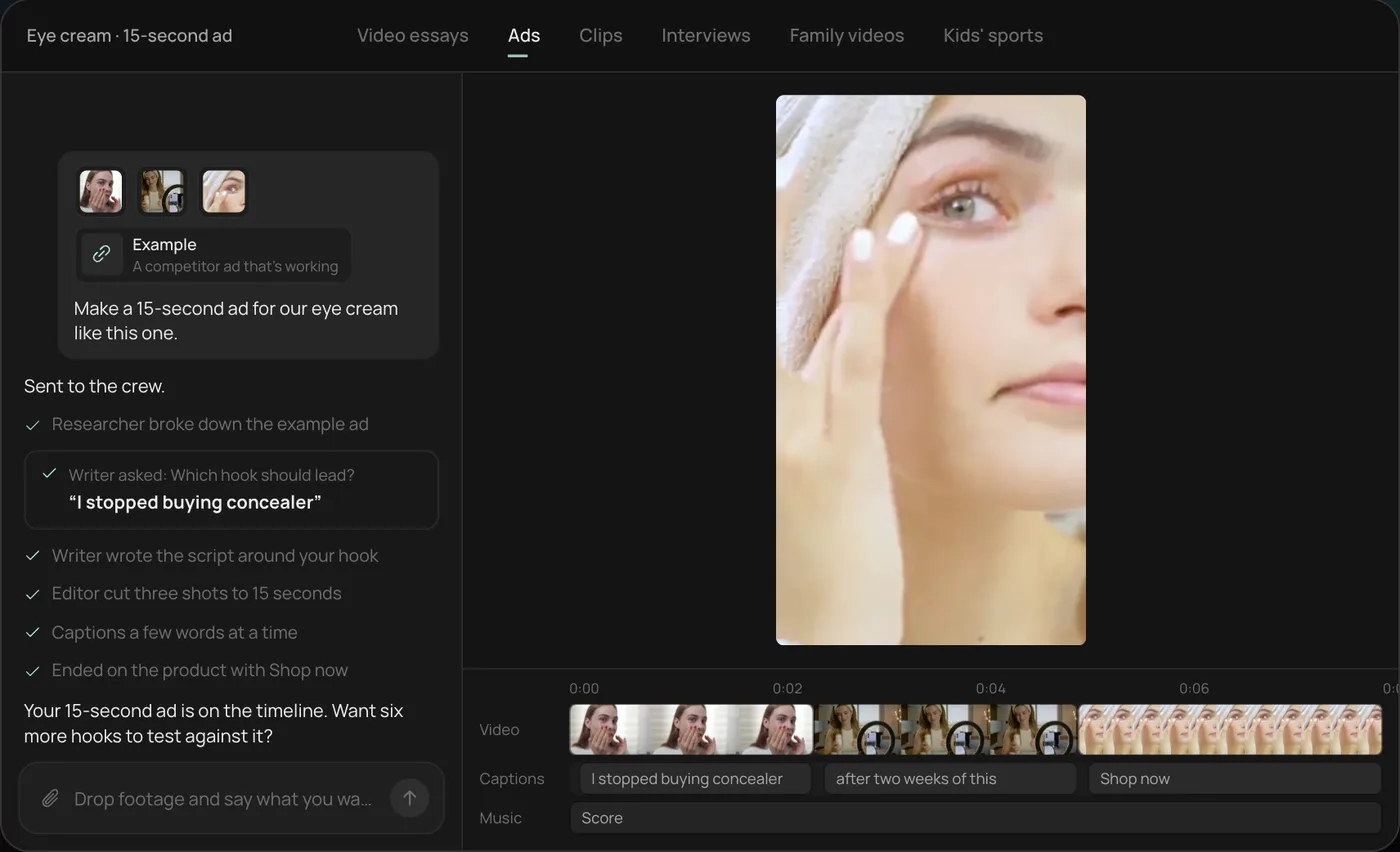
For one vase and one clip, your phone's editor is faster. Rend earns its place on a collection or an ad set. Editing is free and you pay only when Rend renders or generates something; see pricing. For product pages turned into ads, see ecommerce product video ads.
FAQ
How long should a home decor product video be?
20 to 30 seconds for a product page, 10 to 15 seconds for Etsy and most ads. Spend the first seconds on size and color, not mood.
How do I show the real size of decor in a video?
Run a tape measure along it in one take with the number readable, then show it next to a hand or a common object, then in a room. Put the dimensions on screen.
Why does my decor look a different color in photos?
Daylight and warm bulbs render color differently, and phones auto-correct. Lock white balance and show the piece in both lights so buyers see the range.
Can I say "Made in USA" if I assemble it here?
Not unqualified. The FTC requires "all or virtually all" U.S. content for an unqualified claim. Use a qualified line such as "Assembled in USA from imported parts."
Should I use AI-generated room scenes?
They're fine for mood or a setting you can't shoot, but keep the scale and color shots real. A generated room can make any piece look the right size.
If you have a collection waiting for video, start a free Rend project and ask for product page cuts with dimensions on screen and a day-to-night ad for each piece.