Pet Product Video: How to Film Pets, Prove Fit and Stay Legal
A good pet product video shows a real animal using the product, plus the proof an owner needs: what size fits their pet, how it's put on or set up, and how it holds up. Shoot the pet first, while it's interested, in short takes with treats and patience, then film the product details without the animal. Keep claims in your lane: health claims can make a pet food or chew an unapproved drug, and flea and tick products are pesticides that can't be called "safe."
The difference from other categories is the actor. A dog doesn't hit marks, and a cat won't do a second take. Below is a shoot plan that works around that, a 9-shot list by product type, the claim rules most pet video guides skip, and TikTok Shop's pet requirements. For general phone setup, see making a product video with your phone.
Shoot the animal first
Most failed pet shoots go like this: the product is set up perfectly, the lighting is right, and the dog has lost interest by the time the camera rolls. Flip the order.
- Set the light and frame on an empty spot before the pet comes in. Window light, camera on a tripod at the pet's eye level (on the floor for cats and small dogs).
- Bring the pet in hungry for treats, not exhausted and not wired. After a walk usually works.
- Roll continuously. Don't start and stop; you'll miss the moment. Ten minutes of rolling footage is better than twenty attempts.
- Get the reaction shots in the first five minutes: first sniff, first bite, first time in the bed. Novelty fades fast.
- Let the pet go, then film product details, packaging and setup steps without the animal.
Use a second person off camera with treats to steer attention. Squeaks and crinkly packets get a head tilt toward the lens. Burst mode on a phone held in the other hand gets you thumbnails.
A note on welfare: never stage anything that stresses or risks the animal for a shot (a dog on a slippery floor for a zoomie, a cat in a carrier it hates). It's obvious on camera, and TikTok Shop prohibits content showing animal cruelty.
The 9-shot list
| # | Shot | What it proves | Notes |
|---|---|---|---|
| 1 | Pet using it | It works and the pet likes it | Real reaction, uncut, at the pet's eye level |
| 2 | Fit or size on the pet | Which size to buy | Caption the pet's weight or measurement and the size used: "Milo, 32 lb, size M" |
| 3 | Putting it on or setting it up | Ease | Real speed, one take: harness buckled, feeder filled, bed unzipped |
| 4 | Durability test | It lasts | A pull, a chew session at real speed, a wash cycle, with the time on screen |
| 5 | Material macro | Quality | Stitching, seams, coating, the inside of a bowl |
| 6 | Cleaning | Owner's real chore | Cover off and in the machine, bowl in the dishwasher, hair lint-rolled off |
| 7 | Size comparison | Fit range | Two sizes side by side, or the product next to a second pet |
| 8 | Back of pack | Ingredients, feeding guide, warnings | Steady, readable, especially for food and treats |
| 9 | Pack hero | What to search for | Front label readable |
Shot 2 is the one owners need most. "Medium" means nothing until they see it on a dog their dog's size.
By product type
| Product | Must-have shot | Careful with |
|---|---|---|
| Harnesses and collars | Fit on a pet with weight and chest measurement on screen; two fingers under the strap | "Escape-proof" unless you've tested it |
| Beds | Pet settling in (circle and flop), cover off and washed | Calling it "orthopedic" if that implies treating joint disease |
| Toys | Real play session, time on screen; the toy afterward | "Indestructible"; owners will test it |
| Food and treats | Pet eating at real speed, kibble or treat size next to a coin, the feeding guide | Any health claim (see below) |
| Grooming tools | Before and after a brush session, the hair that comes out | Nicked skin or a stressed animal |
| Feeders, fountains, litter boxes | Setup, refill, cleaning, pet using it | Claims about urinary health |
| Flea, tick and calming products | The application step, pack and label | "Safe," "non-toxic," "natural," health claims |
Claims: where pet videos get into trouble
Pet owners love their animals, and pet copy reaches for health language: "supports joints," "calms anxiety," "fixes itchy skin," "safe for puppies." Several of those carry rules.
Pet food and treats. The FDA's animal food labeling page says claims that a product cures, treats, prevents or mitigates disease, or affects the body beyond normal food purposes, may indicate a "new animal drug" that needs approval before it can make that claim. FDA also reviews specific claims such as "maintains urinary tract health" and "hairball control." A treat that "relieves arthritis" is making a drug claim.
"Complete and balanced." The FDA explains on its complete and balanced page that this comes from the nutritional adequacy statement on the label. If your food says it, show that statement; if it doesn't, a treat or topper shouldn't be pitched as a meal.
Flea and tick products. Sprays, spot-ons, collars and shampoos that kill pests are generally pesticides under EPA rules (some oral products are FDA-regulated drugs instead). 40 CFR 156.10 treats safety claims such as "safe," "nonpoisonous," "harmless" or "nontoxic to humans and pets" as false or misleading, "with or without such a qualifying phrase as 'when used as directed,'" and lists "Contains all natural ingredients" as a misleading safety statement too. EPA's labeling questions and answers adds that it "generally has not allowed the use of 'safe' in labeling," that claims made when selling the product must not substantially differ from the registered ones, and that "any reference to a website makes that website labeling."
| Instead of | Say |
|---|---|
| "Relieves joint pain" | "Soft chew, 2 per day for dogs over 50 lb" (the feeding guide) |
| "Safe for cats and kids" (flea spray) | The exact use directions from the registered label |
| "All natural flea protection" | The registered label's claims, word for word |
| "Cures itchy skin" | "Oatmeal shampoo, rinses clean" |
| "Vet approved" | "Developed with [named vet]" only if true and disclosed |
| "Indestructible" | "Lasted 6 weeks with our 70 lb lab" (if it did) |
This is a summary, not legal advice. If you sell anything that touches pests, health or a medical condition, have the label and the claims checked before the creative.
TikTok Shop pet requirements
From TikTok Shop's US Seller Center, read November 22, 2026. Pet supplies and pet healthcare are restricted categories, and pet healthcare and frozen food are invite-only per the Restricted Products Policy. The Pet Supplies Requirements (updated October 9, 2026) may ask pet food and supplement sellers for FDA registration, a cGMP certificate, labels and a lab test report from an approved lab. Prohibited: prescription and veterinary diets, CBD in pet products, unapproved animal drugs, and products under FDA recalls or warning letters. It says plainly: "If a product makes disease or health-condition claims, it may be regulated as an animal drug and is prohibited." Flea drops and some flea collars fall under separate pet healthcare requirements.
TikTok Shop's creator content guide also prohibits selling live animals and content showing animal cruelty, and requires the product to be clearly shown and match the listing. More formats in TikTok Shop videos.
A 20-second harness video, beat by beat
| Time | Shot | Caption |
|---|---|---|
| 0 to 3 s | Dog pulling toward a squirrel, harness holding, no choke (shot 1) | "Pulls from the chest, not the neck." |
| 3 to 8 s | Harness on in one take (shot 3) | "Over the head, one buckle. 6 seconds." |
| 8 to 11 s | Fit close-up, two fingers under strap (shot 2) | "Milo: 32 lb, chest 24 in, size M" |
| 11 to 15 s | Second dog in size S (shot 7) | "Luna: 14 lb, size S" |
| 15 to 18 s | Stitching and buckle macro (shot 5) | "Reflective stitching, metal D-ring" |
| 18 to 20 s | Pack hero (shot 9) | Product name |
No safety guarantee, no "escape-proof." Weight and size on screen do the selling.
From one shoot to a set
One session per product gives you a 20 to 30 second product page video, a 15 to 20 second TikTok Shop video and three ads opening on different moments (the reaction, the fit, the durability test). Pet videos are one of the categories where customer clips work well, because owners film their pets anyway; customer review video ads covers how to use them with permission. For marketplaces, see the Amazon product video guide and the Shopify product video guide.
Rend does the edit. Send ten minutes of rolling pet footage from your phone in chat, by email or a web form, and ask for "the best 20 seconds of Milo using the harness, size captions, and three vertical ads opening on the pull, the buckle and the two-dog comparison." Rend finds the moments, cuts on a real timeline you can open and change, adds word-timed captions in your font, and makes the sizes. Customer clips sent in by owners can go into the same project. Captions are editable text, so swapping "safe" for the label's wording is quick.
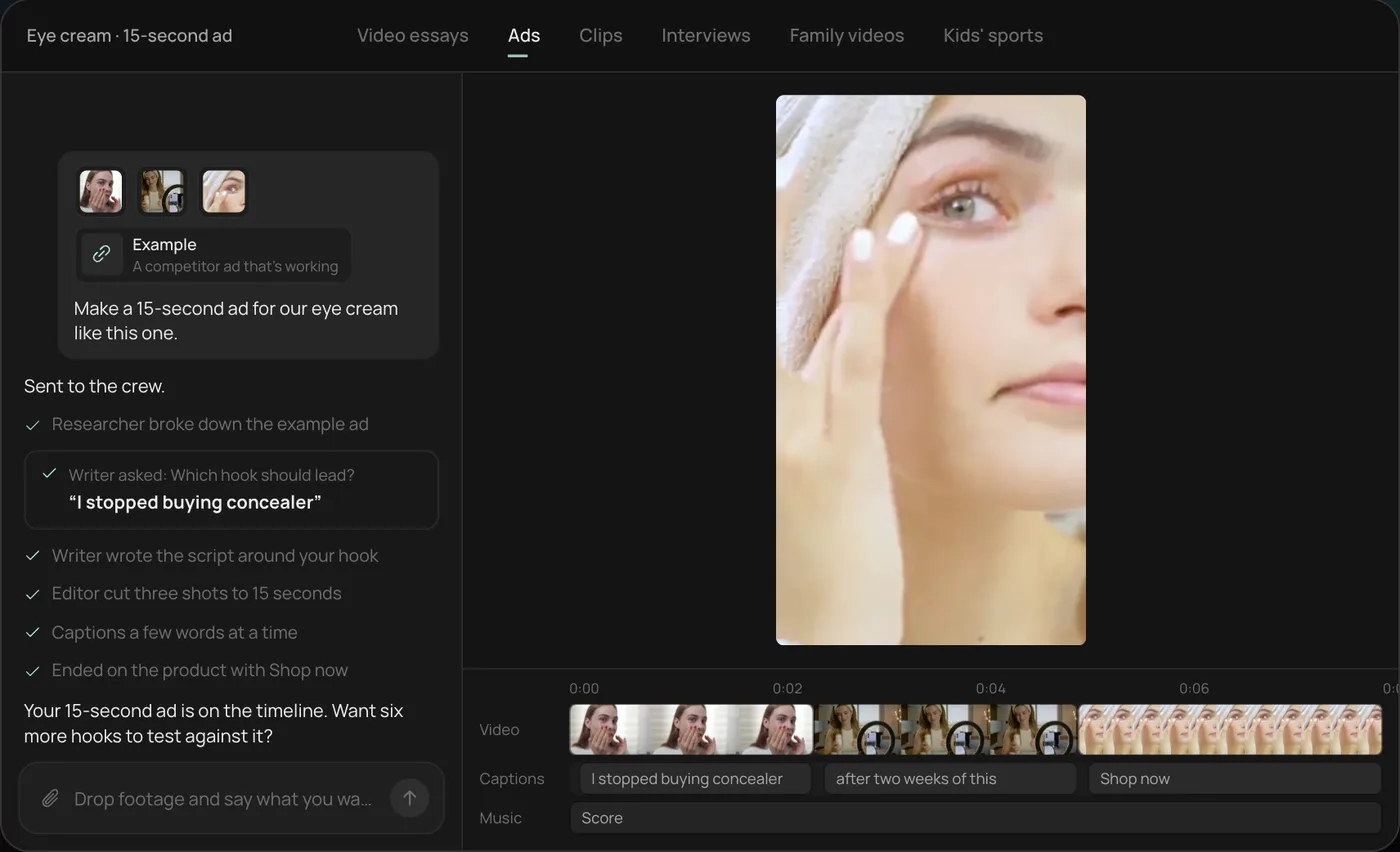
For one short clip, your phone's editor is faster. Rend helps most when you have long, messy pet footage and need a page video and an ad set from it. Editing is free and you pay only when Rend renders or generates something; see pricing.
FAQ
How do I get my pet to cooperate on camera?
Set up before the pet arrives, shoot at their eye level, use a helper with treats behind the camera, and roll continuously for the first five minutes when the product is new to them.
How long should a pet product video be?
15 to 20 seconds for ads and TikTok Shop, 20 to 30 seconds for a product page. Open on the pet using the product.
Can I say my flea and tick product is safe for pets?
No. EPA rules treat "safe," "nontoxic to humans and pets" and similar claims as misleading for pesticides, even with "when used as directed." Use the registered label's wording.
Can a pet treat claim to help joints or anxiety?
Claims to treat, prevent or mitigate a disease, or to affect the body beyond normal food purposes, can make it a new animal drug in FDA's view. TikTok Shop prohibits pet products that make disease or health-condition claims.
Should I use AI-generated pets in my video?
For an illustration or a scene you can't shoot, maybe. But fit and durability need a real animal and the real product, and TikTok Shop requires content to match the actual product.
If you have a camera roll full of pet footage, start a free Rend project and ask for a product page cut and three vertical ads with size captions.