Skincare Product Video: Shot List, Claims and Platform Rules
A skincare product video should show four things a photo can't: the texture coming out of the pack, how much to use, how it goes on and sinks in, and what skin looks like right after (not six weeks later). Film it on real skin under one soft light with no beauty filter, then check every caption against two lines: the FDA's line between a cosmetic and a drug, and each platform's rules on before-and-after shots. Most skincare videos that get rejected fail on words and edits, not on lighting.
Below: the 8-shot list, a phone setup that shows texture honestly, a say-this-not-that table, and the platform rules that apply to skincare specifically. For general product filming, start with making a product video with your phone.
Why skincare is its own problem
Buyers can't touch a serum through a screen, so the video has to do the touching for them. Is it runny or thick? Does it pill? Does it leave a white cast? Does a pump give enough for a whole face? Those are the questions in skincare reviews, and every one of them is answerable on camera in under three seconds.
The second problem is the result. The thing people want to see (clearer, smoother, younger skin) is the thing regulators and platforms watch most closely. The FDA decides whether your product is a cosmetic or a drug partly from what you say in advertising, and TikTok and Meta both restrict before-and-after visuals for skincare. So a skincare video earns trust with texture and routine, and stays careful with outcome.
The phone setup
- One large soft light: a window with indirect daylight, or a window covered with baking parchment. Face the model toward it at about 45 degrees.
- A white card or foam board on the shadow side to fill.
- No ring light for texture shots. It puts a donut reflection in glossy gels and makes every cream look wet.
- A matte, neutral background. A colored wall tints skin and changes how a tinted product reads.
- Lock focus and exposure (press and hold on iPhone until AE/AF Lock shows; Pro mode on Android). Otherwise exposure jumps every time a hand passes the lens.
- Turn off beauty mode and any face smoothing in the camera app. Some phones have it on by default in the front camera.
For texture close-ups, shoot on the 2x or 3x lens from a little farther back instead of pressing the main lens into the product. You get less distortion and fewer reflections of the phone.
The 8-shot skincare list
Hold each shot 5 to 8 seconds and take every one twice. One 45-minute session covers a product page video, a TikTok Shop video and three or four ads.
| # | Shot | What it proves | How to film it |
|---|---|---|---|
| 1 | Pack hero | What it is and the exact variant | Front label readable, slow push in, 3 seconds minimum |
| 2 | Dispense | Texture and pump or dropper behavior | One pump onto a fingertip or the back of a hand, macro, side light |
| 3 | Texture pull | Thickness | Spread between thumb and finger, pull apart slowly |
| 4 | Dose | How much to use | "Two drops for the whole face" with the two drops visible |
| 5 | Application | Feel and absorption | On the face or the back of the hand, real speed, no cuts |
| 6 | Finish | Cast, shine, pilling | Close-up 30 to 60 seconds after application, same light |
| 7 | Routine slot | Where it goes in the routine | After cleanser, before moisturizer, products in order on the counter |
| 8 | Label back | Ingredients and size | Ingredient list and net contents, steady, long enough to pause |
Shots 4 and 6 are the two that most brand videos skip and buyers ask about in reviews. Shot 6 is also the honest version of a "result": it shows what the skin looks like now, not what it might look like in a month.
Shots by product type
| Product | Add this | Skip this |
|---|---|---|
| Sunscreen | Rub-in on darker skin to show cast (or no cast); shot of SPF and broad spectrum line on the pack | Any "all day protection" line that the Drug Facts panel doesn't support |
| Serum | Dropper count, drip speed on a tilted glass slide | Slow-motion drips that make it look thicker than it is |
| Moisturizer | Spatula scoop, finger swipe across the surface of the jar | Whipped "ASMR" texture shots of a different batch |
| Cleanser | Lather on wet hands, rinse in one take | Foam you added with a separate frother |
| Eye cream | Dot-and-tap application, close-up of the finish under the eye | Side-by-side of under-eyes "before and after" |
What your captions can say
The FDA's page on whether a product is a cosmetic, a drug or both says intended use is established by "claims stated on the product labeling, in advertising, on the Internet, or in other promotional materials," and by consumer perception and ingredients. A voiceover is advertising. So is a caption, so is a pinned comment.
The FDA's own examples: claims to "increase or decrease the production of melanin (pigment) in the skin" are drug claims; moisturizers and makeup "marketed with sun-protection claims are cosmetic/drug products"; cleansers intended to treat acne are drugs or both; claims to "regenerate cells" are drug-type claims. The page is explicit that claims alone can make a product a drug even when it's marketed as a cosmetic.
| Instead of | Say | Why |
|---|---|---|
| "Clears acne" | "Lightweight gel cleanser, rinses clean" | Treating acne is a drug claim unless the product is an acne drug with a Drug Facts panel |
| "Repairs damaged skin" | "Skin feels smoother after use" | Repair and regenerate read as changes to the body's structure |
| "Fades dark spots for good" | "Brightening serum" (if the pack says so) | Changing melanin production is a drug claim |
| "Protects all day" | The exact SPF line from the Drug Facts panel | Sun protection makes it a drug; your claim has to match the label |
| "Anti-inflammatory" | "Calming, cooling feel" | Inflammation is a medical condition |
| "Dermatologist approved" | "Dermatologist tested" only if a dermatologist tested it and you have the report | Approval implies an endorsement you'd need to prove |
| "Works for everyone" | "My skin is dry and sensitive; this didn't sting" | Absolutes are banned in TikTok ads and unprovable anyway |
This is a summary, not legal advice. If your product sits near the line (retinoids, acids sold "for acne", anything with SPF), read the FDA page in full and get your label language checked before you write captions around it.
Platform rules that hit skincare
These come from each platform's policy pages, read November 22, 2026.
TikTok Shop
The Guidelines for Responsible Beauty and Skincare-Related Content (updated June 30, 2026) tell creators to avoid beauty filters "that exaggerate product effects," to "apply the product visibly to your face or body" or show it in its packaging, to keep claims "consistent with what is shown on the product listing page," and to add a line such as "Results may vary depending on your skin sensitivity" when a video shows before-and-after or results. The Fall 2026 creator content guide adds that before-and-after results must be "realistic, unedited, and supported by a clear timeframe," and anti-aging or wrinkle claims need official product information behind them. To sell at all, the Beauty and Personal Care requirements may ask for FDA registration proof, the cosmetic label and a Drug Facts label for OTC products; products that "bleach, whiten, lighten, or reduce overall melanin in the skin" are prohibited, while brightening and dark spot claims are permitted.
TikTok ads
The misleading and false content policy lists "showing wrinkles disappearing by using a cream through before-and-after comparisons" as not allowed, along with "Number 1 essence on TikTok." Before-and-after footage that a TikTok Shop video might carry with a disclaimer can still be rejected as a paid ad.
Meta ads
The Health and Wellness policy says cosmetic product ads must target people 18 or older, must not "imply or attempt to generate negative self-perception," and, for anti-aging, can zoom in on skin areas but "should not include side-by-side comparisons."
The practical rule across all three: build the main video without a before-and-after. If you have a real, unfiltered, dated before-and-after, use it in organic content with a timeframe and a "results vary" line, and keep it out of the ad set.
UGC and gifted product
Most skincare video now comes from creators. The FTC's Disclosures 101 for Social Media Influencers says free product counts as a material connection and the disclosure "should be in the video and not just in the description," ideally in audio and on screen. Put that in your creator brief along with your claims list, because their caption is your ad once you run it. Our UGC ad script templates have a skincare structure you can hand to a creator.
A 20-second skincare video, beat by beat
For a hydrating gel moisturizer, 9:16, sound on with captions:
| Time | Shot | Caption or voice |
|---|---|---|
| 0 to 2 s | Texture pull (shot 3) | "It's a gel, not a cream." |
| 2 to 5 s | Dispense on fingertip (shot 2) | "One pump does my whole face." |
| 5 to 10 s | Application, real speed (shot 5) | "Sinks in before I finish." |
| 10 to 14 s | Finish close-up, no filter (shot 6) | "No shine, no pilling under SPF." |
| 14 to 17 s | Routine slot (shot 7) | "After serum, before sunscreen." |
| 17 to 20 s | Pack hero (shot 1) | Product name and size |
Every line describes feel or use. None promises a change in the skin. That script passes the FDA line and all three platforms and still answers what buyers ask.
Editing the shoot
From one session you can cut a 20 to 30 second product page video, a 15 to 25 second TikTok Shop video and three 9:16 ads with different openings (texture pull, dose, finish). Keep white balance identical across clips: a product that shifts from cream to yellow between shots looks like two products. Grade color, never smooth skin. On Shopify, the Shopify product video guide covers placement; for TikTok Shop formats see TikTok Shop videos.
Rend handles the edit. Send the clips from your phone in chat, by email or a web form, plus a competitor ad that's working, and say "a 15-second ad for our eye cream like this one, three hooks." Rend breaks down the example, asks which hook should lead, and cuts on a real timeline you can open and change, with word-timed captions in your font. Every caption stays editable text, so swapping "clears breakouts" for "rinses clean" takes seconds. It then spins new hooks and sizes from the same footage for testing.
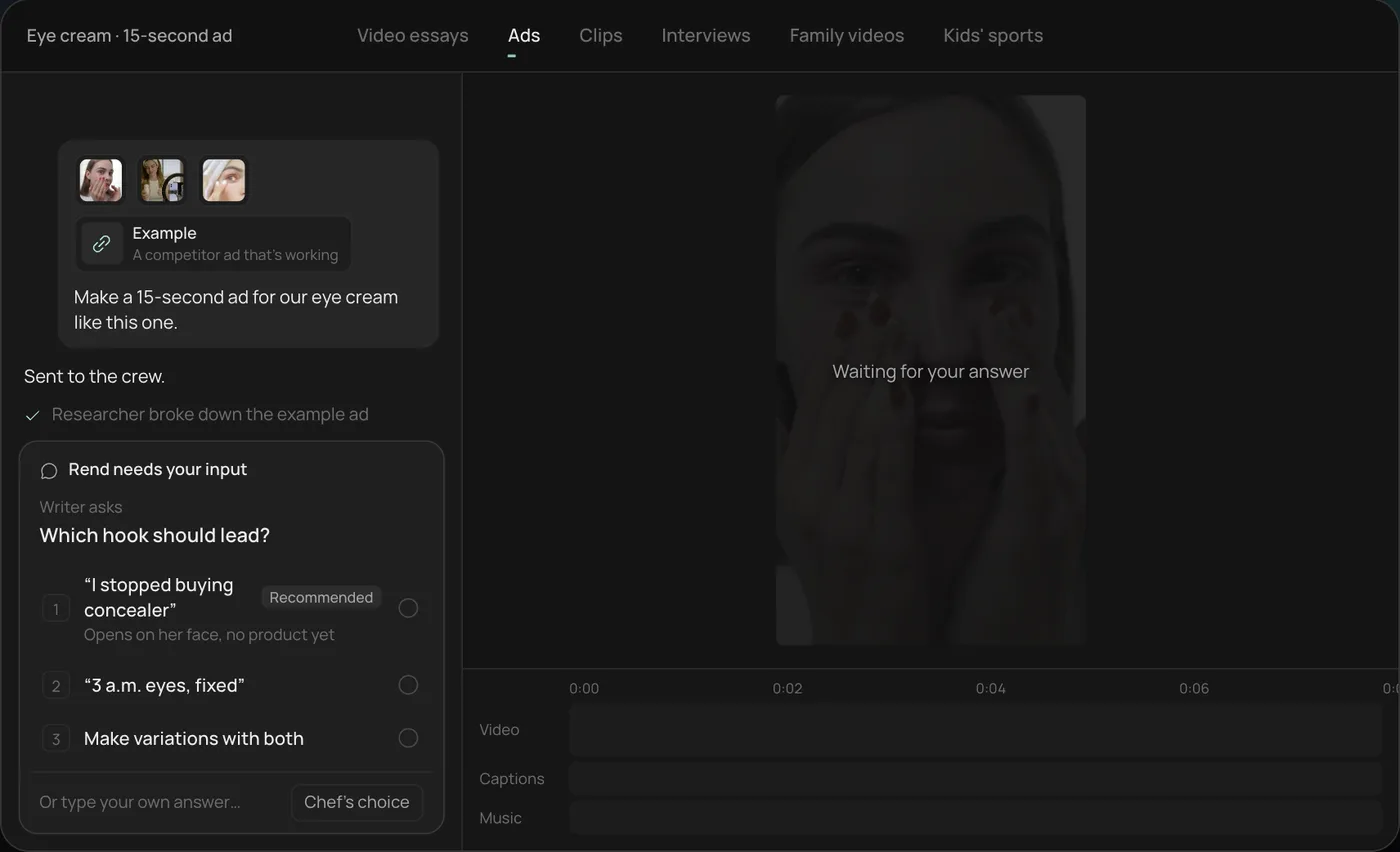
If you have one clip to trim, your phone's editor is faster. Rend is worth it when you need a page video, a Shop video and an ad set from one shoot. Editing is free and you pay only when Rend renders or generates something; see pricing. For running many versions, see how to make 100 ad variations from one video.
FAQ
How long should a skincare product video be?
For a product page, 20 to 30 seconds covers texture, dose, application and finish. For TikTok Shop and Reels, 15 to 25 seconds with the texture or application shot first.
Can I show before-and-after results in a skincare video?
In organic TikTok Shop content, only if the footage is real, unfiltered and has a timeframe and a "results vary" line. TikTok ads don't allow before-and-afters that distort results, and Meta says anti-aging ads should not use side-by-side comparisons. Keep them out of paid ads.
What makes a skincare claim a drug claim?
The FDA looks at intended use, which comes from your claims in labeling and advertising, consumer perception and ingredients. Treating acne, changing melanin, sun protection, and "regenerating" or repairing skin all read as drug claims.
Do I need a person in the video?
On TikTok Shop, the content guide asks for the product applied visibly on face or body or shown in its packaging. Hands on the back of a hand count. A face helps for finish and absorption shots.
Should I use a beauty filter?
No. TikTok Shop's beauty guidelines tell creators to avoid filters that exaggerate effects, and a smoothed face makes the texture and finish shots meaningless.
If you have skincare clips sitting in your camera roll, start a free Rend project, send them, and ask for a product page cut and three vertical ads with different hooks.