Supplement Product Video: Shot List and the FDA and FTC Rules
A supplement product video should show the routine, not the result: the label, the serving (a scoop, two capsules, a gummy), how it's taken, what it tastes or mixes like, and when in the day it fits. Every spoken or written benefit has to be a structure/function claim you can back with evidence, and if you make one, the FDA disclaimer goes on screen. Disease words ("helps with diabetes", "fights anxiety", "boosts immunity against colds") turn a supplement into an unapproved drug and get videos pulled from TikTok Shop.
That changes how you shoot. Below is a routine-first shot list, the claim lines that matter, the exact disclaimer text, and what TikTok, Meta and the FTC add on top. For general product filming, see making a product video with your phone.
Why supplement videos fail
Most supplement videos are made around the outcome: more energy, better sleep, a flatter stomach, clearer skin. That's the part you have the least right to show. You can't film a mechanism, you can't promise a body change, and the FTC expects human clinical evidence for health benefits.
What you can film is everything around the outcome, and that's what buyers check anyway. How big are the capsules? Does the powder clump? How sweet is the gummy? Is it one scoop or three? Does the label list a dose that matches the claim on the front? A video that answers those reads as trustworthy because it doesn't oversell.
The rules in plain language
FDA: structure/function, not disease
The FDA's structure/function claims page says a supplement may describe how a nutrient or ingredient affects normal structure or function of the body, but it can't claim to diagnose, treat, cure or prevent a disease. The manufacturer must have substantiation and must notify the FDA within 30 days of marketing a claim. The FDA doesn't pre-approve these claims.
21 CFR 101.93 sets the disclaimer text. For one claim: "This statement has not been evaluated by the Food and Drug Administration. This product is not intended to diagnose, treat, cure, or prevent any disease." For more than one, it starts "These statements have not been evaluated." On the label it must sit next to the claim or be linked by a symbol such as an asterisk, in bold, at least 1/16 inch high. The same section lists what counts as a disease claim, and it's broad: naming a disease, naming "characteristic signs or symptoms" of one, implying it through the product name or "pictures and symbols," or suggesting the product substitutes for or augments a drug.
Pictures count. A shot of someone clutching their chest, a blood glucose meter next to the bottle, or an X-ray of a joint can make a disease claim without a word being said.
FTC: evidence, and the disclaimer doesn't cure anything
The FTC's Health Products Compliance Guidance replaced its 1998 supplement advertising guide. It says health benefits generally need "randomized, controlled human clinical testing" to meet the "competent and reliable scientific evidence" standard. It treats testimonials and before-and-after images as claims the advertiser must substantiate, and says "Testimonials that report results more dramatic than users can generally expect are likely to be deceptive," with "Results not typical" not curing it. For video, if a claim is made visually and audibly, the disclosure should be too.
It also says the FDA's structure/function framework doesn't decide how the FTC reads your ad: a normal-function claim can still imply a disease benefit that you'd have to prove.
Say this, not that
| Instead of | Say (if you have the evidence) | Why |
|---|---|---|
| "Lowers blood sugar" | A normal-function statement your evidence supports, with the disclaimer | Blood sugar control is disease framing; TikTok names diabetes as an example |
| "Fights colds" | "Vitamin C, 500 mg per serving" | Preventing infection is a disease claim |
| "Natural anxiety relief" | "Part of my wind-down routine" (said by the user, true for them) | Anxiety is a medical condition; TikTok Shop prohibits mental wellness supplements anyway |
| "Melts belly fat" | Don't make a weight claim | Weight management supplements are prohibited on TikTok Shop and restricted on TikTok and Meta ads |
| "Clinically proven" | "In a 12-week study of [n] adults, [result]" with the study on your site | "Clinically proven" needs a real clinical trial on this formula |
| "Natural Ozempic" | Nothing | TikTok Shop names this phrase as not allowed |
| "Doctor recommended" | Only with a real, disclosed doctor and their actual words | Implied endorsement you'd have to prove |
This is a summary, not legal advice. Supplements are a category where a lawyer who knows FDA and FTC rules is worth paying once, before you build a year of creative on a claim.
Platform rules
From each platform's own pages, read November 22, 2026.
TikTok Shop
Dietary supplements are invite-only. The Dietary Supplements Requirements (updated October 9, 2026) ask for a lab test report from an approved lab issued within the last 180 days, and unedited photos of the physical packaging front, back and Supplement Facts panel ("digital mockups ... are not accepted"). Prohibited outright: weight management products including fat burners and meal replacements, mental wellness supplements, CBD, peptides and GLP-1 agonists, among others. Listings may not say a product is FDA approved, and structure/function claims need the FDA disclaimer.
For the video itself, TikTok's Health and Wellness Content Best Practices say "talk about the product, not the condition." Do describe taste, texture, ingredients and how it fits a routine. Don't "promise a specific body change," mention diseases or symptoms to sell, compare a product to prescription medicine, or use "before-and-after content that shows body-size reduction." Its creator guide also bans "AI/Cartoon doctor or experts."
TikTok and Meta ads
TikTok's weight management ad policy restricts weight loss or muscle gain claims to 18+ audiences and bans claims that the product alone, without diet or exercise, causes weight change. Meta's Health and Wellness policy requires dietary and health product ads to target people 18 or older and bans ads that "imply or attempt to generate negative self-perception."
The routine-first shot list
Shoot each shot 5 to 8 seconds, twice. Soft window light, a clean counter, the actual product.
| # | Shot | What it proves | Notes |
|---|---|---|---|
| 1 | Pack hero | Brand, variant, count | Front label readable, 3 seconds minimum |
| 2 | Supplement Facts panel | Dose per serving | Steady, sharp, long enough to pause on; match any number you say |
| 3 | Serving out | Size and form | Two capsules in a palm next to a coin, one scoop leveled, one gummy |
| 4 | Mix or take | Solubility, effort | Powder into water, shake, hold to the light for clumps; capsule with a glass of water |
| 5 | Taste moment | Flavor | Real first sip, real reaction, no cut to a different take |
| 6 | Routine slot | When it fits | Next to the coffee maker, in a gym bag, by the bed |
| 7 | Travel or storage | Convenience | Pouch in a bag, bottle in a drawer, stick pack in a pocket |
| 8 | Third-party test seal or report | Trust | Only if the seal is real and on the pack; show the report on your site |
What's missing on purpose: no body shots, no bathroom scale, no lab-coat actor, no animated organs, no graph of a biomarker. Shot 2 replaces all of them. A buyer who can read "Magnesium glycinate, 200 mg" doesn't need a cartoon of a brain.
Where the disclaimer goes in a video
101.93 was written for labels, but if your video makes a structure/function claim, the simplest consistent practice is to carry the full disclaimer as an on-screen caption for the whole time the claim is visible or spoken, and on the product page beside the video. Mark the claim with an asterisk if the disclaimer sits at the bottom. Keep it readable on a phone: the video ad sizes guide covers safe zones, and the size and safe zone checker shows where a caption gets covered by buttons.
A 20-second supplement video, beat by beat
For an unflavored creatine powder, 9:16, captions on:
| Time | Shot | Caption or voice |
|---|---|---|
| 0 to 2 s | Scoop leveled over the tub (shot 3) | "One 5 g scoop. That's the whole routine." |
| 2 to 6 s | Into water, stir, hold to light (shot 4) | "Dissolves in about ten seconds. No grit." |
| 6 to 9 s | First sip, honest face (shot 5) | "Tastes like water. Which is the point." |
| 9 to 13 s | Supplement Facts panel (shot 2) | "Creatine monohydrate. One ingredient." |
| 13 to 17 s | Tub in a gym bag (shot 7) | "90 servings in one tub." |
| 17 to 20 s | Pack hero (shot 1) | Product name |
No strength promise, no body shot. If you want a benefit line, it needs evidence for your formula and dose, and the disclaimer on screen while it shows.
Working with creators
Creator videos are where supplement claims go wrong, because a happy customer says "this cured my migraines" and you run it as an ad. Under the FTC guidance, that becomes your claim. Give every creator a written list of approved lines and banned words, and have them say what the product is and how they use it. The FTC's Disclosures 101 for Social Media Influencers wants the paid or gifted disclosure in the video itself, in audio and on screen. More on structure in UGC ad script templates, and on using real customer reviews safely in customer review video ads.
Editing it into a set
One session gives you a 30-second product page video (all eight shots), a 15 to 20 second TikTok Shop video and three ads that open on different shots: the scoop, the dissolve, the taste. Test openings, not claims; the claims should be the same approved lines in every version. For Amazon listings, see the Amazon product video guide.
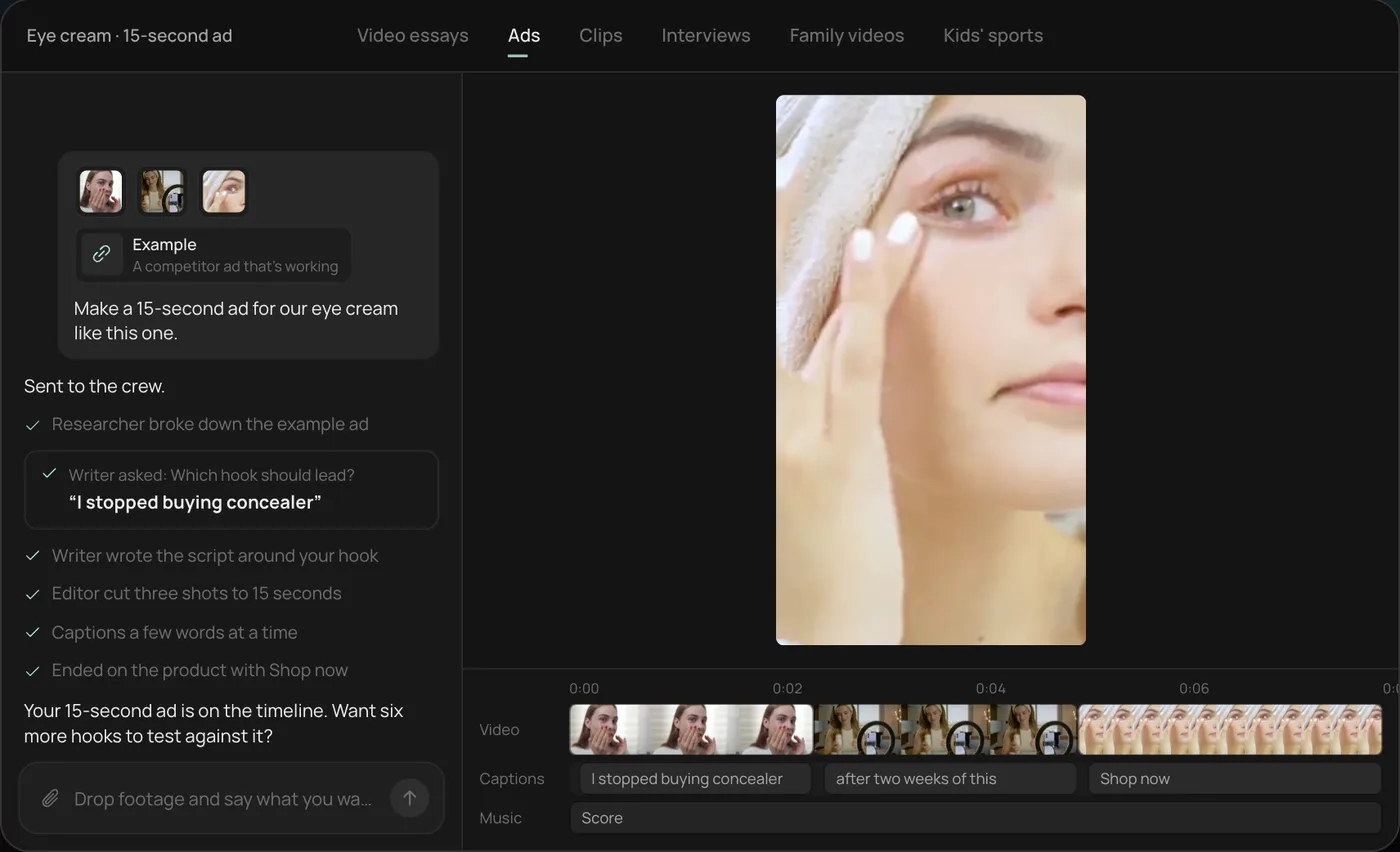
Rend does the editing and the versioning. Send the clips in chat, by email or a web form, with your approved claims list, and ask for "a 20-second TikTok Shop video and three 9:16 ads, disclaimer on screen whenever a benefit line shows." Rend cuts them on a real timeline you can open and change. Captions are word-timed and always editable, so when legal changes "supports" to "contributes to," you change the word and every version follows. A brand kit keeps your caption style, disclaimer placement and music bed the same across every video. When a reviewer flags a line on the share link, the agent reads the note and makes the fix.
Rend won't decide what your evidence supports; that's yours and your lawyer's. Editing is free and you pay only when Rend renders or generates something; see pricing.
FAQ
What is the FDA disclaimer for supplement claims?
"This statement has not been evaluated by the Food and Drug Administration. This product is not intended to diagnose, treat, cure, or prevent any disease." Use the plural "These statements" version for more than one claim. It's set out in 21 CFR 101.93.
Can I sell supplements on TikTok Shop?
Only by invitation, and only with an approved lab report from the last 180 days and unedited packaging photos. Weight management, mental wellness, CBD and several other supplement types are prohibited.
Can I show before-and-after photos in a supplement video?
TikTok Shop's guidance says not to show body-size reduction before-and-afters, and the FTC treats before-and-after images as claims you must substantiate for typical users. For supplements, leave them out.
What's the difference between a structure/function claim and a disease claim?
A structure/function claim describes an effect on the normal structure or function of the body. A disease claim says or implies the product affects a disease or its characteristic signs or symptoms. 21 CFR 101.93 also counts product names, pictures and symbols that imply a disease.
Does a creator's testimonial count as my claim?
Yes, once you use it in your marketing. The FTC says an honest opinion isn't enough if it reports results most users won't get.
If you have supplement footage and a claims list, start a free Rend project and ask for a product page cut and three vertical ads built only from approved lines.