AI Song Ads: How Ecom Brands Make Jingle Video Ads That Convert
An AI song ad is a video ad where an AI-generated song sings the pitch: a short jingle that names the problem and the product, lyrics on screen, and product shots cut to the beat. To make one that converts, write the chorus first so the product name lands in the first 3 seconds, lock the song before you cut any picture, caption every sung line for people watching muted, and generate the track on a plan whose terms allow commercial use.
Below: a worked example (lyrics, timings, shot list), when a song beats a UGC read, and the Suno, Meta and TikTok music rules as their own pages state them today.
Two kinds of song ad, and why it matters
When a media buyer asks for "Suno creatives," they usually mean one of two very different ads.
The long story song. A cartoon character sings a first-person story for minutes, and the product shows up as a plot point. Ghostfeed counted 12 clearly AI-made sung ads from 6 brands in the Meta Ad Library on November 17, 2026, and its breakdown of those song ads found they ran from 1 minute 31 seconds to 11 minutes 3 seconds, with the brand first sung about 39% of the way through. That format has its own craft, covered in our guide to Pixar-style ads.
The jingle ad. 15 to 30 seconds, real product footage, the product name in the chorus, cuts on the beat. Most stores can make this one this week from a sample and a phone, and it's what this post covers.
A five-minute story can wait to name the product because the story is the hook. A 20-second jingle can't. If the first line doesn't say what the product fixes and what it's called, the viewer is gone before the chorus comes back.
The rule: the chorus is the hook
In a jingle ad the chorus is the hook, the pitch and the call to action, and it plays twice. Write it first, and make it pass three tests:
- It names the problem in words the buyer uses. "Fur on the couch," not "pet hair management."
- It names the product by the 3-second mark. Say the name out loud at the speed you'd sing it. If it doesn't fit in the first two bars, shorten the line, not the name.
- It holds one claim the product can back up. A sung claim is still a claim. The FTC's advertising FAQ for small businesses says advertising must be truthful and non-deceptive and that advertisers must have evidence to back up their claims. Rhyme doesn't change that.
Keep the lines short and the syllables even. Generated vocals slur long, crowded lines, and the brand name is the first word to go.
Worked example: a 20-second jingle ad
The product (invented for this example): FurLift, a reusable pet hair roller with a chamber you empty instead of sticky sheets you throw away. The buyer: someone with a dark couch and a light-colored dog.
The song is pop-punk at 120 BPM. At that tempo one beat is half a second and one bar is 2 seconds, which makes the maths for the cut easy: 20 seconds is 10 bars.
The lyrics
[Hook, 0:00 to 0:04]
Fur on the couch, fur on my jeans
FurLift rolls it clean

[Verse, 0:04 to 0:12]
Back and forth, watch the cushion change
No sticky sheets, no refill to replace
Pop the lid, dump the fur, go again
Car seat, blanket, dog bed, done by ten

[Hook, 0:12 to 0:16]
Fur on the couch, fur on my jeans
FurLift rolls it clean

[Tag, 0:16 to 0:20]
FurLift. Link below.
The only claims are that it lifts hair off fabric, it's reusable and you empty it. Those are things the demo shows on camera, which is the best kind of evidence an ad can carry.
The beat-cut shot list
| Time | Bar | Lyric | Shot | On-screen caption |
|---|---|---|---|---|
| 0:00 to 0:02 | 1 | "Fur on the couch, fur on my jeans" | Macro of white fur on a black cushion, hand slaps the cushion, fur flies | FUR ON THE COUCH. FUR ON MY JEANS. |
| 0:02 to 0:04 | 2 | "FurLift rolls it clean" | One stroke of the roller, clean stripe through the fur, product name readable | FURLIFT ROLLS IT CLEAN |
| 0:04 to 0:06 | 3 | "Back and forth, watch the cushion change" | Two strokes, cut on beat 3 between them | Back and forth |
| 0:06 to 0:08 | 4 | "No sticky sheets, no refill to replace" | Split: crumpled sticky sheets in a bin, then the roller | No sticky sheets. No refills. |
| 0:08 to 0:10 | 5 | "Pop the lid, dump the fur, go again" | Overhead: chamber opens, a fur clump drops into the bin | Pop. Dump. Again. |
| 0:10 to 0:12 | 6 | "Car seat, blanket, dog bed, done by ten" | Three quick cuts, one per beat: car seat, blanket, dog bed | Car seat. Blanket. Dog bed. |
| 0:12 to 0:14 | 7 | "Fur on the couch, fur on my jeans" | Dog jumps on the clean couch (the joke lands here) | FUR ON THE COUCH... |
| 0:14 to 0:16 | 8 | "FurLift rolls it clean" | One stroke down a pair of jeans, clean stripe | FURLIFT ROLLS IT CLEAN |
| 0:16 to 0:20 | 9 to 10 | "FurLift. Link below." | Pack shot, product on the clean cushion, hold through two bars | FurLift. Link below. |
Cut once a bar in the hook so the eye can read the name, then speed up in the verse, where the demo lives. Give the second chorus a new picture: the repeated words do the remembering, a repeated shot just looks lazy. And hold the pack shot for two full bars with nothing moving.
For more opening lines to test in bar 1, see our list of video ad hooks.
Captions for the sound-off scroll
A jingle only works on people with the sound on. Everyone else sees silent product footage, so the captions have to carry the ad on their own.
- Caption every sung line, timed to the word. Captions that drift off the vocal look broken with sound on and arrive late with sound off.
- Style the chorus differently. Bigger, capitals, product name in the brand color, so a muted viewer reads the problem and the name in the first 3 seconds.
- Keep captions inside the safe zone. The bottom of a Reel or TikTok is covered by the caption and buttons. Check the frame with the free video ad sizes and safe-zone checker, and try looks with the caption style previewer.
- Put the exact offer in text. A lyric shortens the offer to fit the rhythm. "20% off your first order, code FUR20" doesn't scan; put it on the end card and in the primary text.
More on getting caption timing right: how to add captions to a video.
When song ads beat UGC, and when they don't
Song ads are a format to test alongside creator content. Here's how they usually split.
| Situation | Song ad | UGC read |
|---|---|---|
| Visual problem, visual fix (fur, stains, clutter) | Strong: the demo fits the beat | Fine |
| Product needs explaining (ingredients, how it works) | Weak: specs don't rhyme | Strong |
| Cold audience, cheap product, impulse buy | Strong: memorable, fast | Good |
| Warm retargeting with an offer | Weak: you need the exact terms said clearly | Strong |
| Trust-heavy category (skincare results, health) | Risky: a sung promise reads as hype, and claims rules still apply | Strong: a real face and a real story |
| You need 10 variants by Friday | Song is fixed once locked; swap shots and captions, not lines | Each new line is a quick re-record |
| Account fatigued on talking heads | Strong: a different sound breaks the pattern | Weak |
The practical difference is editing. A voiceover line can be rewritten in a minute; a lyric change means a new song and a re-timed cut. Lock the lyrics before you generate, and vary shots, openings and captions instead.
If you don't have creators, our guide to UGC ads without creators covers the spoken side. For testing both formats against each other, see ad creative testing.
The rights side: read this before you spend
Most song ads that get pulled get pulled for the music. These are the rules as each company's own pages state them.
Suno: free plan vs paid plan
Suno's help article on paid subscriptions says songs downloaded while subscribed get commercial use rights. On the free tier, Suno's ownership FAQ says Suno keeps ownership of the songs and you may use them only for non-commercial purposes. An ad is commercial. Upgrading later doesn't fix it: Suno's article on rights for songs made before subscribing says a Pro or Premier plan does not give retroactive commercial rights to free-plan songs by default.
Three more details from Suno's Terms of Service (effective September 3, 2026) that catch people:
- You may commercially use only output you downloaded through an approved channel, within your plan's monthly download allowance. A screen recording of the player doesn't count.
- Remixes of another user's song are for personal, non-commercial use on every tier.
- Suno makes no promise that any copyright will exist in what you generate.
On Suno's pricing page today, the free plan lists no song downloads and no commercial rights. Pro is $10 a month ($8 a month billed yearly) with 20 song downloads a month; Premier is $30 a month ($24 billed yearly) with 60. If you make 30 test jingles a month on Pro, you'll hit the download cap before you hit the credit cap.
Who owns an AI jingle
The US Copyright Office's Part 2 report on AI and copyrightability concludes that generative AI output can be protected by copyright only where a human author has determined sufficient expressive elements, and that prompts alone don't get there. Human-written work that's perceptible in the output can be protected.
For a brand, that means the lyrics you wrote are the part you can most clearly call yours. The generated melody and vocal may not be protected at all, so a competitor could copy your tune. Your edge is speed and the next ten variants. (A summary of the Office's position, not legal advice.)
Never imitate a real artist or a known song
"Parody-style" should mean a style you describe in words (pop-punk, 120 BPM, shouty chorus), never a famous melody with new words. Meta's music guidelines say use of music for commercial or non-personal purposes is prohibited unless you have the appropriate licenses, and a new set of lyrics over someone else's melody is still their music.
The same goes for voices. TikTok's Music Terms tell users not to upload AI music with vocals made from a person's voice to create a false impression that it's their real voice, and not to use a person's likeness without permission. Suno's terms only allow a voice model of your own voice. Don't prompt for "sounds like" any singer.
Meta and TikTok music rules for ads
- Meta. Meta's help page on adding music to ads in Ads Manager says the music it offers for ads is royalty-free audio from the Meta Sound Collection. The Sound Collection terms allow commercial use only in content on Meta's own products, so that track can't follow your ad to TikTok. Trending songs from the in-app music picker are a separate case, and the music guidelines above apply to them.
- TikTok. TikTok's Commercial Music Library page says businesses can't use the general music library for commercial use and should use the Commercial Music Library for video ads, branded content and organic posts. TikTok's guide to using the library says business accounts see only Commercial Sounds when they add a sound.
- Your own jingle sidesteps both libraries: it's baked into the video file you upload. That only holds if you actually hold commercial rights to it, which brings you back to the plan you made it on.
Making song ads in Rend
Rend is an AI video agent: you say what you want, and a crew of specialist agents takes it from idea to export on a real, editable timeline you can open and change. For a jingle ad, you send the product page or a few product clips and say something like "20-second jingle ad, pop-punk, name the product in the first line, captions for sound-off, 9:16 and 4:5."
Rend writes the lyrics and script, makes an original song from those lyrics (no sound-alike voices or borrowed melodies) and cuts your shots to it, generating any missing shot from an approved shot list. Captions are word-timed and editable, music sits on its own track, and the sizes come out as a set. To move a cut half a beat, you drag it on the timeline.
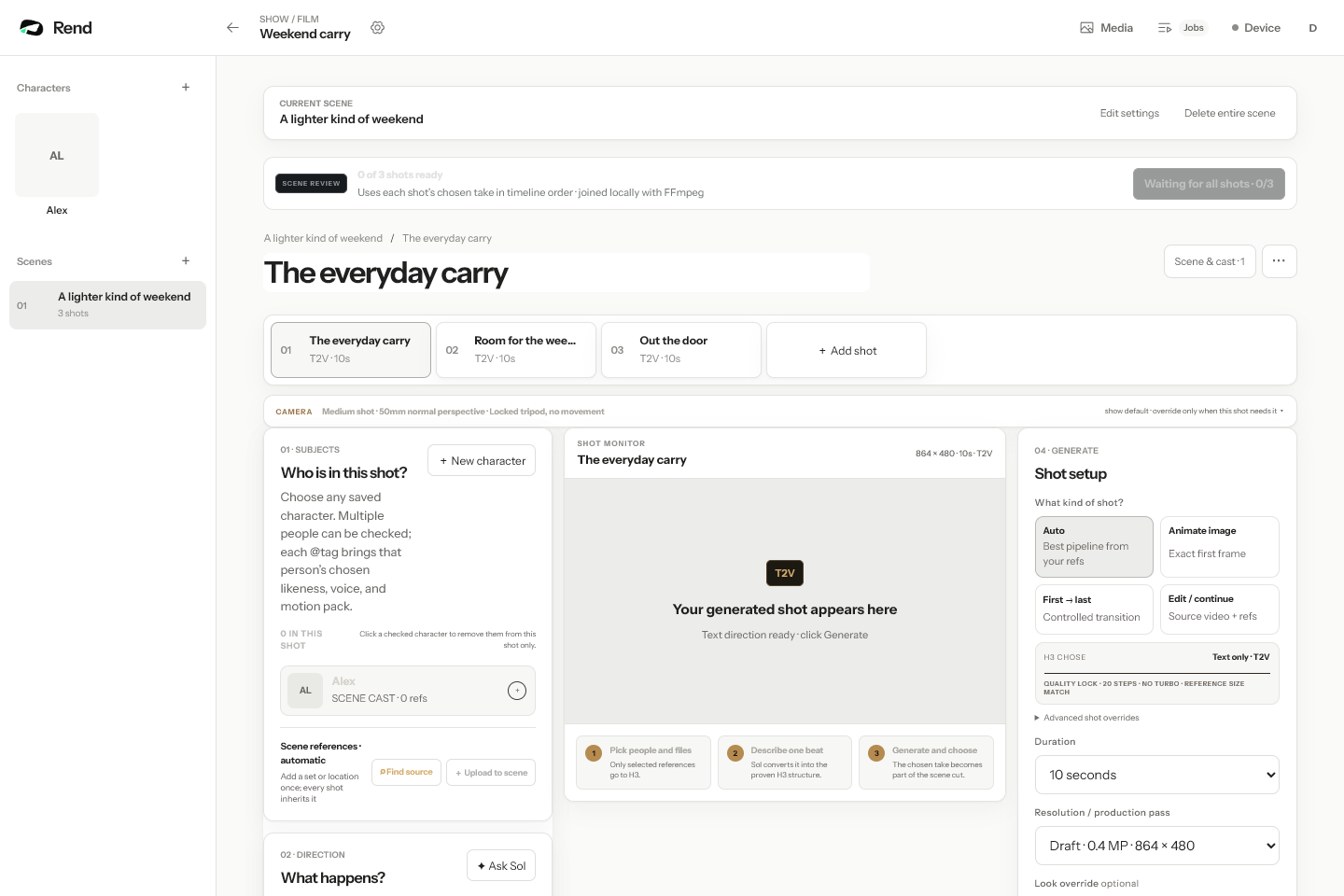
From one approved song, Rend spins new hooks and sizes for testing, and a review link lets your client circle the frame where the pack shot cuts too early. Editing is free, and you pay only when it renders or generates; see pricing and the full list of tools. More on how this fits a creative pipeline: ecommerce video ad creative agency, making 100 ad variations from one video and AI music for videos for instrumental scoring.
To be fair to the dedicated song-ad generators: if all you want is a long cartoon story song, a tool built only for that format will get you a first draft with fewer decisions. Rend fits better when the ad is built on your real product footage and you want to keep editing it.
FAQ
What are Suno ads?
Media-buyer shorthand for video ads built around an AI-generated song, often made in Suno: a jingle or story song about the product, lyrics on screen, shots cut to the music. The ad still needs footage, captions and an edit.
Can I use Suno songs in Facebook ads?
Only songs made and downloaded while on a paid Suno plan (Pro or Premier), per Suno's own help center and terms. Free-plan songs are for non-commercial use, and upgrading later doesn't add commercial rights to them by default.
How long should an AI song ad be?
For a product-footage jingle, 15 to 30 seconds, with the product named in the first 3 seconds and the chorus heard twice. Story-style song ads run much longer (Ghostfeed's count found 1:31 to 11:03), but they work on a different hook.
Can I make a parody of a famous song for my ad?
Don't. New lyrics over a known melody still use that song, and Meta's music guidelines prohibit commercial use of music without the appropriate licenses. Describe a genre and tempo instead, and avoid imitating any real singer's voice.
Are AI-generated songs copyrighted?
Per the US Copyright Office, AI output is protected only where a human determined enough of the expression; prompts alone aren't enough. Lyrics you wrote are the clearest part you own.
If you have a product and a chorus idea, start a free Rend project, send the product page and the lyrics, and get a first cut on a timeline you can change.