Video Ad Creatives for Ecom Brands: Agency, Freelancer or AI?
If you need a steady supply of video creatives for a Facebook ecom brand, hire a performance creative agency when you spend enough to pay a retainer (published tiers run $5,000 to $25,000 a month), use a UGC platform or freelancer when you need real people holding your product, and use an AI video agent for the volume work: new hooks, sizes and variations every week. Most brands that scale on Meta end up with two of these, because no single route is cheap, fast and human at once.
The question worth asking is who can ship enough new creatives each week to stay ahead of fatigue, at a cost per tested creative your margins can carry. A beautiful ad that arrives once a month loses to ten decent ones that arrive every Monday. This guide compares the four routes on that basis, with prices read on November 22, 2026, a brief template you can send to whoever you hire, and a weekly testing cadence.
We make Rend, one of the AI options, so we have tried to be specific about where it loses.
Why volume decides this
Meta says it plainly in its developer docs: creative fatigue rises as an audience sees the same creative repeatedly, and it usually shows up as a falling click-through rate and a rising cost per action. Every winning ad has a shelf life. The bigger your budget, the faster your audience burns through it.
So you are hiring a pipeline: a predictable number of new concepts and variations per week, each cheap enough that it is fine when most of them lose. Most ads fail and a few carry the account. Our guide to ad creative testing covers how to structure the tests.
Range matters too. Buyers asking for "Pixar creatives, UGC, etc." want several formats, because each reaches different people and wears out at its own pace.
The four routes compared
| Creative agency | Freelancer or UGC platform | In-house editor | AI video agent (Rend) | |
|---|---|---|---|---|
| Realistic volume per week | About 5 to 20 assets (published monthly tiers divided by four) | Scales with how many creators you order | Set by footage and hours | Many hooks, sizes and variations from one source video |
| Cost per creative | Roughly $200 to $300 an asset at published tiers | From $99 a video on Billo; Fiverr varies by creator | Salary divided by output | Editing free; you pay for renders and generated shots |
| Turnaround | 24 hours to a week | Days to weeks (product has to ship) | Same day to a few days | In the same chat, no brief-and-wait cycle |
| UGC with real people | Yes, through their creator network | Yes, the main strength | Only if you film people | Edits real UGC you have; generated people need a reference image |
| 3D and "Pixar-style" animation | Some, usually at a premium | Specialist animators only | Rarely | Generated shots and real 3D graphics |
| AI song ads | Some | Specialist freelancers | Rarely | Original music on its own track |
| Product demos and statics | Yes | Statics from designers; demos need product | Yes | Yes, from your product page and clips |
| Who owns iteration | Agency strategist, on their schedule | You, one revision round at a time | You and the editor | You, in chat or on the timeline |
| Typical failure mode | Slow monthly batches, few true new concepts | Creator quality varies, briefs get ignored | Bottleneck when they are sick or busy | Generic output if you send nothing specific |
The agency per-asset figure comes from dividing Darkroom's published tiers: boutique agencies at $5,000 to $10,000 a month for 20 to 40 assets, full-stack agencies at $10,000 to $25,000 for 40 to 80 or more. Those counts mix statics and video, so the cost of a finished video ad is higher than the average.
Route 1: a performance creative agency
A good agency gives you a strategist, a creator network, editors and a testing plan on one invoice. Someone reads your ad account and tells you which angle to try next. At six figures a month on Meta, that judgment is worth more than the edits.
Darkroom's guide puts turnaround at 3 to 5 days for boutique shops and 24 to 48 hours for full-stack ones, and says a freelancer or boutique is enough under $20,000 a month in ad spend.
Where agencies win: real people on camera at scale, physical product handling, and strategy from people who see many accounts. If your product needs to be poured, applied to skin or assembled on camera, humans with the product in hand still beat anything generated.
Where they break: you pay for a fixed monthly count whether or not the ideas land, and "variations" often means the same video with a new first line of text. Ask any agency how many net-new concepts (new angle, new script, new footage) are in the retainer, separately from iterations.
Route 2: a freelancer or UGC platform
This is what most people in ecom groups mean by "a freelancer." You can hire an editor or a UGC creator directly on Fiverr or Upwork, or go through a managed marketplace.
Published prices we read today:
- Billo sells prepaid packs: $1,000 covers up to 10 videos, $2,500 (plus a $300 bonus) up to 28, and $5,000 (plus $700) up to 57. Their own pricing guide says videos start at $99 each, with length, creator tier, hooks and variations adding to it.
- Insense charges a platform fee before any creator is paid: the Brand plan is $500 a month billed quarterly ($1,500) or $400 a month billed yearly, plus a 10% marketplace fee on each creator payment. Creator payments are separate.
- On Fiverr, UGC video gig prices vary by creator and package, and many packages limit how long you may run the video as an ad. Read the usage rights before you order, not after the ad wins.
Darkroom puts a freelancer retainer at $2,000 to $5,000 a month for 10 to 20 assets, with 5 to 7 day turnaround.
Where this route wins: real faces and real hands for under $200 a video. For trust-driven categories like skincare, supplements and apparel, a believable person on camera is hard to replace. Our roundup of the best UGC ad tools compares the marketplaces in more detail.
Where it breaks: each creator is a separate project. You brief, ship product, wait, review and request a revision, and the creator who nailed round one is booked for round two. One raw creator video is also one ad; turning it into five hooks and three sizes is a separate editing job unless you pay for add-ons.
Route 3: an in-house editor
A full-time editor who knows your brand is the fastest human route. They can turn a new hook around before lunch and remember what failed last quarter.
The catch is that an editor edits. They still need raw footage coming in and someone deciding what to test, and they become the bottleneck the week they are on holiday. Hire one once you already have a footage pipeline (creators, customers, the founder) and the work is mostly cutting variants.
Route 4: an AI video agent
An AI video agent does the editing and generation work itself from what you send it. With Rend, you give it one video, your product page and your brand, and it makes new hooks, sizes, UGC-style ads, product videos and image ads. It researches (including competitors' Meta ads), writes the scripts and hooks, generates b-roll and shots that are missing, adds word-timed captions and original music, and checks its own cut before export.
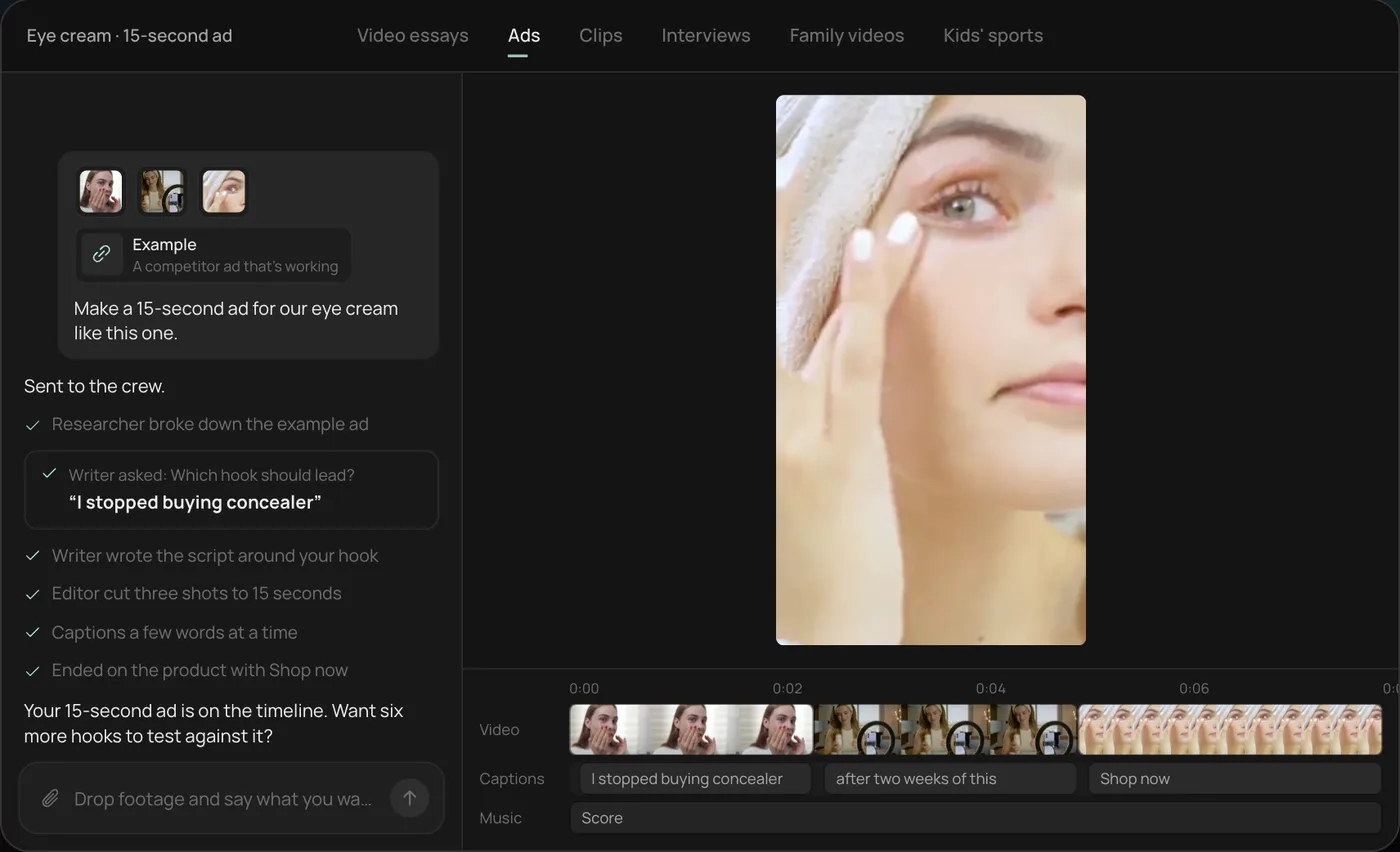
You get back an editable timeline with every cut, caption and sound on its own track. Change anything by hand, or leave a note on a review link and the agent makes the fix. Your brand kit (caption style, voice, music bed, templates) carries into every ad.
For format range: Rend can make 3D graphics and generated shots for the animated character ads people call "Pixar-style" (see our guide to Pixar-style ads), and original music for jingle and song ads (see AI song ads).
The limits: Rend does not put a real-looking person into a generated shot without a reference image of that person, so a face-to-camera testimonial needs real footage or a reference image you have rights to. It cannot hold your product in a real kitchen. And it works best from something specific, like a video that already sold or real reviews; send nothing and you get generic ads.
The useful combination for most brands: buy a small number of real creator videos, then use the agent to turn each one into a full test set. Our guide to mass ad creation shows how one video becomes a hundred variations, and UGC ads without creators covers getting the look when you have no creator footage at all.
Which route to pick
| Your situation | Best route |
|---|---|
| Under $10k a month on Meta, founder-led, no footage pipeline | AI video agent, plus a few founder or customer clips |
| Need real faces for a trust-heavy product | UGC platform for source videos, AI agent for variants |
| $20k to $100k a month, no one on your team doing strategy | Boutique performance creative agency |
| $100k or more a month, many SKUs and markets | Full-stack agency, with an in-house editor or agent for fast iterations |
| Product must be demonstrated by hand (apply, pour, assemble) | Real creators or your own shoot; AI for the edit and cutdowns |
| You already have lots of raw footage | In-house editor or AI agent |
The brief you send to whoever you hire
Most bad creatives come from bad briefs. This works for an agency, a Fiverr creator or an AI agent. Copy it and fill in the brackets.
PRODUCT: [name, link to product page, price, offer running now]
WHO BUYS IT: [one sentence: who, what problem, what they tried before]
WHAT'S WORKING: [link or file of your current best ad, and its key metric]
WHAT FAILED: [1-2 ads or angles that flopped, so nobody repeats them]
ANGLE FOR THIS BATCH: [one angle, e.g. "cheaper than a salon visit"]
HOOKS TO TEST: [3-5 first lines, or "write 10 and pick 5"]
FORMAT: [UGC talking head / product demo / 3D character / song ad / static]
LENGTH AND SIZES: [e.g. 15s and 30s; 9:16, 4:5, 1:1]
MUST SHOW: [product in hand by second 3, the result, the offer]
MUST NOT SAY: [claims legal won't allow, competitor names]
BRAND: [fonts, colors, caption style, music feel, logo files]
DELIVERABLES: [e.g. 3 concepts x 3 hooks x 2 sizes = 18 files]
RIGHTS: [paid usage, duration, whitelisting/partnership ads]
DUE: [date, and when you will send feedback]
The two lines people skip matter most. "What failed" stops you paying for the same losing angle twice. "Deliverables" written as concepts times hooks times sizes stops a supplier calling one video with three text overlays "nine creatives." Check finished sizes against Meta's placements with our free video ad sizes tool. For a longer version, see our video ad brief template.
A weekly testing cadence
A simple rhythm for a brand spending a few thousand to a few tens of thousands a month on Meta:
- Monday: launch 2 or 3 net-new concepts (new angle, new script or new format), each with 3 hooks.
- Wednesday: read early signals, mainly hook rate and click-through. Kill the clear losers.
- Thursday: make 5 to 10 variations of anything showing promise: new hooks, new first frame, shorter cut, other sizes.
- Friday: write next week's brief from what you learned, including the "what failed" line.
That is roughly 70% variations and 30% new concepts. Smaller accounts can't give many new concepts enough data, so lean on variations; larger accounts fatigue faster and need more new concepts.
A monthly agency batch can cover the concepts; it rarely covers Thursday. That gap is where an in-house editor or an AI agent earns its place. For the platform side, see our Facebook video ad maker guide, and Rend's free ad tools for previews and safe zones.
FAQ
How much does a Facebook ad creative agency cost?
Darkroom's published tiers run $5,000 to $10,000 a month for a boutique agency (20 to 40 assets) and $10,000 to $25,000 for a full-stack one (40 to 80 or more), roughly $200 to $300 per asset with statics and video counted together.
Should I hire a freelancer or an agency for ecom video ads?
Hire a freelancer or UGC platform if you mainly need real people filming your product and you can write briefs and run tests yourself. Hire an agency if you also need someone to decide what to test and read the results. Below about $20,000 a month in ad spend, most agency retainers are a large share of your budget.
How many new ad creatives does an ecom brand need per week?
Enough to replace ads as they fatigue. Start with 2 or 3 new concepts a week plus 5 to 10 variations of the winners, and add more as spend grows.
Can AI make UGC video ads for Facebook?
Yes, with limits. Rend turns UGC you already have into many hooks and sizes and makes UGC-style ads from your product page. Generated people need a reference image, and an ad built on someone handling the product is still better filmed by a real person.
Who makes Pixar-style and AI song ads?
Some agencies and specialist freelancers do, usually priced above standard UGC. Rend can make them too, using generated shots, 3D graphics and original music. Our guides to Pixar-style ads and AI song ads walk through both.
If you want to see what an agent does with your own product, start a free Rend project with one ad that worked and your product page. Editing is free, and the pricing page shows what renders and generated shots cost before you make any.