Clothing Product Video: A Fit-First Shot List for Apparel
A clothing product video has one main job: show how the garment fits and moves on a real body, with the model's height and the size they're wearing on screen. Film a front walk, a side and back view, a turn, a sit or reach, a fabric close-up and the details (closures, pockets, lining), in daylight-balanced light so the color matches what arrives. If a caption or voiceover mentions a fiber ("linen", "cashmere", "bamboo"), the FTC expects the full fiber content in the ad too.
Most apparel videos are mood pieces: slow motion, a model walking toward a window, music. They look good and answer nothing a buyer is unsure about. Below is a fit-first 9-shot list, a way to show sizing that cuts guesswork, and the textile labeling rules that apply to video. For phone basics, see making a product video with your phone.
What a buyer is actually checking
Read the questions under any apparel listing and they repeat: How long is it on someone my height? Is it see-through? Does it wrinkle? Does it stretch? Is the color the same as the photo? Does it run small? A product photo answers almost none of these. Ten seconds of video can answer all of them, if you shoot for the questions instead of the mood.
The best single change most stores can make: put "Model is 5'7", wearing size S" on screen for every on-body shot, and if you can, show the same piece on a second body in a different size. Two bodies beat any size chart, because buyers find the person closest to them and picture it.
Setup
- Light: a large window or two soft lights, daylight balanced. Turn off warm room lights; mixed light shifts color between shots, and color mismatch is the complaint you can prevent most cheaply.
- Background: plain, neutral, a few feet behind the model so the garment doesn't cast onto it.
- Camera: vertical 9:16 at chest height for full body, on a tripod for the static shots. Lock exposure so a white shirt doesn't blow out when the model turns.
- Steam everything. Fold lines read as defects at 1080p.
- A color reference: hold the garment next to a white card for one second at the start of each setup. It makes color matching in the edit fast and honest.
The 9-shot fit-first list
Hold each 5 to 8 seconds, shoot twice. One person can do a garment in about 15 minutes.
| # | Shot | What it proves | How |
|---|---|---|---|
| 1 | Front walk toward camera | Length, silhouette, how it hangs | Full body, 4 to 5 steps, natural pace |
| 2 | Side profile | Fit through hip and chest, length at back | Model stands, turns 90 degrees, holds |
| 3 | Back | Back seam, fit across shoulders, how it sits at the seat | Slow turn, hold 2 seconds |
| 4 | Movement test | Stretch, restriction, riding up | Sit down, reach overhead, squat for trousers |
| 5 | Drape and weight | Fabric hand | Hold the garment by the shoulders and let it fall; shake gently |
| 6 | Opacity | See-through or not | Hand behind a single layer against window light |
| 7 | Fabric macro | Weave, knit, texture, pilling risk | 2x lens, side light across the surface |
| 8 | Details | Closures, pockets, lining, label | Zip up and down in one take, hand in pocket |
| 9 | Second body or size | Fit range | Same piece on a different model in a different size, same framing |
Shots 4 and 6 are the ones nobody films and every buyer of leggings, linen and white shirts asks about. Shot 5 is how you show "heavyweight" or "drapey" without adjectives.
By garment type
| Garment | Add this | Watch out for |
|---|---|---|
| Jeans and trousers | Squat test, waistband stretch pulled by hand, inseam on screen | Clipping fabric at the back to fake a slimmer fit (the garment you ship won't look like that) |
| Dresses | Twirl once, sit and stand, close-up of hem | Wind machines that hide the true cut |
| Knitwear | Stretch the cuff and let it return, macro of the knit | Steaming a pilled sample |
| Activewear | Squat against window light for opacity, a real run or stretch | Filters that smooth sheen |
| Outerwear | Zipped and unzipped, hood up, layered over a sweater to show room | Shooting on a tiny model to make it look oversized |
| Swim and lingerie | Mannequin or flat lay for platforms that require it (see below) | On-body try-ons on TikTok Shop |
Sizing on screen
Put sizing data where people can't miss it:
- Model height and size worn, as a lower-third caption on every on-body shot: "Maya is 5'4", wearing M."
- The key measurement for the garment type in the first frame of the detail shots: inseam for trousers, length from shoulder for dresses, pit-to-pit for tees.
- A "fits like" line in plain words if you have return data that supports it: "Runs one size small in the chest."
If your catalog has one model, shoot shot 9 with a second person once per collection rather than per item. Even a few comparison videos help buyers calibrate your sizing across the whole store.
The FTC rules that reach your captions
The FTC's Threading Your Way Through the Labeling Requirements covers textile ads as well as labels. Three parts matter for video.
Fiber claims. The guide says written advertising includes internet advertising, and "If a written ad for a textile product makes any statement about a fiber, or implies the presence of a fiber, the fiber content information that's required on the label must appear in the ad, minus the percentages." So a caption that says "linen shirt" on a linen-cotton blend should name both fibers. Fibers must be called by their generic names.
Country of origin. Internet and mail order descriptions must say whether the product was "made in U.S.A., imported or both," and match the label. That's on the product page; if your video says "made in LA," your page and label need to agree.
Bamboo. The FTC's bamboo guidance says only fabric made directly from bamboo fiber can be called bamboo; most "bamboo" fabric is rayon and should be described as "rayon" or "rayon made from bamboo." Claims that the fabric keeps bamboo's antimicrobial properties need "competent and reliable evidence."
| Instead of | Say |
|---|---|
| "Bamboo tee" (rayon) | "Rayon made from bamboo" or "viscose from bamboo" |
| "Cashmere sweater" (10% cashmere blend) | "Wool and cashmere blend" with the fibers named |
| "Made in USA" (sewn here from imported fabric) | "Made in USA of imported fabric" |
| "Antibacterial, odor-free" | Only with test results for that fabric |
| "Silk feel" | Fine as a feel claim if it isn't silk, but don't caption it "silk" |
On "Made in USA" more broadly, the FTC's Made in USA guide uses an "all or virtually all" standard and applies to digital and social marketing. This is a summary, not legal advice.
Platform rules for apparel video
TikTok Shop's Fall 2026 creator content guide says "Show lingerie or swimwear on mannequins instead of using on-body try-ons," to "Pair skin-tone or tight clothing with added coverage and keep private areas out of frame," and for shapewear to focus on "comfort, fit, material, and everyday support." The same guide requires the product to be "clearly and accurately" displayed, not off screen or only in the background, and asks for at least 3 seconds of dynamic content. Kids' fashion is a restricted category that may need qualification, per the Restricted Products Policy.
The TikTok Shop content policy also bans showing an item in the wrong size, color or material compared with the listing, and AI-generated content that doesn't match the actual product's size, color or material. AI try-on videos are useful for mood; they can't replace a real fit shot. For format ideas, see TikTok Shop videos.
On Shopify, product media video can run up to 10 minutes and 1 GB per the Shopify file upload limits; a 15 to 30 second fit video in 3:4 or 9:16 sits best next to vertical product photos. More in the Shopify product video guide, and for Etsy's 3 to 15 second silent listing videos, the Etsy listing video guide.
Cutting the shoot into a set
From one garment's 18 or so clips:
- A 15 to 20 second product page video: shots 1, 2, 3, 4, 7, 8, captions with height and size.
- A silent 10 second cut for marketplaces that strip audio.
- Three 9:16 ads that open differently: the movement test ("squat-proof?"), the opacity test, the second-body comparison.
- A size comparison cut for the collection page.
Keep color consistent across clips by matching to the white card, and check the export against the garment in daylight before you publish.
Rend handles this part. Send the clips in chat, by email or a web form, and ask for "a 20-second product page video with model height and size as lower thirds, a silent 10-second cut, and three vertical ads opening on the squat test, the window test and the two-body shot." Rend cuts them on a real timeline you can open and change, with word-timed captions in your font, and makes the square and vertical versions. A brand kit carries your caption style and lower-third design into every garment, so a 40-piece drop looks like one store. Reviewers can draw on the frame on a share link ("color is too warm here") and the agent makes the fix.
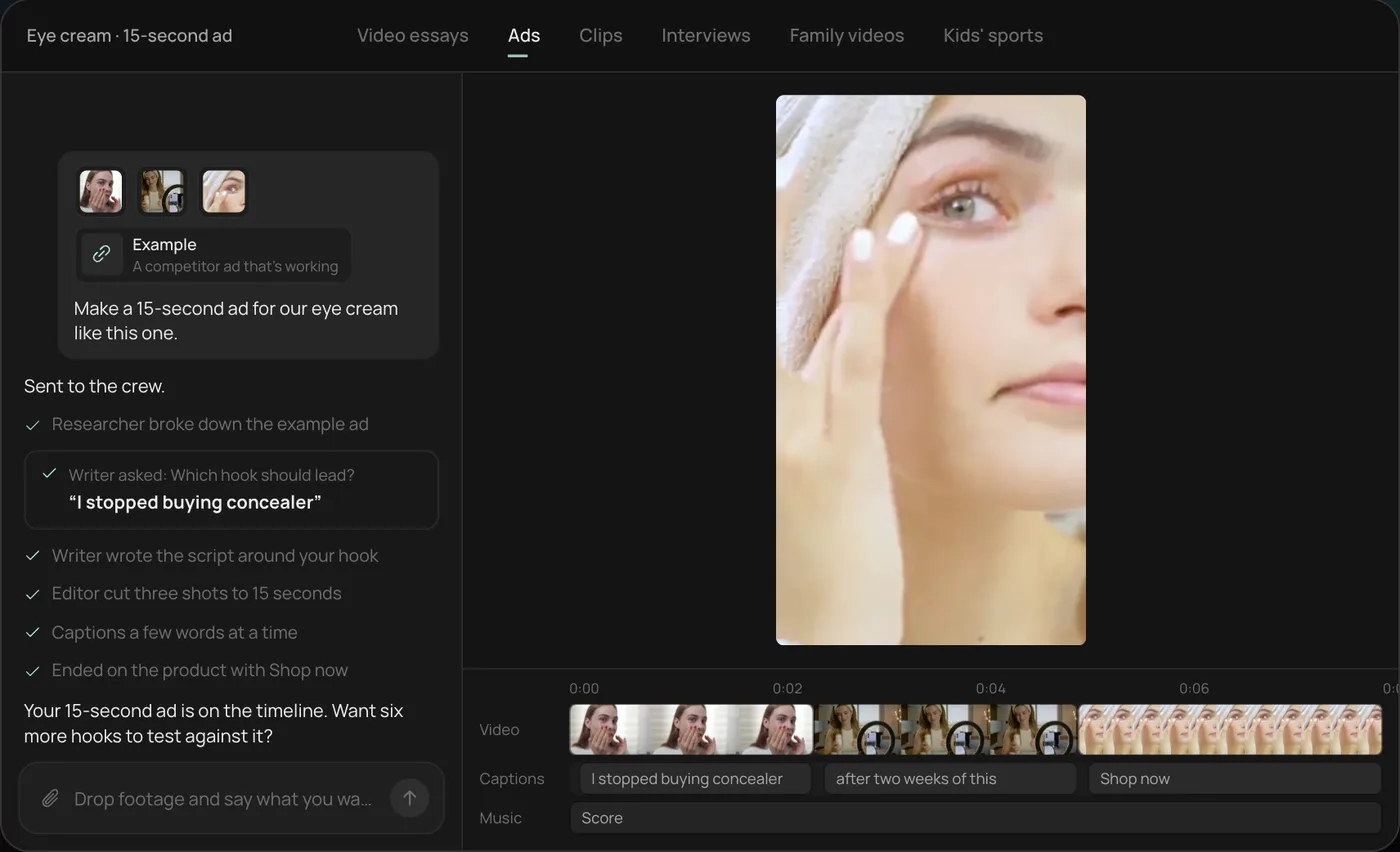
If you have one garment and one clip, your phone's editor is faster. Rend is worth it for a full collection, or when you need product page video and ads from the same shoot. Editing is free and you pay only when Rend renders or generates something; see pricing. To test many openings, see ad creative testing.
FAQ
How long should a clothing product video be?
For a product page, 15 to 30 seconds: walk, side, back, movement and detail. For TikTok and Reels ads, 10 to 20 seconds with the most useful proof (movement, opacity, fit comparison) first.
Should I say the model's height and size?
Yes, on screen during every on-body shot. It's the single most useful line in an apparel video and costs nothing.
Can I call a fabric "bamboo" in my video?
Only if it's made directly from bamboo fiber. Most bamboo fabric is rayon, and the FTC says to call it "rayon" or "rayon made from bamboo."
Can I show swimwear or lingerie on a model on TikTok Shop?
TikTok Shop's creator guide says to show lingerie and swimwear on mannequins instead of on-body try-ons.
Can I use AI models instead of filming?
For mood and variety, yes. But TikTok Shop requires AI content to match the real product's size, color and material, and a generated body can't prove fit. Keep at least the walk, movement and detail shots real.
If you have clothing clips piling up, start a free Rend project and ask for a fit video with sizing lower thirds plus three vertical ads from the same shoot.