Financial Advisor Video Marketing: Market Updates and Explainers
Financial advisor video marketing comes down to two repeatable formats: a short market update (two to four minutes, monthly or after a big market move) that shows clients you are paying attention, and an explainer series (60 to 120 seconds per topic) that answers the questions prospects type into search, like "Roth conversion explained" or "what happens to my 401(k) when I leave my job." Both are advertising in the eyes of regulators, so every video goes through your compliance review before it is posted, and the rules you work under depend on your registration: SEC-registered adviser, registered rep at a FINRA member firm, or dual.
One recording session a month gives you both formats. The steps below show the edit; the rest of the guide covers what to film, what to say, and how to get it approved without three weeks of email.
How to cut an advisor video in Rend, step by step
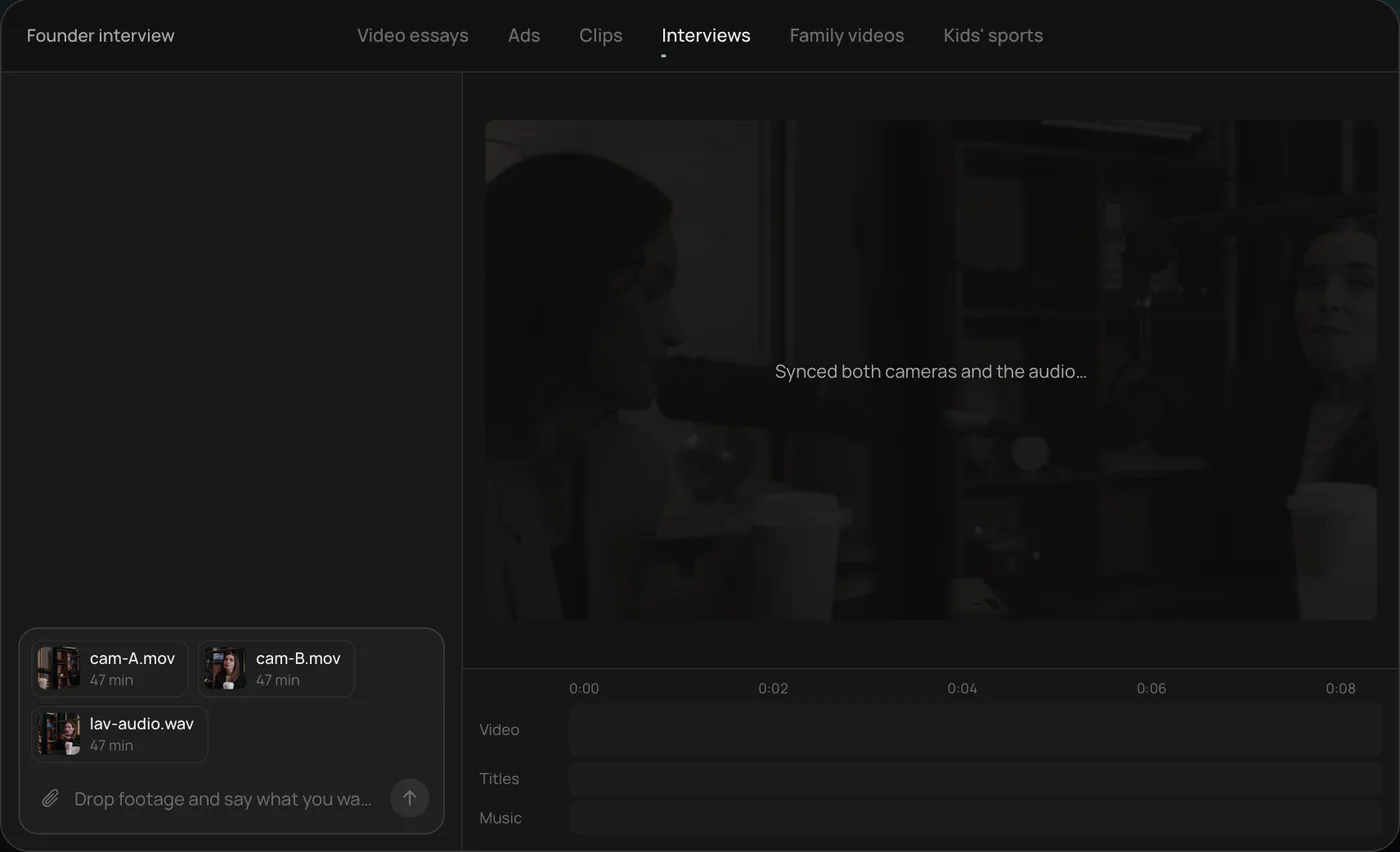
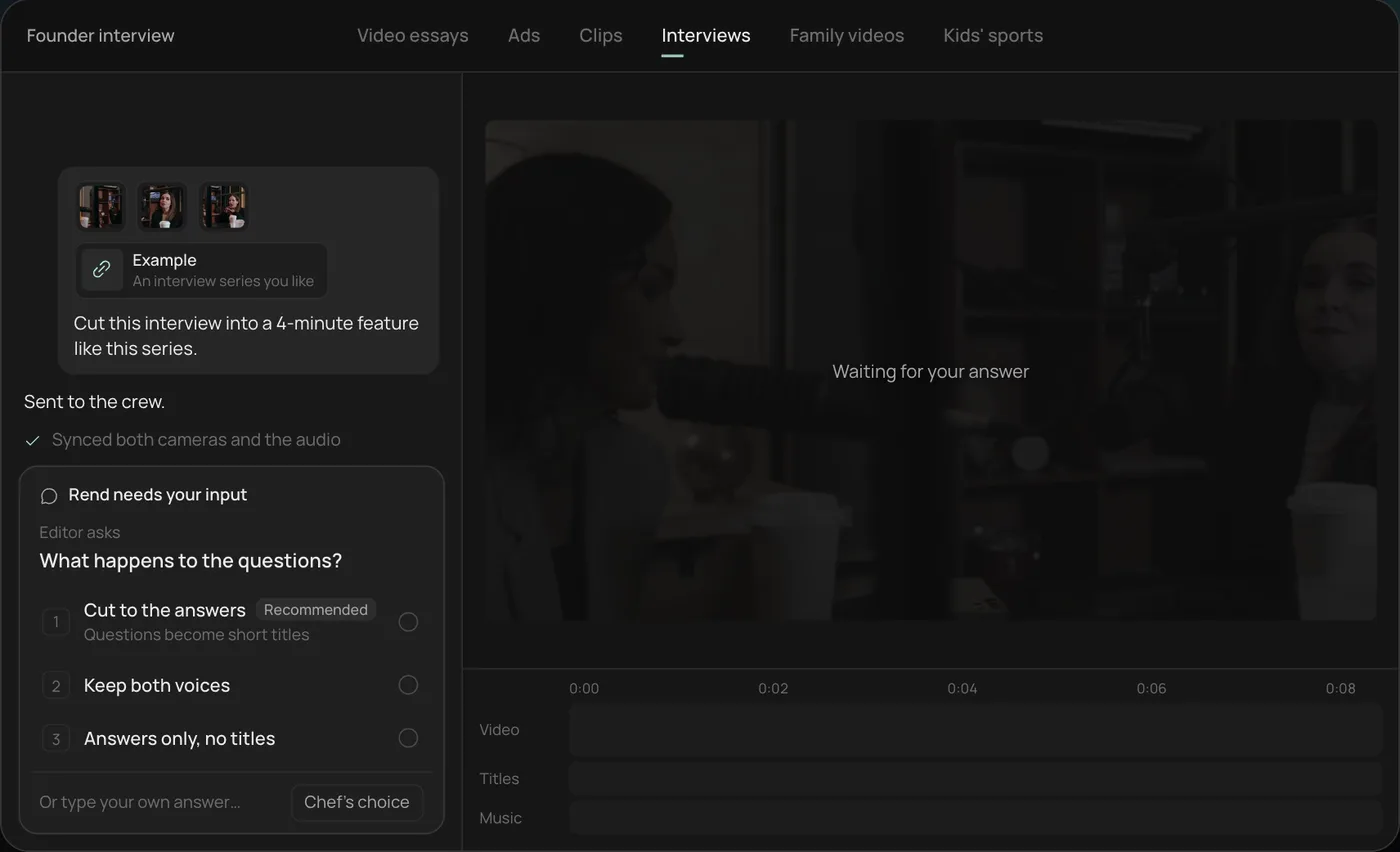
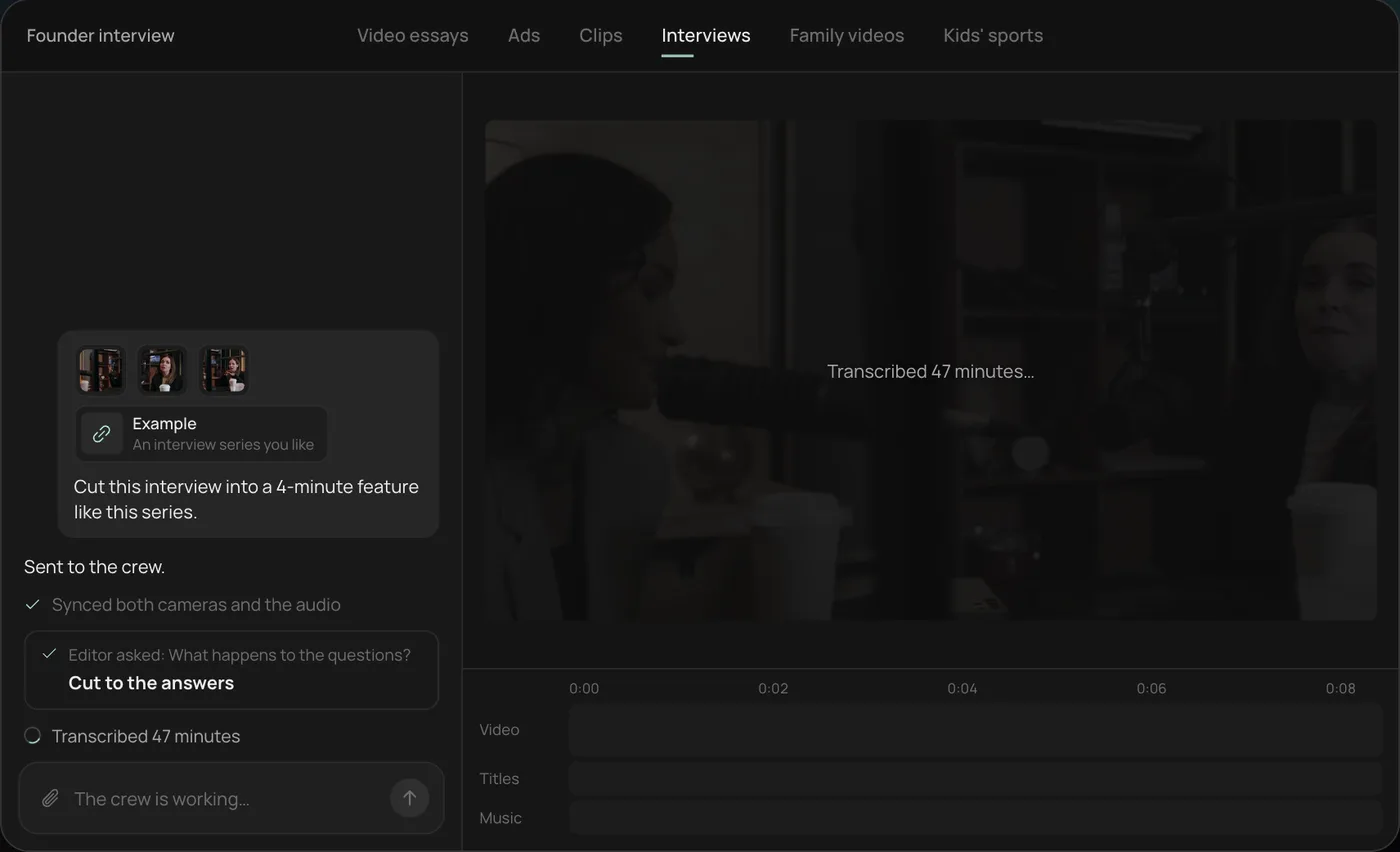
These screenshots come from Rend's demo of cutting an interview; your own project works the same way.
1. Drop in your footage. Add your files (here two camera angles and a lav mic recording) and say what you want: "Cut this interview into a 4-minute feature like this series."
2. Answer one question. Rend asks what should happen to the interviewer's questions and recommends cutting straight to the answers.
3. Watch the crew work. The crew syncs both cameras with the audio and transcribes all 47 minutes, each step checked off in the chat.
4. Get the finished cut. A 4-minute feature lands on a real timeline with both angles, a name title and the best answers in order, on separate tracks.
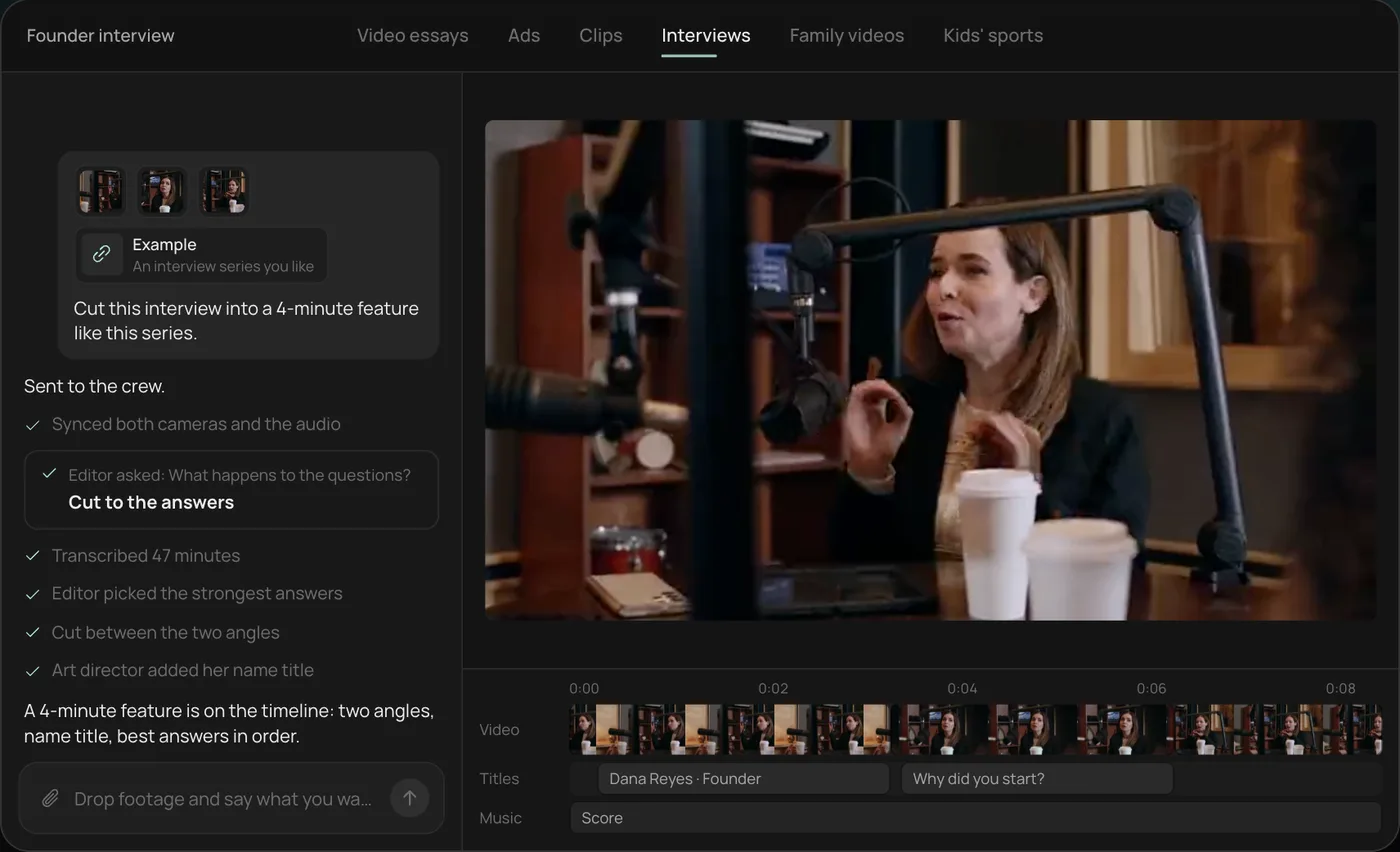
From there you can open the timeline and change anything by hand, share a review link with your compliance reviewer, or export. An advisor's monthly session usually becomes one market update plus four to six explainers. Start a free Rend project to try it on your own footage.
The two formats that carry an advisor's channel
Most advisor video fails because it tries to be a brand film. Clients don't hire you for drone footage of a lake. They hire you because you sounded steady when the market wasn't.
| Format | Length | Cadence | Audience | Compliance load |
|---|---|---|---|---|
| Market update | 2 to 4 min | Monthly, plus after big moves | Existing clients, warm prospects | Higher: commentary on markets and outlook |
| Explainer | 60 to 120 s | 2 to 4 a month | Search traffic, new prospects | Lower if purely educational |
| Advisor intro | 60 to 90 s | Once, refresh yearly | Website visitors | Moderate |
| Event recap or seminar clip | 30 to 90 s | As they happen | Local prospects | Depends on content |
| Client story | 45 to 90 s | Rarely | Prospects | Highest: testimonial rules apply |
Start with the intro and five explainers. They are the easiest to approve and they keep working for years.
The market update: a format that holds up
Keep the same structure every month so viewers know what to expect and your reviewer knows what to look for.
- Cold open, 10 seconds. One plain sentence about what happened, in the shape of "Stocks had a rough month, and the question I've heard most is whether to do anything."
- What happened, 45 seconds. Two or three facts with dates and sources on screen. Keep a lower third with the source and as-of date on every number.
- What it means for a typical plan, 60 seconds. This is where you add value. Talk about time horizons, rebalancing, cash needs, not about where the index is going.
- What we're doing, 30 seconds. Process, not predictions. "We're reviewing each household's cash reserve and checking for tax-loss opportunities."
- Close, 15 seconds. "If you want to talk through your situation, reply to this email or book a call."
Shoot it within a day or two of the data you cite, and say the recording date on camera. A market update posted two weeks late is worse than none.
The line to watch is the forecast. FINRA Rule 2210(d)(1)(F) says broker-dealer communications may not predict or project performance, with narrow exceptions. Advisers under the SEC's Marketing Rule face a fair-and-balanced standard and restrictions on hypothetical performance. In practice: talk about what you're watching, never about where prices will be.
The explainer series: plan 12 at once
Pull topics from client emails and prospect meetings. The same questions come up every year, and that's what makes them searchable.
A starter list that tends to cover most of what prospects ask:
- What a fiduciary is, and how you're paid
- Roth conversion basics
- Required minimum distributions, in plain words
- What to do with an old 401(k)
- How Social Security claiming age changes your benefit
- Tax-loss harvesting in one minute
- Emergency fund size for a single-income family
- What a 529 plan covers
- Why your portfolio isn't 100 percent stocks
- The difference between term and permanent life insurance (if you're licensed for it)
Record all twelve in one sitting with the questions sent a day ahead. No memorizing; bullet points only. Each explainer starts with the question as a title in the first second and the answer in the first ten seconds. Keep any rule numbers, contribution limits or ages on a lower third with the year, because they change and the reviewer will check them.
Think in years, not days. An explainer on old 401(k) rollovers will draw searches for a long time, which is also why you should re-review evergreen videos on a schedule (once a year works for most firms) and pull anything with stale numbers.
Compliance: the rules in general terms
This is not legal advice, and your firm's compliance team has the final word. The broad shape, from the regulators' own pages:
If you're an SEC-registered investment adviser, the Marketing Rule (Rule 206(4)-1 under the Advisers Act, compliance date November 4, 2022) governs advertisements. The SEC's summary lists general prohibitions, including untrue or misleading statements, discussing benefits without fair and balanced treatment of risks, and presenting performance unfairly. Testimonials and endorsements are allowed with conditions: clear and prominent disclosure of whether the person is a client and whether they're compensated, adviser oversight, a written agreement with paid promoters (with an exception for de minimis compensation of $1,000 or less over twelve months), and a bar on certain disqualified "bad actors." Gross performance can't appear without net performance. State-registered advisers follow their state's rules instead.
If you're a registered rep of a FINRA member, Rule 2210 applies. A registered principal must approve each retail communication before it's used or filed, some communications must be filed with FINRA's Advertising Regulation Department, and the firm must keep copies with first and last use dates and the approver's name. Testimonials about investment advice or performance need prominent disclosures, including that the experience may not be representative and is no guarantee of future success. FINRA's social media guidance says most static content needs principal approval before posting, while interactive posts can be supervised like correspondence, and records of business communications must be kept regardless of the device.
Dual registrants usually meet both, and the stricter rule wins in practice. Check every specific point with your compliance team before you film, not after.
A review workflow that doesn't take three weeks
Compliance is where advisor video goes to die. Most of the delay is format: the reviewer gets an MP4 by email, writes "at 1:42 remove the line about bonds," and the edit comes back a week later with a new problem.
What works better:
- Send the reviewer the outline before you film. It catches problem topics before anyone sits in a chair.
- Send the transcript with the cut. Reviewers read faster than they watch.
- Use a review link where the reviewer can tap the exact frame and leave a note. In Rend, the agent reads every note and makes each fix on the timeline, so the second version comes back the same day.
- Keep the approved version, the transcript, the approval date and the reviewer's name in one folder. FINRA's rule asks for those records, and your SEC books-and-records obligations cover advertisements too.
- Never edit an approved video after approval without sending it back. Even a caption change.
Shooting setup
Sit at a table, not behind a big desk, angled slightly off the lens with a window to the side. Two phones (one tight, one wide) and a lavalier mic into a third device. Clap once on camera at the start so the angles can be synced. Avoid a wall of screens with live tickers behind you; it dates the video and puts numbers on screen your reviewer has to check.
Charts help a market update a lot. Make them simple, label every axis, put the source and date in the corner, and hold each on screen for at least four seconds. A quick motion graphic that draws a line from 2020 to today reads better than a static screenshot of a terminal.
Where to post
| Channel | Shape | Cut |
|---|---|---|
| Website, client portal | 16:9 | Full market update, full explainers |
| Client email | 16:9 thumbnail link | Market update with a one-line summary |
| YouTube | 16:9 | Explainer library, one topic per video, with the question as the title |
| 16:9 or 1:1 | 60 to 90 s cut of the market update | |
| Shorts, Reels | 9:16 | First 30 to 45 s of each explainer, captioned |
Every one of these platforms is a business use under FINRA's guidance, so the same approval and recordkeeping apply. Test titles for the YouTube library with the YouTube title tester, and pick a caption look that stays readable on a phone with the caption styles previewer.
How Rend fits
Rend takes the recording you send (in chat, by email or through a web form), transcribes it with speakers labeled, and cuts on the exact words you choose. It adds titles, lower thirds with your sources, simple chart animations and word-timed captions you can restyle, with music on its own track. A brand kit keeps every episode in the same fonts, colors and caption style. The review link is the part compliance teams notice: notes on the exact frame, fixes made, and every version on one link.
Rend doesn't do your compliance review and doesn't archive communications for regulatory purposes; keep using your firm's approved archive. Editing is free, and you pay when Rend renders or generates something; see pricing. For a different take on turning one recording into many pieces, read repurposing a long video into Shorts, and for general explainer craft see the AI explainer video guide.
FAQ
Do financial advisor videos need compliance approval?
Almost always. FINRA Rule 2210 requires a registered principal to approve each retail communication before use, and the SEC's Marketing Rule covers advisers' advertisements. Your firm's compliance team decides what applies to your registration.
Can advisors use client testimonials in videos?
SEC-registered advisers can under the Marketing Rule, with required disclosures, oversight and, for paid promoters, a written agreement. FINRA requires specific disclosures for testimonials about investment advice or performance. Check with compliance before recording.
How long should a market update video be?
Two to four minutes. Lead with one sentence about what happened, then what it means for a plan, then what you're doing. Post within a day or two of the data.
Can I talk about where the market is headed?
Avoid it. FINRA's rule bars predicting or projecting performance in most communications, and the SEC expects fair and balanced treatment of risk. Talk about process and what you're watching.
Do I need to keep copies of my videos?
Yes. FINRA requires retaining retail communications with first and last use dates and the approving principal, and SEC-registered advisers have books-and-records duties for advertisements. Your firm's archive should hold every approved version.
What equipment do I need?
Two phones, a lavalier mic, a tripod and a window. Good audio matters more than the camera.
Record one session, send it in, and Rend will cut the market update and the explainers on a timeline your compliance reviewer can mark up frame by frame. Start free here.