Amazon Product Video Ideas by Category: What to Show in Each
The best Amazon product video idea for any listing is the answer to the question your category's buyers ask most, shown on camera in the first few seconds. For apparel that's fit, for home goods it's size, for kitchen gadgets it's whether it actually works, for beauty it's texture, for supplements it's what's in a serving. Each category also has its own rules about what a caption may claim, and those rules come from the FDA, FTC, EPA or CPSC, not from Amazon alone.
Our Amazon product video guide covers the specs, upload steps and what gets videos rejected. This post is the category layer on top: for ten common Amazon categories, the question to answer, the shots that answer it, a script line, and the rule that applies.
Start with the question, not the format
Amazon's own seller blog on product videos describes a general video as "an overview of your product with a 360-degree view, some action shots to show how it's used, dimensions (if it's not immediately evident), and a call to action," and suggests 30 to 90 seconds. That's a good default. But every category has one question that decides the sale, and the 360 spin rarely answers it.
Find yours in ten minutes: open your top three competitors' listings, read the 3-star reviews and the Q&A, and write down the question that repeats. That question is your first five seconds.
The category matrix
| Category | The buyer's question | Lead shot | Rule to know |
|---|---|---|---|
| Apparel | Will it fit me? | On-body walk with height and size on screen | Fiber content in ads that mention a fiber (FTC) |
| Home and furniture | How big is it, really? | Tape measure along it, then in a room | "Made in USA" standard; dresser tip-over rule (CPSC) |
| Kitchen gadgets | Does it work on real food? | One uncut demo on a real ingredient | Performance claims need testing |
| Beauty and skincare | What's the texture, how much do I use? | Dispense and spread, macro | Cosmetic vs drug claims (FDA) |
| Supplements | What's in a serving, is it easy to take? | Serving in a palm, Supplement Facts panel | Structure/function claims and disclaimer (FDA) |
| Grocery and snacks | What does it look like out of the pack? | Pour or open into a bowl | "Healthy," "natural," allergens (FDA) |
| Pet supplies | Will it fit and will my pet use it? | Pet using it, weight and size on screen | Health claims can make it a drug; flea products are pesticides (FDA, EPA) |
| Toys | Is it the right age, is it fun? | A child's hands playing, age grade on screen | Choking hazard warnings for small parts (CPSC) |
| Electronics and accessories | Is it compatible and what's in the box? | Plugging it into the named device | Battery life and compatibility claims need testing |
| Tools and home improvement | Is it strong enough for my job? | Real task at real speed | Load and performance numbers need testing |
The sections below take each category in turn.
Apparel
Show fit before anything else: a front walk, side and back, a sit or reach, with "Model is 5'8", wearing M" on screen. Add a window-light opacity check for leggings and white tops. Script line: "Size M on 5'8". Fits true to size through the hips."
The rule: the FTC's textile labeling guide says written ads include internet ads, and if an ad "makes any statement about a fiber," it must carry the label's fiber content (minus percentages). Most "bamboo" fabric is rayon and must be called that. Full shot list: clothing product video.
Home and furniture
Size is the return reason you can prevent. Run a tape measure along the piece with the number readable, show it next to a hand or a person, then in a room. Shoot color in daylight and in warm lamp light. Script line: "32 inches wide. Fits a standard hallway."
The rules: the FTC's Made in USA guide requires "all or virtually all" U.S. content for an unqualified claim and covers digital marketing. For dressers, chests and armoires, CPSC's clothing storage unit rule requires stability testing and an anti-tip device in the box; show the unit anchored. More in home decor product video.
Kitchen gadgets
Buyers have seen the gadget work in a staged clip. They want it on a real onion. Film one uncut demo, start to finish, on real food at real speed, then the cleanup. Script line: "One onion, 8 seconds, no tears. Top rack dishwasher safe."
The rule: there's no kitchen-specific claims rule, so the general one applies: objective claims ("dices in 8 seconds," "dishwasher safe") need a basis. Test it and keep the notes.
Beauty and skincare
Texture and dose: one pump onto a fingertip, spread between fingers, applied on skin at real speed, and the finish 30 seconds later. Script line: "One pump, whole face. Sinks in, no shine."
The rule: the FDA's page on cosmetics versus drugs says intended use is set partly by claims "in advertising, on the Internet, or in other promotional materials." Acne treatment, changing melanin and sun protection are drug claims. Full guide: skincare product video.
Supplements
Show what's in a serving: capsules in a palm next to a coin, a scoop leveled, a powder dissolving in water, then the Supplement Facts panel held steady. Script line: "Two capsules a day. 200 mg magnesium per serving."
The rule: 21 CFR 101.93 sets the disclaimer for structure/function claims ("This statement has not been evaluated by the Food and Drug Administration...") and defines disease claims broadly, including through "pictures and symbols." The FTC's Health Products Compliance Guidance expects randomized, controlled human trials for health benefit claims. Full guide: supplement product video.
Grocery and snacks
Show what's in the pack: tear it open, pour it into a bowl, a close-up of the texture, a real bite, then the nutrition and allergen panel. Script line: "Three ingredients. 4 g sugar per bag."
The rule: "healthy" has an FDA definition (updated in a final rule announced December 19, 2024), and "natural" follows a long-standing FDA policy of nothing artificial or synthetic added. Sesame is one of nine major allergens. Full guide: food product video.
Pet supplies
Shoot the pet first, while it's curious, then the details without the animal. Put the pet's weight and the size used on screen. Script line: "Milo, 32 lb, size M."
The rules: the FDA's pet food claims page says disease claims may make a product a new animal drug. Flea and tick sprays and collars are usually pesticides, and 40 CFR 156.10 treats "safe" and "nontoxic to humans and pets" as misleading. Full guide: pet product video.
Toys
Show play from a child's eye level, hands only if you'd rather not feature a child's face, with the age grade on screen. Show every piece in the box laid out. Script line: "Ages 3+. 48 pieces, storage tub included."
The rule: under 16 CFR 1500.20, toys and games for ages 3 to under 6 that contain small parts, and products with latex balloons, small balls or marbles, need choking hazard cautionary statements in advertising that lets people buy directly, and the CPSIA extends that to internet sales. Make sure the warning is on the listing, and don't show a toddler under the age grade playing with it.
Electronics and accessories
Compatibility is the question. Plug it into the named device on camera, show the connection or pairing screen, then everything in the box. Script line: "Works with iPhone 16 and 17. Cable and adapter included." Only name devices you've tested.
The rule: battery life, charge speed and range are objective claims; state the test conditions in the listing ("up to 10 hours at 50% volume") and keep the video consistent with them.
Tools and home improvement
Show the real task: the drill through a real stud, the shelf holding the weight you claim with the weight visible, the ladder at full height. Real speed, no cuts in the proof. Script line: "Holds 50 lb. Here's 50 lb of paint cans."
The rule: load ratings and performance numbers are the claims buyers rely on for safety. If a video shows a shelf with 50 lb on it, the rating on the listing needs to be at least 50 lb and tested.
What every category video has in common
- Lead with the answer to your category's question in the first five seconds.
- Put numbers on screen: size, weight, servings, age grade, compatibility.
- Keep captions to what your label and testing support. A rule that applies to your packaging usually applies to your video.
- Leave out what Amazon flags on any listing video: prices, URLs, competitor names, review quotes (see the Amazon product video guide for the full list).
Making a category set
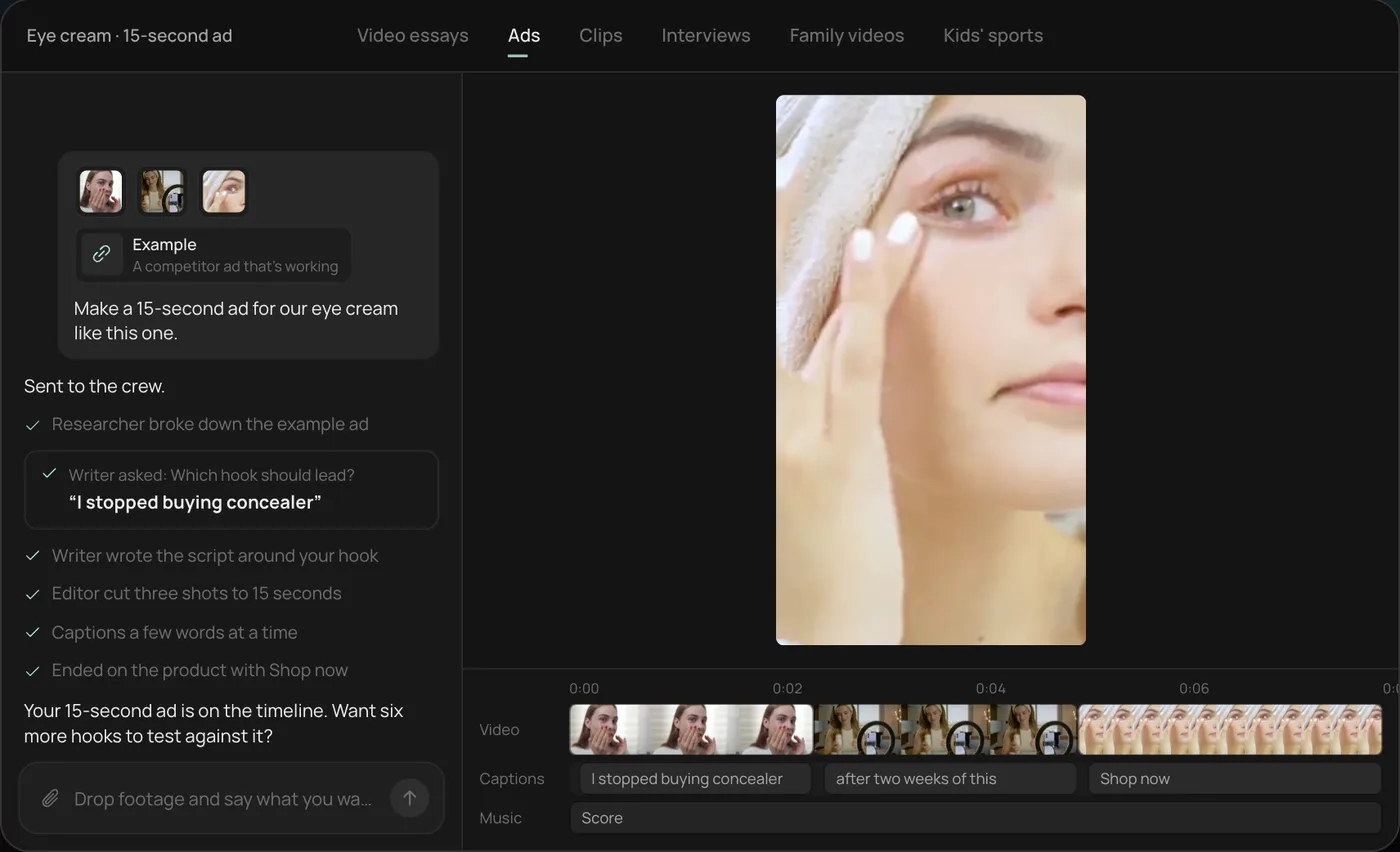
If you sell across categories, the work is a different shot list and caption set for each, in the same look. Rend does the editing. Send your phone clips in chat, by email or a web form, with the category and your approved claims, and ask for "a 30-second Amazon video that opens on the tape measure, dimensions as captions, plus a 9:16 version for ads." Rend cuts on a real timeline you can open and change, with word-timed captions that stay editable, and a brand kit keeps caption style and end card the same across every listing. It can also turn the same footage into a set of product video ads with new hooks and sizes.
Rend won't check your claims against the law; that's on you. Editing is free and you pay only when Rend renders or generates something; see pricing.
FAQ
What should an Amazon product video show?
Amazon suggests an overview with a 360-degree view, the product in use, dimensions if they aren't obvious, and a call to action. Lead with the one question your category's buyers ask most.
How long should an Amazon product video be?
Amazon's seller blog suggests 30 to 90 seconds, up to two minutes for detailed products. Put the deciding shot in the first five seconds either way.
What product video works best for apparel on Amazon?
An on-body walk with the model's height and size on screen, a side and back view, and a movement test. Fit is the question that decides apparel sales.
Can I make health claims in an Amazon supplement or skincare video?
Only claims you can substantiate and that stay on the right side of FDA lines: structure/function claims with the disclaimer for supplements, and cosmetic claims (not acne treatment or sun protection unless it's a labeled drug) for skincare.
Do toy videos on Amazon need a choking hazard warning?
Toys for ages 3 to under 6 with small parts, and products with balloons, small balls or marbles, need cautionary statements where they're sold online. Put it on the listing, and make sure the video doesn't contradict the age grade.
If you have product footage for several listings, start a free Rend project and ask for one Amazon cut per category, each opening on the shot that answers its buyers' question.